

40
2 Molecular States
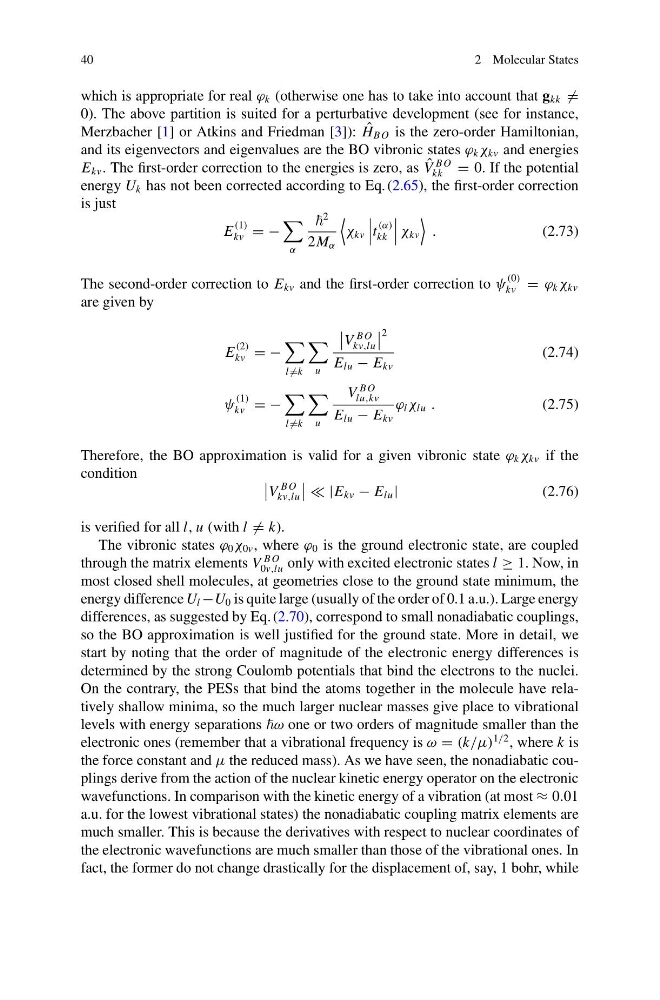
which is appropriate for real ϕ k (otherwise one has to take into account that g kk =
0). The above partition is suited for a perturbative development (see for instance,
Merzbacher [1] or Atkins and Friedman [3]): ˆ
H B O is the zero-order Hamiltonian,
and its eigenvectors and eigenvalues are the BO vibronic states ϕ k χ kv and energies
E kv . The first-order correction to the energies is zero, as ˆ
V
B O
kk = 0. If the potential
energy U k has not been corrected according to Eq. (2.65), the first-order correction
is just
E
(1)
kv = −
α
2
2M α
χ kv
t
(α)
kk
χ kv
.
(2.73)
The second-order correction to E kv and the first-order correction to ψ
(0)
kv = ϕ k χ kv
are given by
E
(2)
kv = −
l =k
u
V
B O
kv,lu
2
E lu − E kv
(2.74)
ψ
(1)
kv = −
l =k
u
V
B O
lu,kv
E lu − E kv
ϕ l χ lu .
(2.75)
Therefore, the BO approximation is valid for a given vibronic state ϕ k χ kv if the
condition
V
B O
kv,lu
|E kv − E lu |
(2.76)
is verified for all l, u (with l = k).
The vibronic states ϕ 0 χ 0v , where ϕ 0 is the ground electronic state, are coupled
through the matrix elements V
B O
0v,lu only with excited electronic states l ≥ 1. Now, in
most closed shell molecules, at geometries close to the ground state minimum, the
energy difference U l −U 0 is quite large (usually of the order of 0.1 a.u.). Large energy
differences, as suggested by Eq. (2.70), correspond to small nonadiabatic couplings,
so the BO approximation is well justified for the ground state. More in detail, we
start by noting that the order of magnitude of the electronic energy differences is
determined by the strong Coulomb potentials that bind the electrons to the nuclei.
On the contrary, the PESs that bind the atoms together in the molecule have relatively shallow minima, so the much larger nuclear masses give place to vibrational
levels with energy separations ω one or two orders of magnitude smaller than the
electronic ones (remember that a vibrational frequency is ω = (k/μ)
1/2 , where k is
the force constant and μ the reduced mass). As we have seen, the nonadiabatic couplings derive from the action of the nuclear kinetic energy operator on the electronic
wavefunctions. In comparison with the kinetic energy of a vibration (at most ≈ 0.01
a.u. for the lowest vibrational states) the nonadiabatic coupling matrix elements are
much smaller. This is because the derivatives with respect to nuclear coordinates of
the electronic wavefunctions are much smaller than those of the vibrational ones. In
fact, the former do not change drastically for the displacement of, say, 1 bohr, while
2 Molecular States
which is appropriate for real ϕ k (otherwise one has to take into account that g kk =
0). The above partition is suited for a perturbative development (see for instance,
Merzbacher [1] or Atkins and Friedman [3]): ˆ
H B O is the zero-order Hamiltonian,
and its eigenvectors and eigenvalues are the BO vibronic states ϕ k χ kv and energies
E kv . The first-order correction to the energies is zero, as ˆ
V
B O
kk = 0. If the potential
energy U k has not been corrected according to Eq. (2.65), the first-order correction
is just
E
(1)
kv = −
α
2
2M α
χ kv
t
(α)
kk
χ kv
.
(2.73)
The second-order correction to E kv and the first-order correction to ψ
(0)
kv = ϕ k χ kv
are given by
E
(2)
kv = −
l =k
u
V
B O
kv,lu
2
E lu − E kv
(2.74)
ψ
(1)
kv = −
l =k
u
V
B O
lu,kv
E lu − E kv
ϕ l χ lu .
(2.75)
Therefore, the BO approximation is valid for a given vibronic state ϕ k χ kv if the
condition
V
B O
kv,lu
|E kv − E lu |
(2.76)
is verified for all l, u (with l = k).
The vibronic states ϕ 0 χ 0v , where ϕ 0 is the ground electronic state, are coupled
through the matrix elements V
B O
0v,lu only with excited electronic states l ≥ 1. Now, in
most closed shell molecules, at geometries close to the ground state minimum, the
energy difference U l −U 0 is quite large (usually of the order of 0.1 a.u.). Large energy
differences, as suggested by Eq. (2.70), correspond to small nonadiabatic couplings,
so the BO approximation is well justified for the ground state. More in detail, we
start by noting that the order of magnitude of the electronic energy differences is
determined by the strong Coulomb potentials that bind the electrons to the nuclei.
On the contrary, the PESs that bind the atoms together in the molecule have relatively shallow minima, so the much larger nuclear masses give place to vibrational
levels with energy separations ω one or two orders of magnitude smaller than the
electronic ones (remember that a vibrational frequency is ω = (k/μ)
1/2 , where k is
the force constant and μ the reduced mass). As we have seen, the nonadiabatic couplings derive from the action of the nuclear kinetic energy operator on the electronic
wavefunctions. In comparison with the kinetic energy of a vibration (at most ≈ 0.01
a.u. for the lowest vibrational states) the nonadiabatic coupling matrix elements are
much smaller. This is because the derivatives with respect to nuclear coordinates of
the electronic wavefunctions are much smaller than those of the vibrational ones. In
fact, the former do not change drastically for the displacement of, say, 1 bohr, while