

38
2 Molecular States
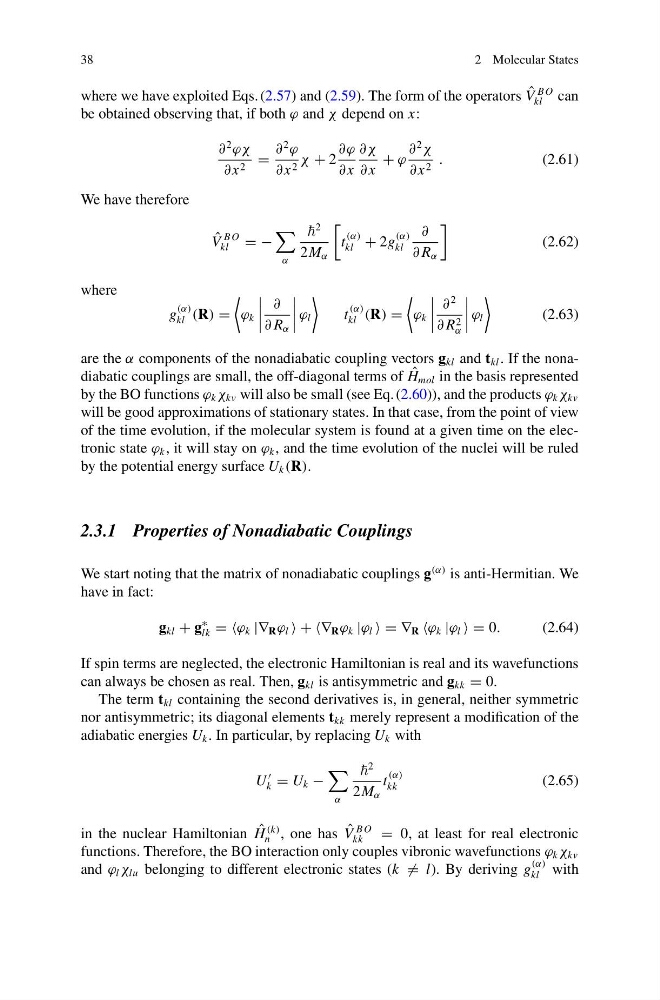
where we have exploited Eqs. (2.57) and (2.59). The form of the operators ˆ
V
B O
kl
can
be obtained observing that, if both ϕ and χ depend on x:
∂
2
ϕχ
∂ x 2 =
∂
2
ϕ
∂ x 2 χ + 2
∂ϕ
∂ x
∂χ
∂ x
+ ϕ
∂
2
χ
∂ x 2 .
(2.61)
We have therefore
ˆ
V
B O
kl
= −
α
2
2M α
t
(α)
kl + 2g
(α)
kl
∂
∂ R α
(2.62)
where
g
(α)
kl (R) =
ϕ k
∂
∂ R α
ϕ l
t
(α)
kl (R) =
ϕ k
∂
2
∂ R 2
α
ϕ l
(2.63)
are the α components of the nonadiabatic coupling vectors g kl and t kl . If the nonadiabatic couplings are small, the off-diagonal terms of ˆ
H mol in the basis represented
by the BO functions ϕ k χ kv will also be small (see Eq. (2.60)), and the products ϕ k χ kv
will be good approximations of stationary states. In that case, from the point of view
of the time evolution, if the molecular system is found at a given time on the electronic state ϕ k , it will stay on ϕ k , and the time evolution of the nuclei will be ruled
by the potential energy surface U k (R).
2.3.1 Properties of Nonadiabatic Couplings
We start noting that the matrix of nonadiabatic couplings g
(α) is anti-Hermitian. We
have in fact:
g kl + g
∗
lk = ϕ k |∇ R ϕ l + ∇ R ϕ k |ϕ l = ∇ R ϕ k |ϕ l = 0.
(2.64)
If spin terms are neglected, the electronic Hamiltonian is real and its wavefunctions
can always be chosen as real. Then, g kl is antisymmetric and g kk = 0.
The term t kl containing the second derivatives is, in general, neither symmetric
nor antisymmetric; its diagonal elements t kk merely represent a modification of the
adiabatic energies U k . In particular, by replacing U k with
U
k = U k −
α
2
2M α
t
(α)
kk
(2.65)
in the nuclear Hamiltonian ˆ
H
(k)
n , one has ˆ
V
B O
kk
= 0, at least for real electronic
functions. Therefore, the BO interaction only couples vibronic wavefunctions ϕ k χ kv
and ϕ l χ lu belonging to different electronic states (k = l). By deriving g
(α)
kl with
2 Molecular States
where we have exploited Eqs. (2.57) and (2.59). The form of the operators ˆ
V
B O
kl
can
be obtained observing that, if both ϕ and χ depend on x:
∂
2
ϕχ
∂ x 2 =
∂
2
ϕ
∂ x 2 χ + 2
∂ϕ
∂ x
∂χ
∂ x
+ ϕ
∂
2
χ
∂ x 2 .
(2.61)
We have therefore
ˆ
V
B O
kl
= −
α
2
2M α
t
(α)
kl + 2g
(α)
kl
∂
∂ R α
(2.62)
where
g
(α)
kl (R) =
ϕ k
∂
∂ R α
ϕ l
t
(α)
kl (R) =
ϕ k
∂
2
∂ R 2
α
ϕ l
(2.63)
are the α components of the nonadiabatic coupling vectors g kl and t kl . If the nonadiabatic couplings are small, the off-diagonal terms of ˆ
H mol in the basis represented
by the BO functions ϕ k χ kv will also be small (see Eq. (2.60)), and the products ϕ k χ kv
will be good approximations of stationary states. In that case, from the point of view
of the time evolution, if the molecular system is found at a given time on the electronic state ϕ k , it will stay on ϕ k , and the time evolution of the nuclei will be ruled
by the potential energy surface U k (R).
2.3.1 Properties of Nonadiabatic Couplings
We start noting that the matrix of nonadiabatic couplings g
(α) is anti-Hermitian. We
have in fact:
g kl + g
∗
lk = ϕ k |∇ R ϕ l + ∇ R ϕ k |ϕ l = ∇ R ϕ k |ϕ l = 0.
(2.64)
If spin terms are neglected, the electronic Hamiltonian is real and its wavefunctions
can always be chosen as real. Then, g kl is antisymmetric and g kk = 0.
The term t kl containing the second derivatives is, in general, neither symmetric
nor antisymmetric; its diagonal elements t kk merely represent a modification of the
adiabatic energies U k . In particular, by replacing U k with
U
k = U k −
α
2
2M α
t
(α)
kk
(2.65)
in the nuclear Hamiltonian ˆ
H
(k)
n , one has ˆ
V
B O
kk
= 0, at least for real electronic
functions. Therefore, the BO interaction only couples vibronic wavefunctions ϕ k χ kv
and ϕ l χ lu belonging to different electronic states (k = l). By deriving g
(α)
kl with