

22
1 Introduction to Photochemistry
high irradiance
low irradiance
photostationary state
thermal equilibrium
t
h
g
i
l
k
r
a
d
time, s
fraction of B isomer, [B]/([A]+[B])
400
350
300
250
200
150
100
0
0
5
1
0.8
0.6
0.4
0.2
0
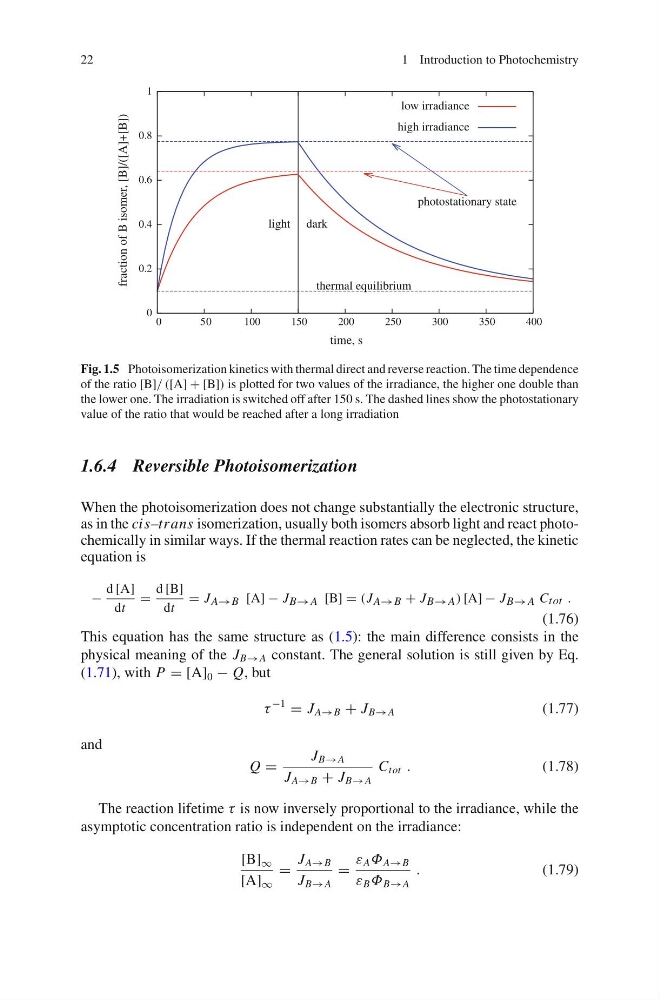
Fig. 1.5 Photoisomerization kinetics with thermal direct and reverse reaction. The time dependence
of the ratio [B]/ ([A] + [B]) is plotted for two values of the irradiance, the higher one double than
the lower one. The irradiation is switched off after 150 s. The dashed lines show the photostationary
value of the ratio that would be reached after a long irradiation
1.6.4 Reversible Photoisomerization
When the photoisomerization does not change substantially the electronic structure,
as in the cis–trans isomerization, usually both isomers absorb light and react photochemically in similar ways. If the thermal reaction rates can be neglected, the kinetic
equation is
−
d [A]
dt
=
d [B]
dt
= J A→B [A] − J B→A [B] = (J A→B + J B→A ) [A] − J B→A C tot .
(1.76)
This equation has the same structure as (1.5): the main difference consists in the
physical meaning of the J B→A constant. The general solution is still given by Eq.
(1.71), with P = [A] 0 − Q, but
τ
−1
= J A→B + J B→A
(1.77)
and
Q =
J B→A
J A→B + J B→A
C tot .
(1.78)
The reaction lifetime τ is now inversely proportional to the irradiance, while the
asymptotic concentration ratio is independent on the irradiance:
[B] ∞
[A] ∞
=
J A→B
J B→A
=
ε A Φ A→B
ε B Φ B→A
.
(1.79)
1 Introduction to Photochemistry
high irradiance
low irradiance
photostationary state
thermal equilibrium
t
h
g
i
l
k
r
a
d
time, s
fraction of B isomer, [B]/([A]+[B])
400
350
300
250
200
150
100
0
0
5
1
0.8
0.6
0.4
0.2
0
Fig. 1.5 Photoisomerization kinetics with thermal direct and reverse reaction. The time dependence
of the ratio [B]/ ([A] + [B]) is plotted for two values of the irradiance, the higher one double than
the lower one. The irradiation is switched off after 150 s. The dashed lines show the photostationary
value of the ratio that would be reached after a long irradiation
1.6.4 Reversible Photoisomerization
When the photoisomerization does not change substantially the electronic structure,
as in the cis–trans isomerization, usually both isomers absorb light and react photochemically in similar ways. If the thermal reaction rates can be neglected, the kinetic
equation is
−
d [A]
dt
=
d [B]
dt
= J A→B [A] − J B→A [B] = (J A→B + J B→A ) [A] − J B→A C tot .
(1.76)
This equation has the same structure as (1.5): the main difference consists in the
physical meaning of the J B→A constant. The general solution is still given by Eq.
(1.71), with P = [A] 0 − Q, but
τ
−1
= J A→B + J B→A
(1.77)
and
Q =
J B→A
J A→B + J B→A
C tot .
(1.78)
The reaction lifetime τ is now inversely proportional to the irradiance, while the
asymptotic concentration ratio is independent on the irradiance:
[B] ∞
[A] ∞
=
J A→B
J B→A
=
ε A Φ A→B
ε B Φ B→A
.
(1.79)