

1.6 Photochemical Kinetics
21
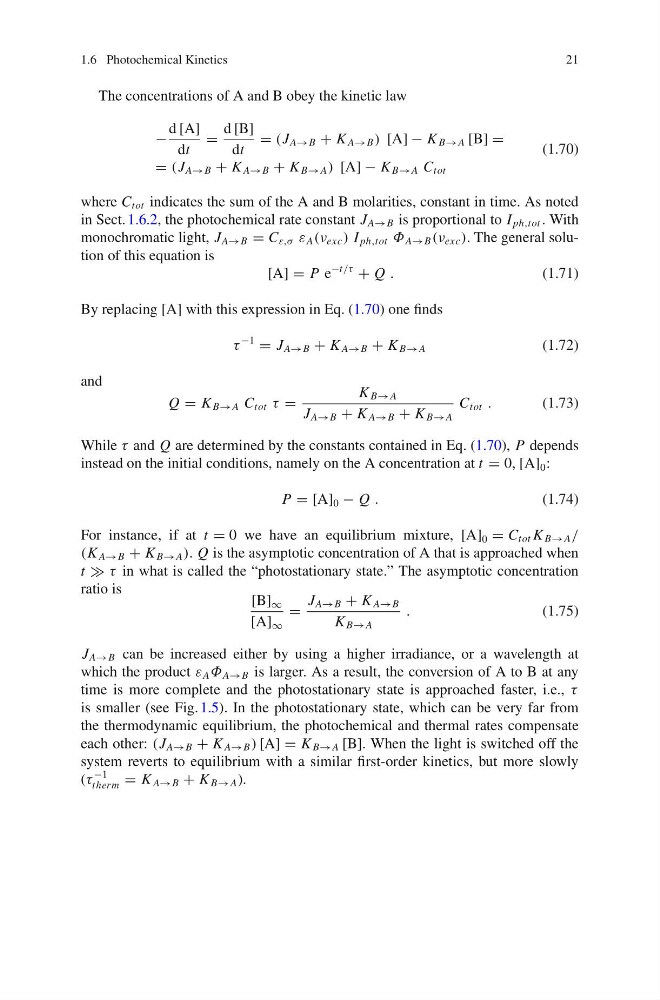
The concentrations of A and B obey the kinetic law
−
d [A]
dt
=
d [B]
dt
= (J A→B + K A→B ) [A] − K B→A [B] =
= (J A→B + K A→B + K B→A ) [A] − K B→A C tot
(1.70)
where C tot indicates the sum of the A and B molarities, constant in time. As noted
in Sect. 1.6.2, the photochemical rate constant J A→B is proportional to I ph,tot . With
monochromatic light, J A→B = C ε,σ ε A (ν exc ) I ph,tot Φ A→B (ν exc ). The general solution of this equation is
[A] = P e
−t/τ
+ Q .
(1.71)
By replacing [A] with this expression in Eq. (1.70) one finds
τ
−1
= J A→B + K A→B + K B→A
(1.72)
and
Q = K B→A C tot τ =
K B→A
J A→B + K A→B + K B→A
C tot .
(1.73)
While τ and Q are determined by the constants contained in Eq. (1.70), P depends
instead on the initial conditions, namely on the A concentration at t = 0, [A] 0 :
P = [A] 0 − Q .
(1.74)
For instance, if at t = 0 we have an equilibrium mixture, [A] 0 = C tot K B→A /
(K A→B + K B→A ). Q is the asymptotic concentration of A that is approached when
t τ in what is called the “photostationary state.” The asymptotic concentration
ratio is
[B] ∞
[A] ∞
=
J A→B + K A→B
K B→A
.
(1.75)
J A→B can be increased either by using a higher irradiance, or a wavelength at
which the product ε A Φ A→B is larger. As a result, the conversion of A to B at any
time is more complete and the photostationary state is approached faster, i.e., τ
is smaller (see Fig. 1.5). In the photostationary state, which can be very far from
the thermodynamic equilibrium, the photochemical and thermal rates compensate
each other: (J A→B + K A→B ) [A] = K B→A [B]. When the light is switched off the
system reverts to equilibrium with a similar first-order kinetics, but more slowly
(τ
−1
therm = K A→B + K B→A ).
21
The concentrations of A and B obey the kinetic law
−
d [A]
dt
=
d [B]
dt
= (J A→B + K A→B ) [A] − K B→A [B] =
= (J A→B + K A→B + K B→A ) [A] − K B→A C tot
(1.70)
where C tot indicates the sum of the A and B molarities, constant in time. As noted
in Sect. 1.6.2, the photochemical rate constant J A→B is proportional to I ph,tot . With
monochromatic light, J A→B = C ε,σ ε A (ν exc ) I ph,tot Φ A→B (ν exc ). The general solution of this equation is
[A] = P e
−t/τ
+ Q .
(1.71)
By replacing [A] with this expression in Eq. (1.70) one finds
τ
−1
= J A→B + K A→B + K B→A
(1.72)
and
Q = K B→A C tot τ =
K B→A
J A→B + K A→B + K B→A
C tot .
(1.73)
While τ and Q are determined by the constants contained in Eq. (1.70), P depends
instead on the initial conditions, namely on the A concentration at t = 0, [A] 0 :
P = [A] 0 − Q .
(1.74)
For instance, if at t = 0 we have an equilibrium mixture, [A] 0 = C tot K B→A /
(K A→B + K B→A ). Q is the asymptotic concentration of A that is approached when
t τ in what is called the “photostationary state.” The asymptotic concentration
ratio is
[B] ∞
[A] ∞
=
J A→B + K A→B
K B→A
.
(1.75)
J A→B can be increased either by using a higher irradiance, or a wavelength at
which the product ε A Φ A→B is larger. As a result, the conversion of A to B at any
time is more complete and the photostationary state is approached faster, i.e., τ
is smaller (see Fig. 1.5). In the photostationary state, which can be very far from
the thermodynamic equilibrium, the photochemical and thermal rates compensate
each other: (J A→B + K A→B ) [A] = K B→A [B]. When the light is switched off the
system reverts to equilibrium with a similar first-order kinetics, but more slowly
(τ
−1
therm = K A→B + K B→A ).