

20
1 Introduction to Photochemistry
Fig. 1.3 Benzophenone and
naphthalene chromophores
in one compound
1.6.3 Photoisomerization with Thermal Direct and Reverse
Reaction
Many compounds can exist in different isomeric forms that can be interconverted by
photochemical and/or thermal reactions. In the absence of light the thermal isomerizations produce a mixture of isomers at equilibrium. Here we shall consider two
isomers, A and B, of which A is the more stable. The photoisomerization
A
hν
−→ B
(1.67)
occurs with quantum yield Φ A→B and the thermal reactions
A −→ B
(1.68)
and
B −→ A
(1.69)
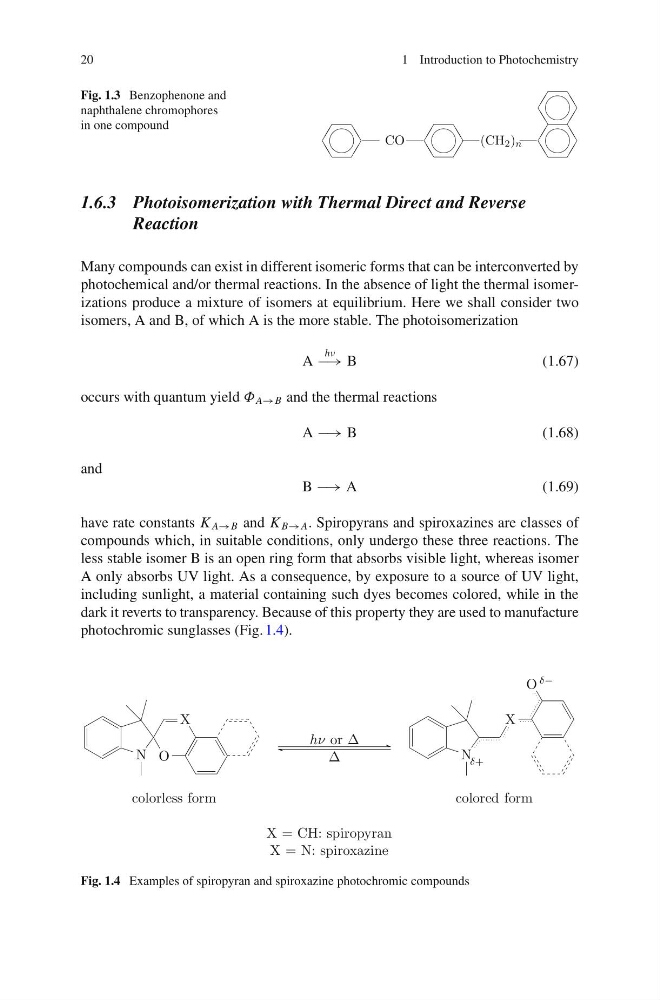
have rate constants K A→B and K B→A . Spiropyrans and spiroxazines are classes of
compounds which, in suitable conditions, only undergo these three reactions. The
less stable isomer B is an open ring form that absorbs visible light, whereas isomer
A only absorbs UV light. As a consequence, by exposure to a source of UV light,
including sunlight, a material containing such dyes becomes colored, while in the
dark it reverts to transparency. Because of this property they are used to manufacture
photochromic sunglasses (Fig. 1.4).
N O
X
colorless form
hν or Δ
Δ
N δ+
X
O δ−
colored form
X = CH: spiropyran
X = N: spiroxazine
Fig. 1.4 Examples of spiropyran and spiroxazine photochromic compounds
1 Introduction to Photochemistry
Fig. 1.3 Benzophenone and
naphthalene chromophores
in one compound
1.6.3 Photoisomerization with Thermal Direct and Reverse
Reaction
Many compounds can exist in different isomeric forms that can be interconverted by
photochemical and/or thermal reactions. In the absence of light the thermal isomerizations produce a mixture of isomers at equilibrium. Here we shall consider two
isomers, A and B, of which A is the more stable. The photoisomerization
A
hν
−→ B
(1.67)
occurs with quantum yield Φ A→B and the thermal reactions
A −→ B
(1.68)
and
B −→ A
(1.69)
have rate constants K A→B and K B→A . Spiropyrans and spiroxazines are classes of
compounds which, in suitable conditions, only undergo these three reactions. The
less stable isomer B is an open ring form that absorbs visible light, whereas isomer
A only absorbs UV light. As a consequence, by exposure to a source of UV light,
including sunlight, a material containing such dyes becomes colored, while in the
dark it reverts to transparency. Because of this property they are used to manufacture
photochromic sunglasses (Fig. 1.4).
N O
X
colorless form
hν or Δ
Δ
N δ+
X
O δ−
colored form
X = CH: spiropyran
X = N: spiroxazine
Fig. 1.4 Examples of spiropyran and spiroxazine photochromic compounds