

1.6 Photochemical Kinetics
19
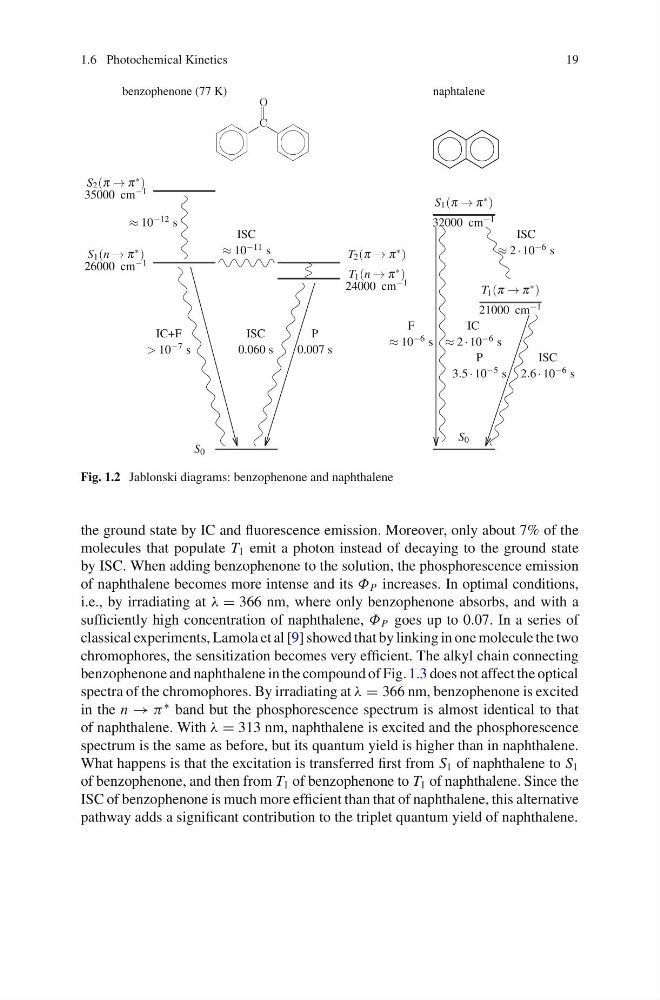
Fig. 1.2 Jablonski diagrams: benzophenone and naphthalene
the ground state by IC and fluorescence emission. Moreover, only about 7% of the
molecules that populate T 1 emit a photon instead of decaying to the ground state
by ISC. When adding benzophenone to the solution, the phosphorescence emission
of naphthalene becomes more intense and its Φ P increases. In optimal conditions,
i.e., by irradiating at λ = 366 nm, where only benzophenone absorbs, and with a
sufficiently high concentration of naphthalene, Φ P goes up to 0.07. In a series of
classical experiments, Lamola et al [9] showed that by linking in one molecule the two
chromophores, the sensitization becomes very efficient. The alkyl chain connecting
benzophenone and naphthalene in the compound of Fig. 1.3 does not affect the optical
spectra of the chromophores. By irradiating at λ = 366 nm, benzophenone is excited
in the n → π
∗ band but the phosphorescence spectrum is almost identical to that
of naphthalene. With λ = 313 nm, naphthalene is excited and the phosphorescence
spectrum is the same as before, but its quantum yield is higher than in naphthalene.
What happens is that the excitation is transferred first from S 1 of naphthalene to S 1
of benzophenone, and then from T 1 of benzophenone to T 1 of naphthalene. Since the
ISC of benzophenone is much more efficient than that of naphthalene, this alternative
pathway adds a significant contribution to the triplet quantum yield of naphthalene.
19
Fig. 1.2 Jablonski diagrams: benzophenone and naphthalene
the ground state by IC and fluorescence emission. Moreover, only about 7% of the
molecules that populate T 1 emit a photon instead of decaying to the ground state
by ISC. When adding benzophenone to the solution, the phosphorescence emission
of naphthalene becomes more intense and its Φ P increases. In optimal conditions,
i.e., by irradiating at λ = 366 nm, where only benzophenone absorbs, and with a
sufficiently high concentration of naphthalene, Φ P goes up to 0.07. In a series of
classical experiments, Lamola et al [9] showed that by linking in one molecule the two
chromophores, the sensitization becomes very efficient. The alkyl chain connecting
benzophenone and naphthalene in the compound of Fig. 1.3 does not affect the optical
spectra of the chromophores. By irradiating at λ = 366 nm, benzophenone is excited
in the n → π
∗ band but the phosphorescence spectrum is almost identical to that
of naphthalene. With λ = 313 nm, naphthalene is excited and the phosphorescence
spectrum is the same as before, but its quantum yield is higher than in naphthalene.
What happens is that the excitation is transferred first from S 1 of naphthalene to S 1
of benzophenone, and then from T 1 of benzophenone to T 1 of naphthalene. Since the
ISC of benzophenone is much more efficient than that of naphthalene, this alternative
pathway adds a significant contribution to the triplet quantum yield of naphthalene.