

1.6 Photochemical Kinetics
23
λ exc =334 nm
λ exc =436 nm
λ exc =334 nm
λ exc =436 nm
λ exc =334 nm
time, s
fraction of cis
isomer
1000
800
600
400
200
0
1
0.8
0.6
0.4
0.2
0
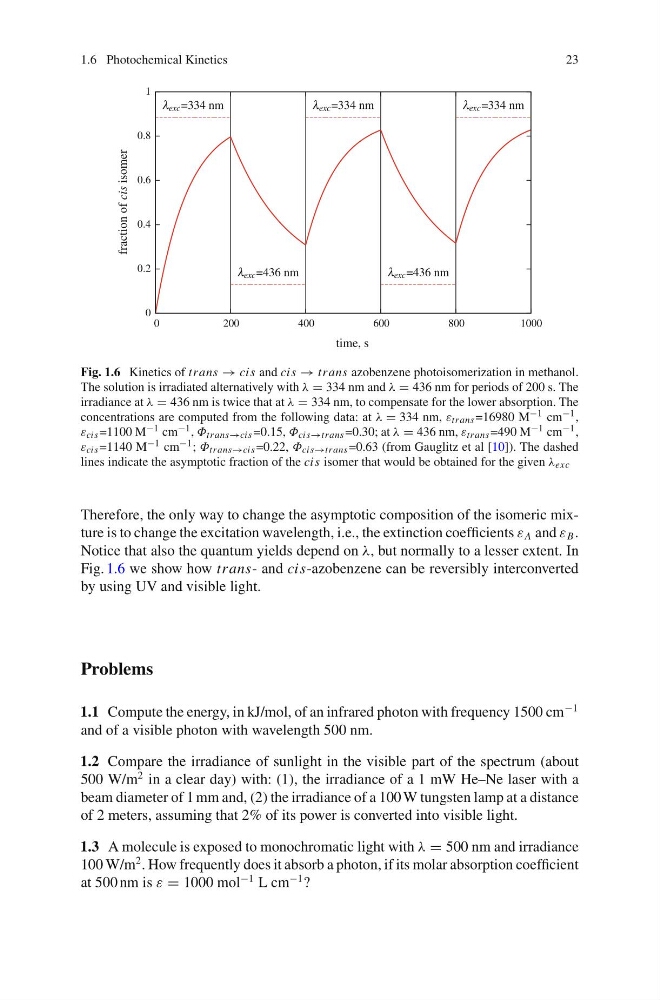
Fig. 1.6 Kinetics of trans → cis and cis → trans azobenzene photoisomerization in methanol.
The solution is irradiated alternatively with λ = 334 nm and λ = 436 nm for periods of 200 s. The
irradiance at λ = 436 nm is twice that at λ = 334 nm, to compensate for the lower absorption. The
concentrations are computed from the following data: at λ = 334 nm, ε trans =16980 M −1 cm −1 ,
ε cis =1100 M −1 cm −1 , Φ trans→cis =0.15, Φ cis→trans =0.30; at λ = 436 nm, ε trans =490 M −1 cm −1 ,
ε cis =1140 M −1 cm −1 ; Φ trans→cis =0.22, Φ cis→trans =0.63 (from Gauglitz et al [10]). The dashed
lines indicate the asymptotic fraction of the cis isomer that would be obtained for the given λ exc
Therefore, the only way to change the asymptotic composition of the isomeric mixture is to change the excitation wavelength, i.e., the extinction coefficients ε A and ε B .
Notice that also the quantum yields depend on λ, but normally to a lesser extent. In
Fig. 1.6 we show how trans- and cis-azobenzene can be reversibly interconverted
by using UV and visible light.
Problems
1.1 Compute the energy, in kJ/mol, of an infrared photon with frequency 1500 cm
−1
and of a visible photon with wavelength 500 nm.
1.2 Compare the irradiance of sunlight in the visible part of the spectrum (about
500 W/m
2 in a clear day) with: (1), the irradiance of a 1 mW He–Ne laser with a
beam diameter of 1 mm and, (2) the irradiance of a 100 W tungsten lamp at a distance
of 2 meters, assuming that 2% of its power is converted into visible light.
1.3 A molecule is exposed to monochromatic light with λ = 500 nm and irradiance
100 W/m
2 . How frequently does it absorb a photon, if its molar absorption coefficient
at 500 nm is ε = 1000 mol
−1 L cm
−1 ?
23
λ exc =334 nm
λ exc =436 nm
λ exc =334 nm
λ exc =436 nm
λ exc =334 nm
time, s
fraction of cis
isomer
1000
800
600
400
200
0
1
0.8
0.6
0.4
0.2
0
Fig. 1.6 Kinetics of trans → cis and cis → trans azobenzene photoisomerization in methanol.
The solution is irradiated alternatively with λ = 334 nm and λ = 436 nm for periods of 200 s. The
irradiance at λ = 436 nm is twice that at λ = 334 nm, to compensate for the lower absorption. The
concentrations are computed from the following data: at λ = 334 nm, ε trans =16980 M −1 cm −1 ,
ε cis =1100 M −1 cm −1 , Φ trans→cis =0.15, Φ cis→trans =0.30; at λ = 436 nm, ε trans =490 M −1 cm −1 ,
ε cis =1140 M −1 cm −1 ; Φ trans→cis =0.22, Φ cis→trans =0.63 (from Gauglitz et al [10]). The dashed
lines indicate the asymptotic fraction of the cis isomer that would be obtained for the given λ exc
Therefore, the only way to change the asymptotic composition of the isomeric mixture is to change the excitation wavelength, i.e., the extinction coefficients ε A and ε B .
Notice that also the quantum yields depend on λ, but normally to a lesser extent. In
Fig. 1.6 we show how trans- and cis-azobenzene can be reversibly interconverted
by using UV and visible light.
Problems
1.1 Compute the energy, in kJ/mol, of an infrared photon with frequency 1500 cm
−1
and of a visible photon with wavelength 500 nm.
1.2 Compare the irradiance of sunlight in the visible part of the spectrum (about
500 W/m
2 in a clear day) with: (1), the irradiance of a 1 mW He–Ne laser with a
beam diameter of 1 mm and, (2) the irradiance of a 100 W tungsten lamp at a distance
of 2 meters, assuming that 2% of its power is converted into visible light.
1.3 A molecule is exposed to monochromatic light with λ = 500 nm and irradiance
100 W/m
2 . How frequently does it absorb a photon, if its molar absorption coefficient
at 500 nm is ε = 1000 mol
−1 L cm
−1 ?