

256
Solutions
V 13 =
μ
2
p + 2μ
2
r
2
√
2R 3
.
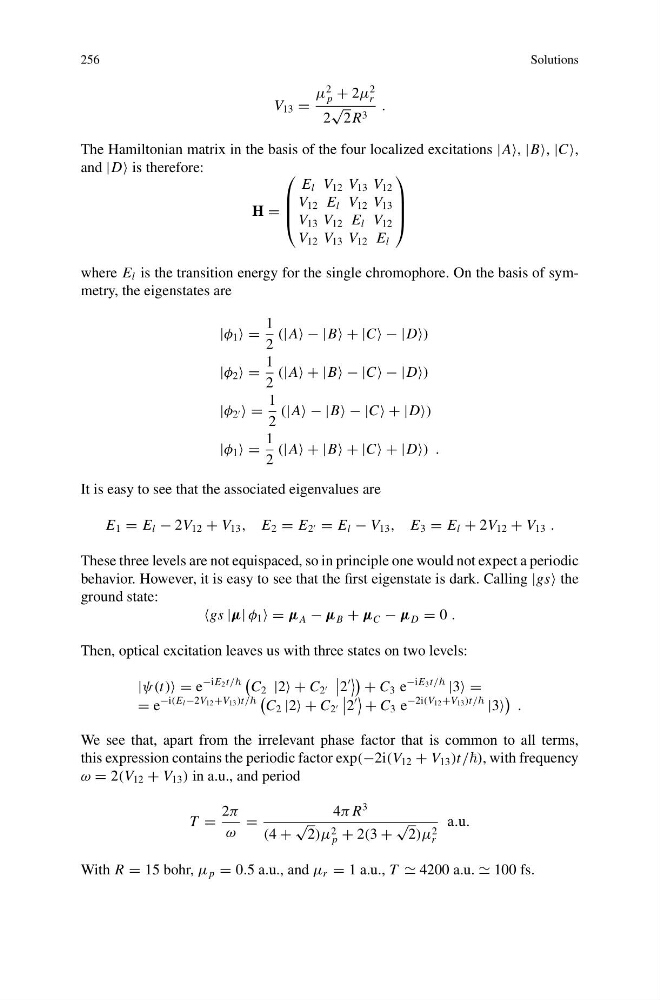
The Hamiltonian matrix in the basis of the four localized excitations |A, |B, |C,
and |D is therefore:
H =
⎛
⎜
⎜
⎝
E l V 12 V 13 V 12
V 12 E l V 12 V 13
V 13 V 12 E l V 12
V 12 V 13 V 12 E l
⎞
⎟
⎟
⎠
where E l is the transition energy for the single chromophore. On the basis of symmetry, the eigenstates are
|φ 1 =
1
2
(|A − |B + |C − |D)
|φ 2 =
1
2
(|A + |B − |C − |D)
|φ 2 =
1
2
(|A − |B − |C + |D)
|φ 1 =
1
2
(|A + |B + |C + |D) .
It is easy to see that the associated eigenvalues are
E 1 = E l − 2V 12 + V 13 , E 2 = E 2 = E l − V 13 , E 3 = E l + 2V 12 + V 13 .
These three levels are not equispaced, so in principle one would not expect a periodic
behavior. However, it is easy to see that the first eigenstate is dark. Calling |gs the
ground state:
gs |μ| φ 1 = μ A − μ B + μ C − μ D = 0 .
Then, optical excitation leaves us with three states on two levels:
|ψ(t) = e
−iE 2 t/
C 2 |2 + C 2
2
+ C 3 e
−iE 3 t/
|3 =
= e
−i(E l −2V 12 +V 13 )t/
C 2 |2 + C 2
2
+ C 3 e
−2i(V 12 +V 13 )t/
|3
.
We see that, apart from the irrelevant phase factor that is common to all terms,
this expression contains the periodic factor exp(−2i(V 12 + V 13 )t/), with frequency
ω = 2(V 12 + V 13 ) in a.u., and period
T =
2π
ω
=
4π R
3
(4 +
√
2)μ 2
p + 2(3 +
√
2)μ 2
r
a.u.
With R = 15 bohr, μ p = 0.5 a.u., and μ r = 1 a.u., T 4200 a.u. 100 fs.
Solutions
V 13 =
μ
2
p + 2μ
2
r
2
√
2R 3
.
The Hamiltonian matrix in the basis of the four localized excitations |A, |B, |C,
and |D is therefore:
H =
⎛
⎜
⎜
⎝
E l V 12 V 13 V 12
V 12 E l V 12 V 13
V 13 V 12 E l V 12
V 12 V 13 V 12 E l
⎞
⎟
⎟
⎠
where E l is the transition energy for the single chromophore. On the basis of symmetry, the eigenstates are
|φ 1 =
1
2
(|A − |B + |C − |D)
|φ 2 =
1
2
(|A + |B − |C − |D)
|φ 2 =
1
2
(|A − |B − |C + |D)
|φ 1 =
1
2
(|A + |B + |C + |D) .
It is easy to see that the associated eigenvalues are
E 1 = E l − 2V 12 + V 13 , E 2 = E 2 = E l − V 13 , E 3 = E l + 2V 12 + V 13 .
These three levels are not equispaced, so in principle one would not expect a periodic
behavior. However, it is easy to see that the first eigenstate is dark. Calling |gs the
ground state:
gs |μ| φ 1 = μ A − μ B + μ C − μ D = 0 .
Then, optical excitation leaves us with three states on two levels:
|ψ(t) = e
−iE 2 t/
C 2 |2 + C 2
2
+ C 3 e
−iE 3 t/
|3 =
= e
−i(E l −2V 12 +V 13 )t/
C 2 |2 + C 2
2
+ C 3 e
−2i(V 12 +V 13 )t/
|3
.
We see that, apart from the irrelevant phase factor that is common to all terms,
this expression contains the periodic factor exp(−2i(V 12 + V 13 )t/), with frequency
ω = 2(V 12 + V 13 ) in a.u., and period
T =
2π
ω
=
4π R
3
(4 +
√
2)μ 2
p + 2(3 +
√
2)μ 2
r
a.u.
With R = 15 bohr, μ p = 0.5 a.u., and μ r = 1 a.u., T 4200 a.u. 100 fs.