

Solutions
255
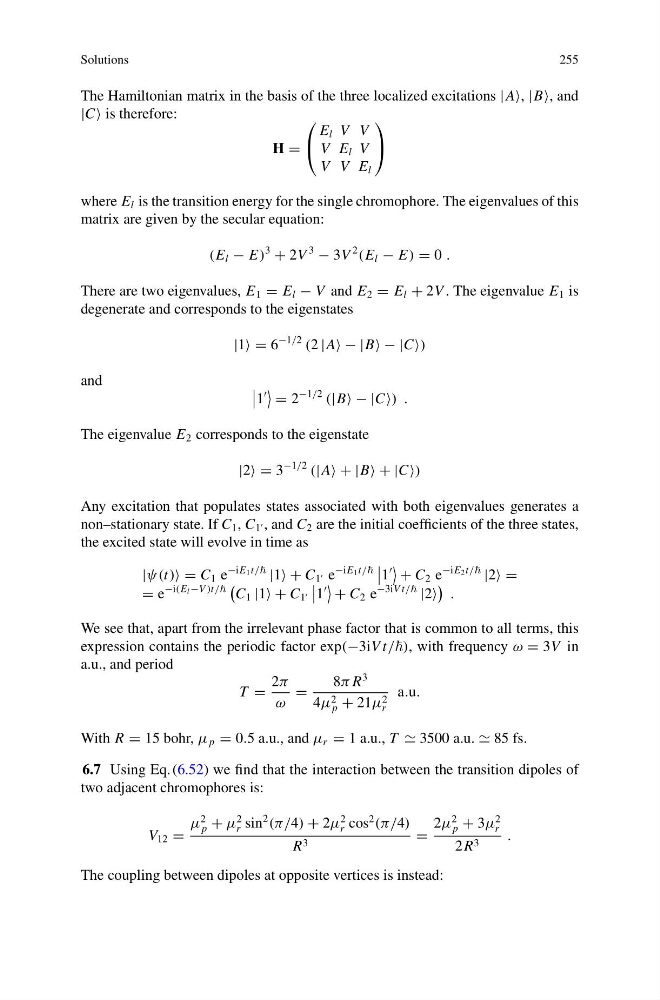
The Hamiltonian matrix in the basis of the three localized excitations |A, |B, and
|C is therefore:
H =
⎛
⎝
E l V V
V E l V
V V E l
⎞
⎠
where E l is the transition energy for the single chromophore. The eigenvalues of this
matrix are given by the secular equation:
(E l − E)
3
+ 2V
3
− 3V
2
(E l − E) = 0 .
There are two eigenvalues, E 1 = E l − V and E 2 = E l + 2V . The eigenvalue E 1 is
degenerate and corresponds to the eigenstates
|1 = 6
−1/2
(2 |A − |B − |C)
and
1
= 2
−1/2
(|B − |C) .
The eigenvalue E 2 corresponds to the eigenstate
|2 = 3
−1/2
(|A + |B + |C)
Any excitation that populates states associated with both eigenvalues generates a
non–stationary state. If C 1 , C 1 , and C 2 are the initial coefficients of the three states,
the excited state will evolve in time as
|ψ(t) = C 1 e
−iE 1 t/
|1 + C 1 e
−iE 1 t/
1
+ C 2 e
−iE 2 t/
|2 =
= e
−i(E l −V )t/
C 1 |1 + C 1
1
+ C 2 e
−3iV t/
|2
.
We see that, apart from the irrelevant phase factor that is common to all terms, this
expression contains the periodic factor exp(−3iV t/), with frequency ω = 3V in
a.u., and period
T =
2π
ω
=
8π R
3
4μ 2
p + 21μ 2
r
a.u.
With R = 15 bohr, μ p = 0.5 a.u., and μ r = 1 a.u., T 3500 a.u. 85 fs.
6.7 Using Eq. (6.52) we find that the interaction between the transition dipoles of
two adjacent chromophores is:
V 12 =
μ
2
p + μ
2
r sin
2
(π/4) + 2μ
2
r cos
2
(π/4)
R 3
=
2μ
2
p + 3μ
2
r
2R 3
.
The coupling between dipoles at opposite vertices is instead:
255
The Hamiltonian matrix in the basis of the three localized excitations |A, |B, and
|C is therefore:
H =
⎛
⎝
E l V V
V E l V
V V E l
⎞
⎠
where E l is the transition energy for the single chromophore. The eigenvalues of this
matrix are given by the secular equation:
(E l − E)
3
+ 2V
3
− 3V
2
(E l − E) = 0 .
There are two eigenvalues, E 1 = E l − V and E 2 = E l + 2V . The eigenvalue E 1 is
degenerate and corresponds to the eigenstates
|1 = 6
−1/2
(2 |A − |B − |C)
and
1
= 2
−1/2
(|B − |C) .
The eigenvalue E 2 corresponds to the eigenstate
|2 = 3
−1/2
(|A + |B + |C)
Any excitation that populates states associated with both eigenvalues generates a
non–stationary state. If C 1 , C 1 , and C 2 are the initial coefficients of the three states,
the excited state will evolve in time as
|ψ(t) = C 1 e
−iE 1 t/
|1 + C 1 e
−iE 1 t/
1
+ C 2 e
−iE 2 t/
|2 =
= e
−i(E l −V )t/
C 1 |1 + C 1
1
+ C 2 e
−3iV t/
|2
.
We see that, apart from the irrelevant phase factor that is common to all terms, this
expression contains the periodic factor exp(−3iV t/), with frequency ω = 3V in
a.u., and period
T =
2π
ω
=
8π R
3
4μ 2
p + 21μ 2
r
a.u.
With R = 15 bohr, μ p = 0.5 a.u., and μ r = 1 a.u., T 3500 a.u. 85 fs.
6.7 Using Eq. (6.52) we find that the interaction between the transition dipoles of
two adjacent chromophores is:
V 12 =
μ
2
p + μ
2
r sin
2
(π/4) + 2μ
2
r cos
2
(π/4)
R 3
=
2μ
2
p + 3μ
2
r
2R 3
.
The coupling between dipoles at opposite vertices is instead: