

254
Solutions
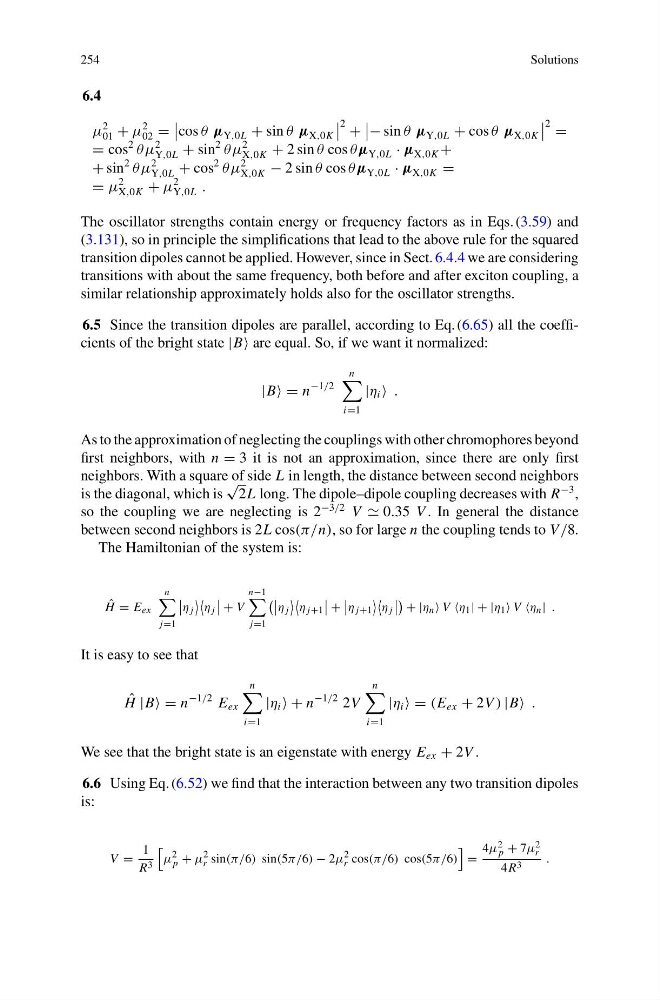
6.4
μ
2
01 + μ
2
02 =
cos θ μ Y,0L + sin θ μ X,0K
2 +
− sin θ μ Y,0L + cos θ μ X,0K
2 =
= cos
2
θμ
2
Y,0L + sin
2
θμ
2
X,0K + 2 sin θ cos θ μ Y,0L · μ X,0K +
+ sin
2
θμ
2
Y,0L + cos
2
θμ
2
X,0K − 2 sin θ cos θ μ Y,0L · μ X,0K =
= μ
2
X,0K + μ
2
Y,0L .
The oscillator strengths contain energy or frequency factors as in Eqs. (3.59) and
(3.131), so in principle the simplifications that lead to the above rule for the squared
transition dipoles cannot be applied. However, since in Sect. 6.4.4 we are considering
transitions with about the same frequency, both before and after exciton coupling, a
similar relationship approximately holds also for the oscillator strengths.
6.5 Since the transition dipoles are parallel, according to Eq. (6.65) all the coefficients of the bright state |B are equal. So, if we want it normalized:
|B = n
−1/2
n
i=1
|η i .
As to the approximation of neglecting the couplings with other chromophores beyond
first neighbors, with n = 3 it is not an approximation, since there are only first
neighbors. With a square of side L in length, the distance between second neighbors
is the diagonal, which is
√
2L long. The dipole–dipole coupling decreases with R
−3 ,
so the coupling we are neglecting is 2
−3/2 V 0.35 V . In general the distance
between second neighbors is 2L cos(π/n), so for large n the coupling tends to V /8.
The Hamiltonian of the system is:
ˆ
H = E ex
n
j=1
η j
η j
+ V
n−1
j=1
η j
η j+1
+
η j+1
η j
+ |η n V η 1 | + |η 1 V η n | .
It is easy to see that
ˆ
H |B = n
−1/2 E ex
n
i=1
|η i + n
−1/2 2V
n
i=1
|η i = (E ex + 2V ) |B .
We see that the bright state is an eigenstate with energy E ex + 2V .
6.6 Using Eq. (6.52) we find that the interaction between any two transition dipoles
is:
V =
1
R 3
μ
2
p + μ
2
r sin(π/6) sin(5π/6) − 2μ
2
r cos(π/6) cos(5π/6)
=
4μ 2
p + 7μ 2
r
4R 3
.
Solutions
6.4
μ
2
01 + μ
2
02 =
cos θ μ Y,0L + sin θ μ X,0K
2 +
− sin θ μ Y,0L + cos θ μ X,0K
2 =
= cos
2
θμ
2
Y,0L + sin
2
θμ
2
X,0K + 2 sin θ cos θ μ Y,0L · μ X,0K +
+ sin
2
θμ
2
Y,0L + cos
2
θμ
2
X,0K − 2 sin θ cos θ μ Y,0L · μ X,0K =
= μ
2
X,0K + μ
2
Y,0L .
The oscillator strengths contain energy or frequency factors as in Eqs. (3.59) and
(3.131), so in principle the simplifications that lead to the above rule for the squared
transition dipoles cannot be applied. However, since in Sect. 6.4.4 we are considering
transitions with about the same frequency, both before and after exciton coupling, a
similar relationship approximately holds also for the oscillator strengths.
6.5 Since the transition dipoles are parallel, according to Eq. (6.65) all the coefficients of the bright state |B are equal. So, if we want it normalized:
|B = n
−1/2
n
i=1
|η i .
As to the approximation of neglecting the couplings with other chromophores beyond
first neighbors, with n = 3 it is not an approximation, since there are only first
neighbors. With a square of side L in length, the distance between second neighbors
is the diagonal, which is
√
2L long. The dipole–dipole coupling decreases with R
−3 ,
so the coupling we are neglecting is 2
−3/2 V 0.35 V . In general the distance
between second neighbors is 2L cos(π/n), so for large n the coupling tends to V /8.
The Hamiltonian of the system is:
ˆ
H = E ex
n
j=1
η j
η j
+ V
n−1
j=1
η j
η j+1
+
η j+1
η j
+ |η n V η 1 | + |η 1 V η n | .
It is easy to see that
ˆ
H |B = n
−1/2 E ex
n
i=1
|η i + n
−1/2 2V
n
i=1
|η i = (E ex + 2V ) |B .
We see that the bright state is an eigenstate with energy E ex + 2V .
6.6 Using Eq. (6.52) we find that the interaction between any two transition dipoles
is:
V =
1
R 3
μ
2
p + μ
2
r sin(π/6) sin(5π/6) − 2μ
2
r cos(π/6) cos(5π/6)
=
4μ 2
p + 7μ 2
r
4R 3
.