

Solutions
257
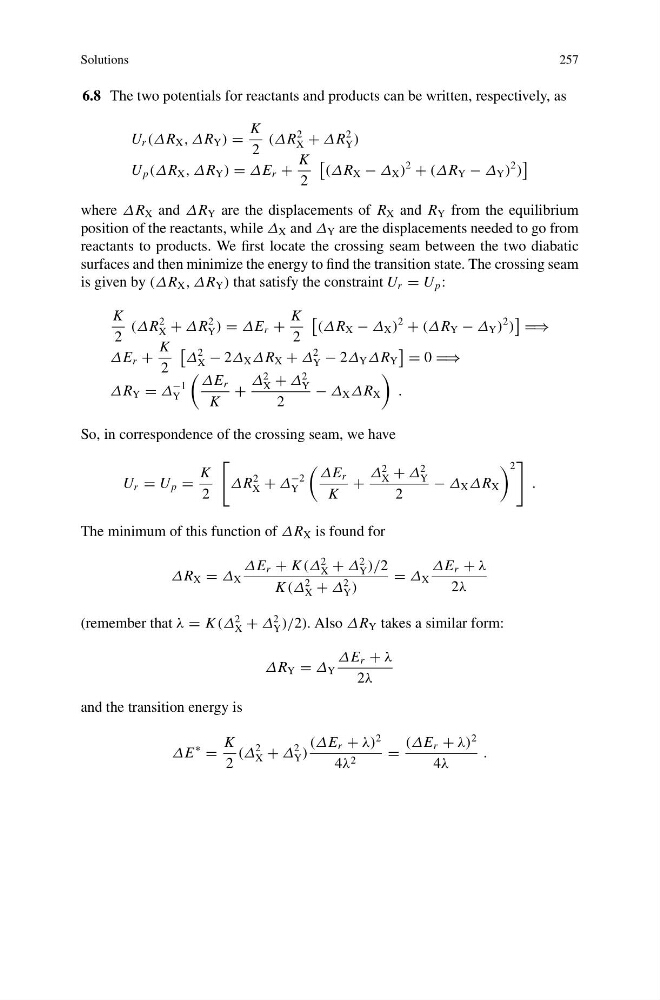
6.8 The two potentials for reactants and products can be written, respectively, as
U r (ΔR X , ΔR Y ) =
K
2
(ΔR
2
X + ΔR
2
Y )
U p (ΔR X , ΔR Y ) = ΔE r +
K
2
(ΔR X − Δ X )
2
+ (ΔR Y − Δ Y )
2
)
where ΔR X and ΔR Y are the displacements of R X and R Y from the equilibrium
position of the reactants, while Δ X and Δ Y are the displacements needed to go from
reactants to products. We first locate the crossing seam between the two diabatic
surfaces and then minimize the energy to find the transition state. The crossing seam
is given by (ΔR X , ΔR Y ) that satisfy the constraint U r = U p :
K
2
(ΔR
2
X + ΔR
2
Y ) = ΔE r +
K
2
(ΔR X − Δ X )
2
+ (ΔR Y − Δ Y )
2
)
=⇒
ΔE r +
K
2
Δ
2
X − 2Δ X ΔR X + Δ
2
Y − 2Δ Y ΔR Y
= 0 =⇒
ΔR Y = Δ
−1
Y
ΔE r
K
+
Δ
2
X + Δ
2
Y
2
− Δ X ΔR X
.
So, in correspondence of the crossing seam, we have
U r = U p =
K
2
ΔR
2
X + Δ
−2
Y
ΔE r
K
+
Δ
2
X + Δ
2
Y
2
− Δ X ΔR X
2
.
The minimum of this function of ΔR X is found for
ΔR X = Δ X
ΔE r + K (Δ
2
X + Δ
2
Y )/2
K (Δ
2
X + Δ
2
Y )
= Δ X
ΔE r + λ
2λ
(remember that λ = K (Δ
2
X + Δ
2
Y )/2). Also ΔR Y takes a similar form:
ΔR Y = Δ Y
ΔE r + λ
2λ
and the transition energy is
ΔE
∗
=
K
2
(Δ
2
X + Δ
2
Y )
(ΔE r + λ)
2
4λ 2
=
(ΔE r + λ)
2
4λ
.
257
6.8 The two potentials for reactants and products can be written, respectively, as
U r (ΔR X , ΔR Y ) =
K
2
(ΔR
2
X + ΔR
2
Y )
U p (ΔR X , ΔR Y ) = ΔE r +
K
2
(ΔR X − Δ X )
2
+ (ΔR Y − Δ Y )
2
)
where ΔR X and ΔR Y are the displacements of R X and R Y from the equilibrium
position of the reactants, while Δ X and Δ Y are the displacements needed to go from
reactants to products. We first locate the crossing seam between the two diabatic
surfaces and then minimize the energy to find the transition state. The crossing seam
is given by (ΔR X , ΔR Y ) that satisfy the constraint U r = U p :
K
2
(ΔR
2
X + ΔR
2
Y ) = ΔE r +
K
2
(ΔR X − Δ X )
2
+ (ΔR Y − Δ Y )
2
)
=⇒
ΔE r +
K
2
Δ
2
X − 2Δ X ΔR X + Δ
2
Y − 2Δ Y ΔR Y
= 0 =⇒
ΔR Y = Δ
−1
Y
ΔE r
K
+
Δ
2
X + Δ
2
Y
2
− Δ X ΔR X
.
So, in correspondence of the crossing seam, we have
U r = U p =
K
2
ΔR
2
X + Δ
−2
Y
ΔE r
K
+
Δ
2
X + Δ
2
Y
2
− Δ X ΔR X
2
.
The minimum of this function of ΔR X is found for
ΔR X = Δ X
ΔE r + K (Δ
2
X + Δ
2
Y )/2
K (Δ
2
X + Δ
2
Y )
= Δ X
ΔE r + λ
2λ
(remember that λ = K (Δ
2
X + Δ
2
Y )/2). Also ΔR Y takes a similar form:
ΔR Y = Δ Y
ΔE r + λ
2λ
and the transition energy is
ΔE
∗
=
K
2
(Δ
2
X + Δ
2
Y )
(ΔE r + λ)
2
4λ 2
=
(ΔE r + λ)
2
4λ
.