

250
Solutions
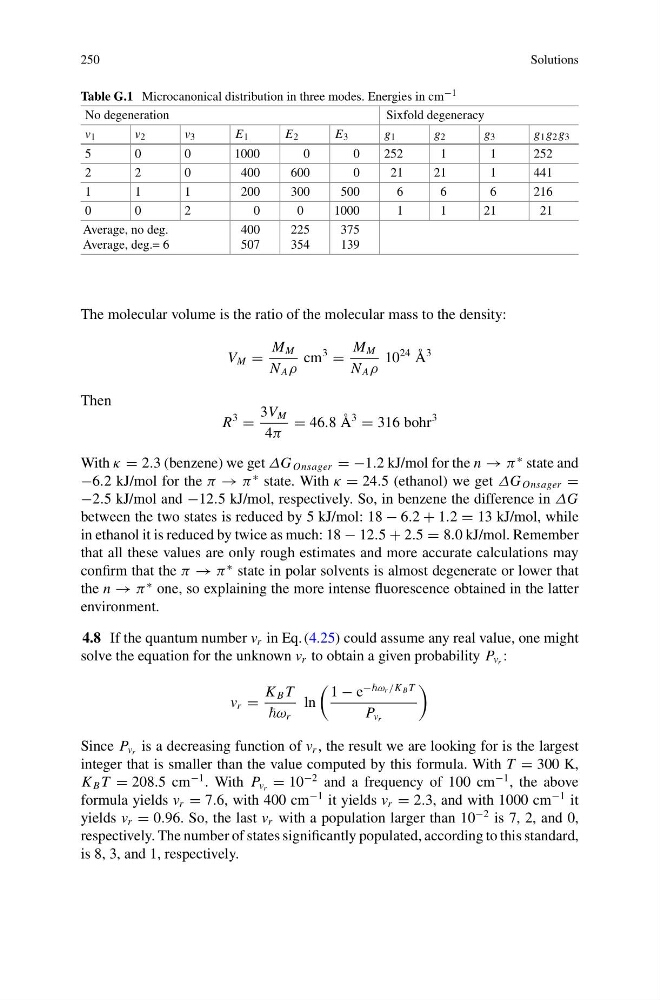
Table G.1 Microcanonical distribution in three modes. Energies in cm −1
No degeneration
Sixfold degeneracy
v 1
v 2
v 3
E 1
E 2
E 3
g 1
g 2
g 3
g 1 g 2 g 3
5
0
0
1000
0
0
252
1
1
252
2
2
0
400
600
0
21
21
1
441
1
1
1
200
300
500
6
6
6
216
0
0
2
0
0
1000
1
1
21
21
Average, no deg.
Average, deg.= 6
400
507
225
354
375
139
The molecular volume is the ratio of the molecular mass to the density:
V M =
M M
N A ρ
cm
3
=
M M
N A ρ
10
24 Å
3
Then
R
3
=
3V M
4π
= 46.8 Å
3
= 316 bohr
3
With κ = 2.3 (benzene) we get ΔG Onsager = −1.2 kJ/mol for the n → π
∗ state and
−6.2 kJ/mol for the π → π
∗ state. With κ = 24.5 (ethanol) we get ΔG Onsager =
−2.5 kJ/mol and −12.5 kJ/mol, respectively. So, in benzene the difference in ΔG
between the two states is reduced by 5 kJ/mol: 18 − 6.2 + 1.2 = 13 kJ/mol, while
in ethanol it is reduced by twice as much: 18 − 12.5 + 2.5 = 8.0 kJ/mol. Remember
that all these values are only rough estimates and more accurate calculations may
confirm that the π → π
∗ state in polar solvents is almost degenerate or lower that
the n → π
∗ one, so explaining the more intense fluorescence obtained in the latter
environment.
4.8 If the quantum number v r in Eq. (4.25) could assume any real value, one might
solve the equation for the unknown v r to obtain a given probability P v r :
v r =
K B T
ω r
ln
1 − e
−ω r /K B T
P v r
Since P v r is a decreasing function of v r , the result we are looking for is the largest
integer that is smaller than the value computed by this formula. With T = 300 K,
K B T = 208.5 cm
−1 . With P v r = 10
−2 and a frequency of 100 cm
−1 , the above
formula yields v r = 7.6, with 400 cm
−1 it yields v r = 2.3, and with 1000 cm
−1 it
yields v r = 0.96. So, the last v r with a population larger than 10
−2 is 7, 2, and 0,
respectively. The number of states significantly populated, according to this standard,
is 8, 3, and 1, respectively.
Solutions
Table G.1 Microcanonical distribution in three modes. Energies in cm −1
No degeneration
Sixfold degeneracy
v 1
v 2
v 3
E 1
E 2
E 3
g 1
g 2
g 3
g 1 g 2 g 3
5
0
0
1000
0
0
252
1
1
252
2
2
0
400
600
0
21
21
1
441
1
1
1
200
300
500
6
6
6
216
0
0
2
0
0
1000
1
1
21
21
Average, no deg.
Average, deg.= 6
400
507
225
354
375
139
The molecular volume is the ratio of the molecular mass to the density:
V M =
M M
N A ρ
cm
3
=
M M
N A ρ
10
24 Å
3
Then
R
3
=
3V M
4π
= 46.8 Å
3
= 316 bohr
3
With κ = 2.3 (benzene) we get ΔG Onsager = −1.2 kJ/mol for the n → π
∗ state and
−6.2 kJ/mol for the π → π
∗ state. With κ = 24.5 (ethanol) we get ΔG Onsager =
−2.5 kJ/mol and −12.5 kJ/mol, respectively. So, in benzene the difference in ΔG
between the two states is reduced by 5 kJ/mol: 18 − 6.2 + 1.2 = 13 kJ/mol, while
in ethanol it is reduced by twice as much: 18 − 12.5 + 2.5 = 8.0 kJ/mol. Remember
that all these values are only rough estimates and more accurate calculations may
confirm that the π → π
∗ state in polar solvents is almost degenerate or lower that
the n → π
∗ one, so explaining the more intense fluorescence obtained in the latter
environment.
4.8 If the quantum number v r in Eq. (4.25) could assume any real value, one might
solve the equation for the unknown v r to obtain a given probability P v r :
v r =
K B T
ω r
ln
1 − e
−ω r /K B T
P v r
Since P v r is a decreasing function of v r , the result we are looking for is the largest
integer that is smaller than the value computed by this formula. With T = 300 K,
K B T = 208.5 cm
−1 . With P v r = 10
−2 and a frequency of 100 cm
−1 , the above
formula yields v r = 7.6, with 400 cm
−1 it yields v r = 2.3, and with 1000 cm
−1 it
yields v r = 0.96. So, the last v r with a population larger than 10
−2 is 7, 2, and 0,
respectively. The number of states significantly populated, according to this standard,
is 8, 3, and 1, respectively.