

Solutions
249
The last equality stems from the fact that ˆ
p i −
ˆ
p i
multiplied by a constant averages
to zero.
4.4
d x i
dt
=
i
ψ
ˆ
T , x i
ψ
=
i
2m i
ψ
ˆ
p
2
i , x i
ψ
=
=
i
2m i
ψ
ˆ
p i
ˆ
p i , x i
+
ˆ
p i , x i
ˆ
p i
ψ
=
p i
m i
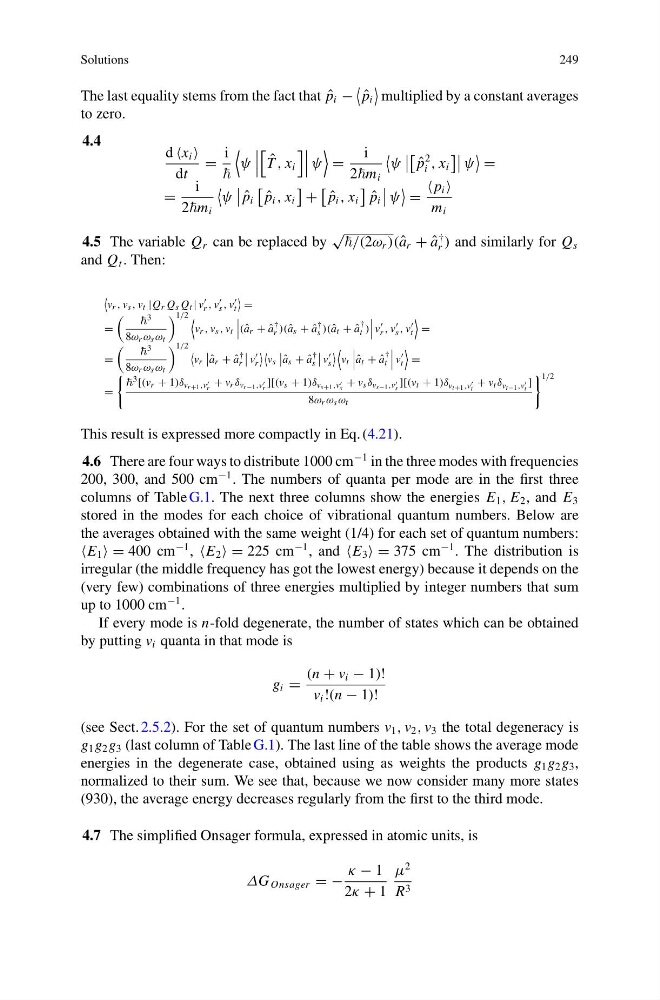
4.5 The variable Q r can be replaced by
√ /(2ω r )( ˆ
a r + ˆ
a
†
r ) and similarly for Q s
and Q t . Then:
v r , v s , v t |Q r Q s Q t | v
r , v
s , v
t
=
=
3
8ω r ω s ω t
1/2
v r , v s , v t
( ˆ
a r + ˆ
a
†
r )( ˆ
a s + ˆ
a
†
s )( ˆ
a t + ˆ
a
†
t )
v
r , v
s , v
t
=
=
3
8ω r ω s ω t
1/2
v r
ˆ
a r + ˆ
a
†
r
v
r
v s
ˆ
a s + ˆ
a
†
s
v
s
v t
ˆ
a t + ˆ
a
†
t
v
t
=
=
3 [(v r + 1)δ vr+1,v
r
+ v r δ vr−1,v
r
][(v s + 1)δ vs+1,v
s
+ v s δ vs−1,v
s
][(v t + 1)δ vt+1,v
t
+ v t δ vt−1,v
t
]
8ω r ω s ω t
1/2
This result is expressed more compactly in Eq. (4.21).
4.6 There are four ways to distribute 1000 cm
−1 in the three modes with frequencies
200, 300, and 500 cm
−1 . The numbers of quanta per mode are in the first three
columns of Table G.1. The next three columns show the energies E 1 , E 2 , and E 3
stored in the modes for each choice of vibrational quantum numbers. Below are
the averages obtained with the same weight (1/4) for each set of quantum numbers:
E 1 = 400 cm
−1 , E 2 = 225 cm
−1 , and E 3 = 375 cm
−1 . The distribution is
irregular (the middle frequency has got the lowest energy) because it depends on the
(very few) combinations of three energies multiplied by integer numbers that sum
up to 1000 cm
−1 .
If every mode is n-fold degenerate, the number of states which can be obtained
by putting v i quanta in that mode is
g i =
(n + v i − 1)!
v i !(n − 1)!
(see Sect. 2.5.2). For the set of quantum numbers v 1 , v 2 , v 3 the total degeneracy is
g 1 g 2 g 3 (last column of Table G.1). The last line of the table shows the average mode
energies in the degenerate case, obtained using as weights the products g 1 g 2 g 3 ,
normalized to their sum. We see that, because we now consider many more states
(930), the average energy decreases regularly from the first to the third mode.
4.7 The simplified Onsager formula, expressed in atomic units, is
ΔG Onsager = −
κ − 1
2κ + 1
μ
2
R 3
249
The last equality stems from the fact that ˆ
p i −
ˆ
p i
multiplied by a constant averages
to zero.
4.4
d x i
dt
=
i
ψ
ˆ
T , x i
ψ
=
i
2m i
ψ
ˆ
p
2
i , x i
ψ
=
=
i
2m i
ψ
ˆ
p i
ˆ
p i , x i
+
ˆ
p i , x i
ˆ
p i
ψ
=
p i
m i
4.5 The variable Q r can be replaced by
√ /(2ω r )( ˆ
a r + ˆ
a
†
r ) and similarly for Q s
and Q t . Then:
v r , v s , v t |Q r Q s Q t | v
r , v
s , v
t
=
=
3
8ω r ω s ω t
1/2
v r , v s , v t
( ˆ
a r + ˆ
a
†
r )( ˆ
a s + ˆ
a
†
s )( ˆ
a t + ˆ
a
†
t )
v
r , v
s , v
t
=
=
3
8ω r ω s ω t
1/2
v r
ˆ
a r + ˆ
a
†
r
v
r
v s
ˆ
a s + ˆ
a
†
s
v
s
v t
ˆ
a t + ˆ
a
†
t
v
t
=
=
3 [(v r + 1)δ vr+1,v
r
+ v r δ vr−1,v
r
][(v s + 1)δ vs+1,v
s
+ v s δ vs−1,v
s
][(v t + 1)δ vt+1,v
t
+ v t δ vt−1,v
t
]
8ω r ω s ω t
1/2
This result is expressed more compactly in Eq. (4.21).
4.6 There are four ways to distribute 1000 cm
−1 in the three modes with frequencies
200, 300, and 500 cm
−1 . The numbers of quanta per mode are in the first three
columns of Table G.1. The next three columns show the energies E 1 , E 2 , and E 3
stored in the modes for each choice of vibrational quantum numbers. Below are
the averages obtained with the same weight (1/4) for each set of quantum numbers:
E 1 = 400 cm
−1 , E 2 = 225 cm
−1 , and E 3 = 375 cm
−1 . The distribution is
irregular (the middle frequency has got the lowest energy) because it depends on the
(very few) combinations of three energies multiplied by integer numbers that sum
up to 1000 cm
−1 .
If every mode is n-fold degenerate, the number of states which can be obtained
by putting v i quanta in that mode is
g i =
(n + v i − 1)!
v i !(n − 1)!
(see Sect. 2.5.2). For the set of quantum numbers v 1 , v 2 , v 3 the total degeneracy is
g 1 g 2 g 3 (last column of Table G.1). The last line of the table shows the average mode
energies in the degenerate case, obtained using as weights the products g 1 g 2 g 3 ,
normalized to their sum. We see that, because we now consider many more states
(930), the average energy decreases regularly from the first to the third mode.
4.7 The simplified Onsager formula, expressed in atomic units, is
ΔG Onsager = −
κ − 1
2κ + 1
μ
2
R 3