

248
Solutions
Then
U =
1
2
Mω
2
2
χ 1,0
R 1 − R 2 +
2Mω 1
( ˆ
a + ˆ
a
†
)
2
χ 1,0
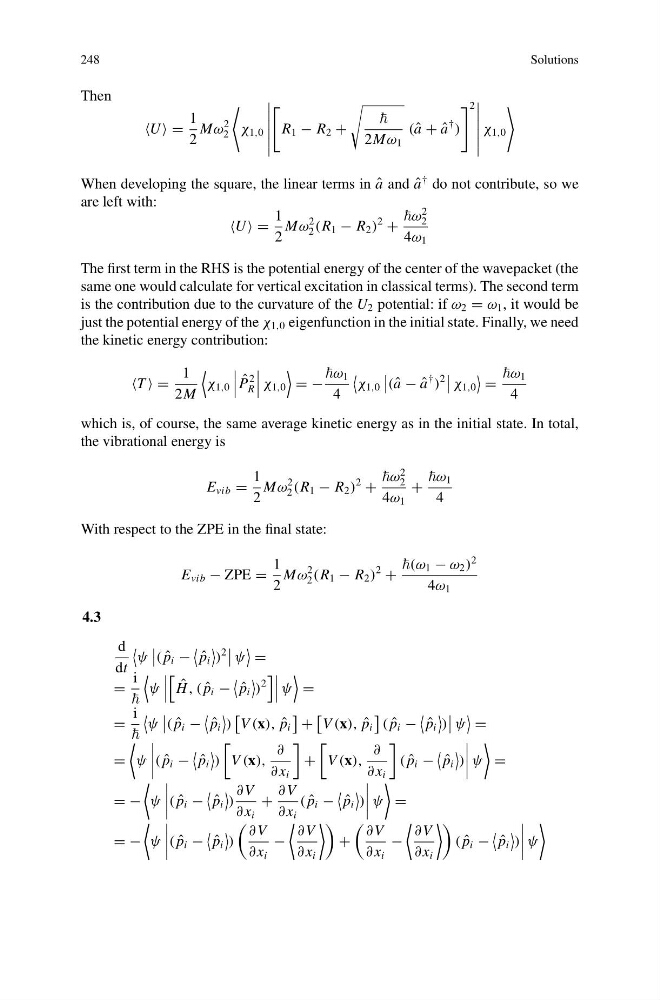
When developing the square, the linear terms in ˆ
a and ˆ
a
† do not contribute, so we
are left with:
U =
1
2
Mω
2
2 (R 1 − R 2 )
2
+
ω
2
2
4ω 1
The first term in the RHS is the potential energy of the center of the wavepacket (the
same one would calculate for vertical excitation in classical terms). The second term
is the contribution due to the curvature of the U 2 potential: if ω 2 = ω 1 , it would be
just the potential energy of the χ 1,0 eigenfunction in the initial state. Finally, we need
the kinetic energy contribution:
T =
1
2M
χ 1,0
ˆ
P
2
R
χ 1,0
= −
ω 1
4
χ 1,0
( ˆ
a − ˆ
a
†
)
2
χ 1,0
=
ω 1
4
which is, of course, the same average kinetic energy as in the initial state. In total,
the vibrational energy is
E vib =
1
2
Mω
2
2 (R 1 − R 2 )
2
+
ω
2
2
4ω 1
+
ω 1
4
With respect to the ZPE in the final state:
E vib − ZPE =
1
2
Mω
2
2 (R 1 − R 2 )
2
+
(ω 1 − ω 2 )
2
4ω 1
4.3
d
dt
ψ
( ˆ
p i −
ˆ
p i
)
2
ψ
=
=
i
ψ
ˆ
H , ( ˆ
p i −
ˆ
p i
)
2
ψ
=
=
i
ψ
( ˆ
p i −
ˆ
p i
)
V (x), ˆ
p i
+
V (x), ˆ
p i
( ˆ
p i −
ˆ
p i
)
ψ
=
=
ψ
( ˆ
p i −
ˆ
p i
)
V (x),
∂
∂ x i
+
V (x),
∂
∂ x i
( ˆ
p i −
ˆ
p i
)
ψ
=
= −
ψ
( ˆ
p i −
ˆ
p i
)
∂ V
∂ x i
+
∂ V
∂ x i
( ˆ
p i −
ˆ
p i
)
ψ
=
= −
ψ
( ˆ
p i −
ˆ
p i
)
∂ V
∂ x i
−
∂ V
∂ x i
+
∂ V
∂ x i
−
∂ V
∂ x i
( ˆ
p i −
ˆ
p i
)
ψ
Solutions
Then
U =
1
2
Mω
2
2
χ 1,0
R 1 − R 2 +
2Mω 1
( ˆ
a + ˆ
a
†
)
2
χ 1,0
When developing the square, the linear terms in ˆ
a and ˆ
a
† do not contribute, so we
are left with:
U =
1
2
Mω
2
2 (R 1 − R 2 )
2
+
ω
2
2
4ω 1
The first term in the RHS is the potential energy of the center of the wavepacket (the
same one would calculate for vertical excitation in classical terms). The second term
is the contribution due to the curvature of the U 2 potential: if ω 2 = ω 1 , it would be
just the potential energy of the χ 1,0 eigenfunction in the initial state. Finally, we need
the kinetic energy contribution:
T =
1
2M
χ 1,0
ˆ
P
2
R
χ 1,0
= −
ω 1
4
χ 1,0
( ˆ
a − ˆ
a
†
)
2
χ 1,0
=
ω 1
4
which is, of course, the same average kinetic energy as in the initial state. In total,
the vibrational energy is
E vib =
1
2
Mω
2
2 (R 1 − R 2 )
2
+
ω
2
2
4ω 1
+
ω 1
4
With respect to the ZPE in the final state:
E vib − ZPE =
1
2
Mω
2
2 (R 1 − R 2 )
2
+
(ω 1 − ω 2 )
2
4ω 1
4.3
d
dt
ψ
( ˆ
p i −
ˆ
p i
)
2
ψ
=
=
i
ψ
ˆ
H , ( ˆ
p i −
ˆ
p i
)
2
ψ
=
=
i
ψ
( ˆ
p i −
ˆ
p i
)
V (x), ˆ
p i
+
V (x), ˆ
p i
( ˆ
p i −
ˆ
p i
)
ψ
=
=
ψ
( ˆ
p i −
ˆ
p i
)
V (x),
∂
∂ x i
+
V (x),
∂
∂ x i
( ˆ
p i −
ˆ
p i
)
ψ
=
= −
ψ
( ˆ
p i −
ˆ
p i
)
∂ V
∂ x i
+
∂ V
∂ x i
( ˆ
p i −
ˆ
p i
)
ψ
=
= −
ψ
( ˆ
p i −
ˆ
p i
)
∂ V
∂ x i
−
∂ V
∂ x i
+
∂ V
∂ x i
−
∂ V
∂ x i
( ˆ
p i −
ˆ
p i
)
ψ