

Solutions
251
4.9 The two periods are approximately T h = 220 fs and T m = 270 fs. They correspond to the frequencies ω h = 6.9 · 10
−4 a.u. and ω m = 5.6 · 10
−4 a.u. The vibrational frequency of the harmonic oscillator is
√
K /M = 6.93 · 10
−4 a.u., in good
agreement with the oscillation period.
The vibrational levels of a Morse oscillator obey a simple formula (see Problem
2.2). The basic vibrational frequency is 6.9 · 10
−4 a.u., somewhat higher than that
desumed from the oscillation period. However, as discussed in Sect. 4.2, the excited
wavepacket is a superposition of stationary states with the largest coefficients for
vibrational quantum numbers close to 40. According to the above-mentioned formula, the levels around v = 40 are separated by about 5.7 · 10
−4 a.u., in much better
agreement with the “measured” period.
Problems of Chap. 5
5.1 From the equipartition theorem Mv
2
= K B T , where M is the reduced mass of
the diatomic molecule and v is the velocity on the neutral potential energy curve
(i.e., the velocity at which the ionic/neutral crossing is traversed). We have then
v = 1.93 · 10
−4 a.u. Using atomic units |F| = Q
−2
x = Δ
2 , where Δ is the difference
between the ionization potential of Na and the electron affinity of Cl. Taking the
numerical values for H 12 and Δ from Sect. 5.1 we obtain P adia = 0.792.
5.2 Let us first evaluate the Landau–Zener probability P adia . In this respect, the only
difference with the previous problem is the kinetic energy in the crossing region,
which in the present case corresponds to Δ. Then, v =
√
2Δ/M = 2.10 · 10
−3 a.u.
and P adia = 0.979. After the first passage through the crossing the populations of
the ionic and the covalent state are, respectively, P ≡ P adia and 1 − P. After the
second passage the population of the ionic state is made of two contributions: (1 −
P)(1 − P) and P
2 , coming, respectively, from the covalent and the ionic state. The
probability of the ionic state after the collision is therefore 1 + 2P(P − 1) = 0.959.
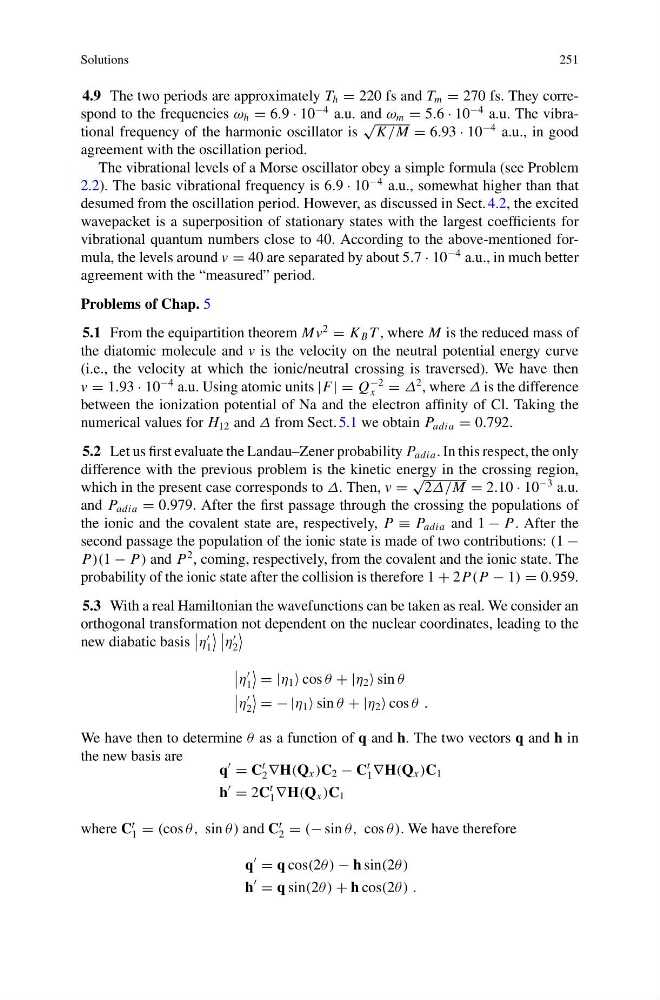
5.3 With a real Hamiltonian the wavefunctions can be taken as real. We consider an
orthogonal transformation not dependent on the nuclear coordinates, leading to the
new diabatic basis
η
1
η
2
η
1
= |η 1 cos θ + |η 2 sin θ
η
2
= − |η 1 sin θ + |η 2 cos θ .
We have then to determine θ as a function of q and h. The two vectors q and h in
the new basis are
q
= C
t
2 ∇H(Q x )C 2 − C
t
1 ∇H(Q x )C 1
h
= 2C
t
1 ∇H(Q x )C 1
where C
t
1 = (cos θ, sin θ) and C
t
2 = (− sin θ, cos θ). We have therefore
q
= q cos(2θ) − h sin(2θ)
h
= q sin(2θ) + h cos(2θ) .
251
4.9 The two periods are approximately T h = 220 fs and T m = 270 fs. They correspond to the frequencies ω h = 6.9 · 10
−4 a.u. and ω m = 5.6 · 10
−4 a.u. The vibrational frequency of the harmonic oscillator is
√
K /M = 6.93 · 10
−4 a.u., in good
agreement with the oscillation period.
The vibrational levels of a Morse oscillator obey a simple formula (see Problem
2.2). The basic vibrational frequency is 6.9 · 10
−4 a.u., somewhat higher than that
desumed from the oscillation period. However, as discussed in Sect. 4.2, the excited
wavepacket is a superposition of stationary states with the largest coefficients for
vibrational quantum numbers close to 40. According to the above-mentioned formula, the levels around v = 40 are separated by about 5.7 · 10
−4 a.u., in much better
agreement with the “measured” period.
Problems of Chap. 5
5.1 From the equipartition theorem Mv
2
= K B T , where M is the reduced mass of
the diatomic molecule and v is the velocity on the neutral potential energy curve
(i.e., the velocity at which the ionic/neutral crossing is traversed). We have then
v = 1.93 · 10
−4 a.u. Using atomic units |F| = Q
−2
x = Δ
2 , where Δ is the difference
between the ionization potential of Na and the electron affinity of Cl. Taking the
numerical values for H 12 and Δ from Sect. 5.1 we obtain P adia = 0.792.
5.2 Let us first evaluate the Landau–Zener probability P adia . In this respect, the only
difference with the previous problem is the kinetic energy in the crossing region,
which in the present case corresponds to Δ. Then, v =
√
2Δ/M = 2.10 · 10
−3 a.u.
and P adia = 0.979. After the first passage through the crossing the populations of
the ionic and the covalent state are, respectively, P ≡ P adia and 1 − P. After the
second passage the population of the ionic state is made of two contributions: (1 −
P)(1 − P) and P
2 , coming, respectively, from the covalent and the ionic state. The
probability of the ionic state after the collision is therefore 1 + 2P(P − 1) = 0.959.
5.3 With a real Hamiltonian the wavefunctions can be taken as real. We consider an
orthogonal transformation not dependent on the nuclear coordinates, leading to the
new diabatic basis
η
1
η
2
η
1
= |η 1 cos θ + |η 2 sin θ
η
2
= − |η 1 sin θ + |η 2 cos θ .
We have then to determine θ as a function of q and h. The two vectors q and h in
the new basis are
q
= C
t
2 ∇H(Q x )C 2 − C
t
1 ∇H(Q x )C 1
h
= 2C
t
1 ∇H(Q x )C 1
where C
t
1 = (cos θ, sin θ) and C
t
2 = (− sin θ, cos θ). We have therefore
q
= q cos(2θ) − h sin(2θ)
h
= q sin(2θ) + h cos(2θ) .