

Appendix E
Orbital Localization and Orthogonality
Localized molecular orbitals (MOs) are a key concept to discuss phenomena such
as charge and excitation transfer (see Chap. 6) and also a useful tool to improve
computational efficiency. Theoretical developments, however, may require that all
MOs are orthogonal, and this may limit the extent of localization. In this appendix
we work out a very simple example that clarifies this aspect.
We consider two equivalent 1s orbitals of two hydrogen atoms, labeled χ a and
χ b :
χ α (r) = π
−1/2 e
−|r−R α |
.
(E.1)
Here we use atomic units and R α is the position of the nucleus, with α = a or b. The
overlap integral of the two orbitals is
S ab = χ a |χ b = e
−R
1 + R +
1
3
R
2
(E.2)
nucleus 2
nucleus 1
•
•
z, bohr
orthogonal orbitals
3
2
1
0
-1
-2
-3
0.4
0.3
0.2
0.1
0
-0.1
-0.2
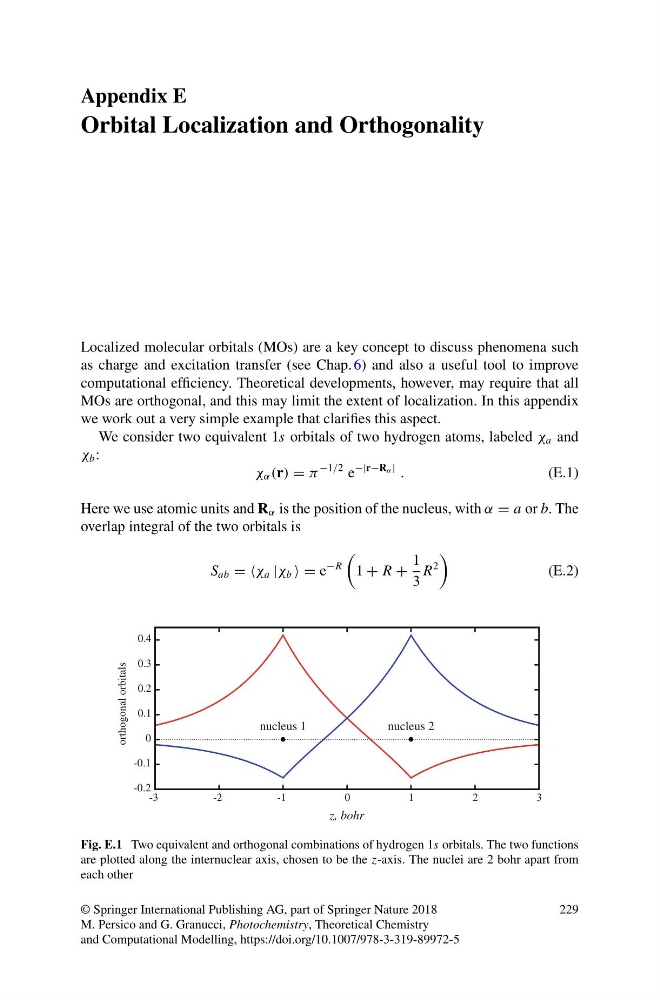
Fig. E.1 Two equivalent and orthogonal combinations of hydrogen 1s orbitals. The two functions
are plotted along the internuclear axis, chosen to be the z-axis. The nuclei are 2 bohr apart from
each other
© Springer International Publishing AG, part of Springer Nature 2018
M. Persico and G. Granucci, Photochemistry, Theoretical Chemistry
and Computational Modelling, https://doi.org/10.1007/978-3-319-89972-5
229
Orbital Localization and Orthogonality
Localized molecular orbitals (MOs) are a key concept to discuss phenomena such
as charge and excitation transfer (see Chap. 6) and also a useful tool to improve
computational efficiency. Theoretical developments, however, may require that all
MOs are orthogonal, and this may limit the extent of localization. In this appendix
we work out a very simple example that clarifies this aspect.
We consider two equivalent 1s orbitals of two hydrogen atoms, labeled χ a and
χ b :
χ α (r) = π
−1/2 e
−|r−R α |
.
(E.1)
Here we use atomic units and R α is the position of the nucleus, with α = a or b. The
overlap integral of the two orbitals is
S ab = χ a |χ b = e
−R
1 + R +
1
3
R
2
(E.2)
nucleus 2
nucleus 1
•
•
z, bohr
orthogonal orbitals
3
2
1
0
-1
-2
-3
0.4
0.3
0.2
0.1
0
-0.1
-0.2
Fig. E.1 Two equivalent and orthogonal combinations of hydrogen 1s orbitals. The two functions
are plotted along the internuclear axis, chosen to be the z-axis. The nuclei are 2 bohr apart from
each other
© Springer International Publishing AG, part of Springer Nature 2018
M. Persico and G. Granucci, Photochemistry, Theoretical Chemistry
and Computational Modelling, https://doi.org/10.1007/978-3-319-89972-5
229