

228
Appendix D: Two-State Eigenvector Problem
tg(2θ) = −
2H 12
ΔH
(D.5)
The coefficients are obtained with the usual formulas
cos θ =
1
1 + tg 2 θ
and sin θ =
tg θ
1 + tg 2 θ
(D.6)
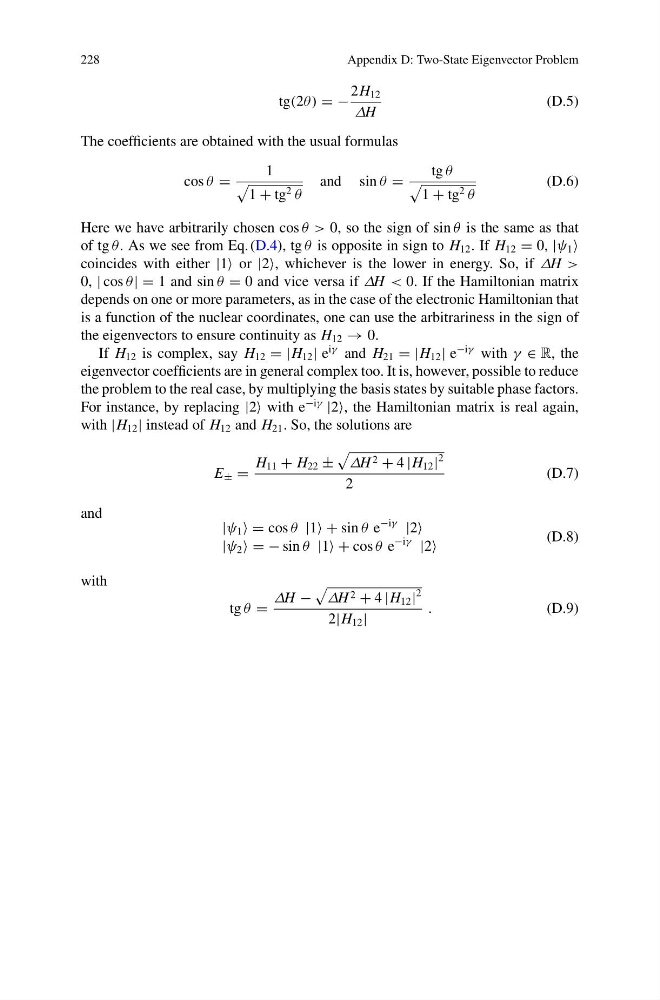
Here we have arbitrarily chosen cos θ > 0, so the sign of sin θ is the same as that
of tg θ . As we see from Eq. (D.4), tg θ is opposite in sign to H 12 . If H 12 = 0, |ψ 1
coincides with either |1 or |2, whichever is the lower in energy. So, if ΔH >
0, | cos θ | = 1 and sin θ = 0 and vice versa if ΔH < 0. If the Hamiltonian matrix
depends on one or more parameters, as in the case of the electronic Hamiltonian that
is a function of the nuclear coordinates, one can use the arbitrariness in the sign of
the eigenvectors to ensure continuity as H 12 → 0.
If H 12 is complex, say H 12 = |H 12 | e
iγ and H 21 = |H 12 | e
−iγ with γ ∈ R, the
eigenvector coefficients are in general complex too. It is, however, possible to reduce
the problem to the real case, by multiplying the basis states by suitable phase factors.
For instance, by replacing |2 with e
−iγ
|2, the Hamiltonian matrix is real again,
with |H 12 | instead of H 12 and H 21 . So, the solutions are
E ± =
H 11 + H 22 ±
ΔH 2 + 4 |H 12 |
2
2
(D.7)
and
|ψ 1 = cos θ |1 + sin θ e
−iγ
|2
|ψ 2 = − sin θ |1 + cos θ e
−iγ
|2
(D.8)
with
tg θ =
ΔH −
ΔH 2 + 4 |H 12 |
2
2|H 12 |
.
(D.9)
Appendix D: Two-State Eigenvector Problem
tg(2θ) = −
2H 12
ΔH
(D.5)
The coefficients are obtained with the usual formulas
cos θ =
1
1 + tg 2 θ
and sin θ =
tg θ
1 + tg 2 θ
(D.6)
Here we have arbitrarily chosen cos θ > 0, so the sign of sin θ is the same as that
of tg θ . As we see from Eq. (D.4), tg θ is opposite in sign to H 12 . If H 12 = 0, |ψ 1
coincides with either |1 or |2, whichever is the lower in energy. So, if ΔH >
0, | cos θ | = 1 and sin θ = 0 and vice versa if ΔH < 0. If the Hamiltonian matrix
depends on one or more parameters, as in the case of the electronic Hamiltonian that
is a function of the nuclear coordinates, one can use the arbitrariness in the sign of
the eigenvectors to ensure continuity as H 12 → 0.
If H 12 is complex, say H 12 = |H 12 | e
iγ and H 21 = |H 12 | e
−iγ with γ ∈ R, the
eigenvector coefficients are in general complex too. It is, however, possible to reduce
the problem to the real case, by multiplying the basis states by suitable phase factors.
For instance, by replacing |2 with e
−iγ
|2, the Hamiltonian matrix is real again,
with |H 12 | instead of H 12 and H 21 . So, the solutions are
E ± =
H 11 + H 22 ±
ΔH 2 + 4 |H 12 |
2
2
(D.7)
and
|ψ 1 = cos θ |1 + sin θ e
−iγ
|2
|ψ 2 = − sin θ |1 + cos θ e
−iγ
|2
(D.8)
with
tg θ =
ΔH −
ΔH 2 + 4 |H 12 |
2
2|H 12 |
.
(D.9)