

230
Appendix E: Orbital Localization and Orthogonality
exchange integral (x80)
Coulomb integral
S ab
R, bohr
S
ab
, and two-electron integrals (a.u.)
12
10
8
6
4
2
0.9
0.8
0.7
0.6
0.5
0.4
0.3
0.2
0.1
0
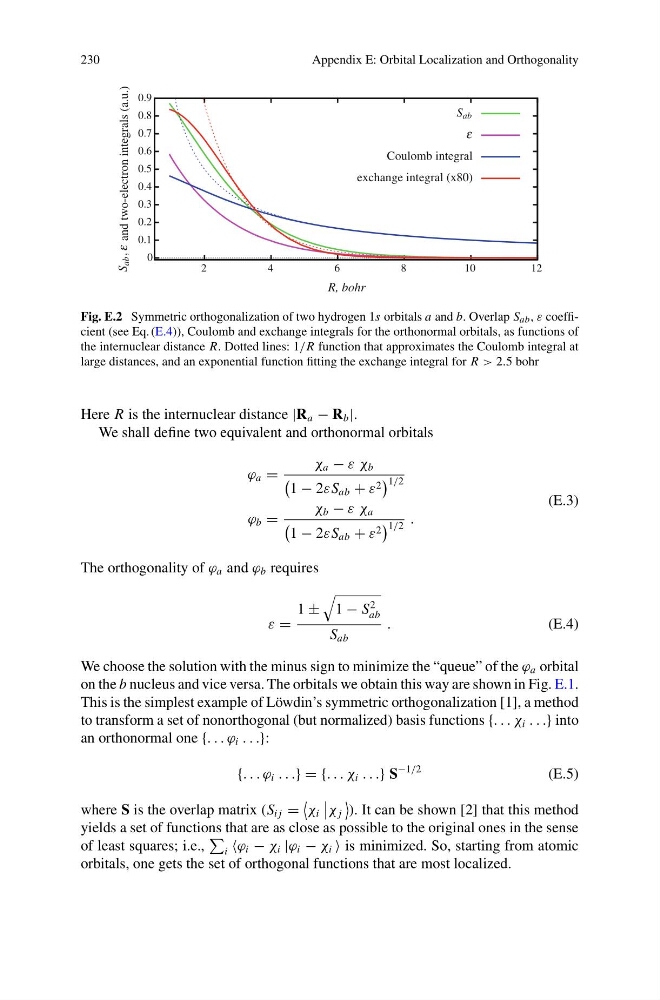
Fig. E.2 Symmetric orthogonalization of two hydrogen 1s orbitals a and b. Overlap S ab , ε coefficient (see Eq. (E.4)), Coulomb and exchange integrals for the orthonormal orbitals, as functions of
the internuclear distance R. Dotted lines: 1/R function that approximates the Coulomb integral at
large distances, and an exponential function fitting the exchange integral for R > 2.5 bohr
Here R is the internuclear distance |R a − R b |.
We shall define two equivalent and orthonormal orbitals
ϕ a =
χ a − ε χ b
1 − 2εS ab + ε 2
1/2
ϕ b =
χ b − ε χ a
1 − 2εS ab + ε 2
1/2 .
(E.3)
The orthogonality of ϕ a and ϕ b requires
ε =
1 ±
1 − S
2
ab
S ab
.
(E.4)
We choose the solution with the minus sign to minimize the “queue” of the ϕ a orbital
on the b nucleus and vice versa. The orbitals we obtain this way are shown in Fig. E.1.
This is the simplest example of Löwdin’s symmetric orthogonalization [1], a method
to transform a set of nonorthogonal (but normalized) basis functions {. . . χ i . . .} into
an orthonormal one {. . . ϕ i . . .}:
{. . . ϕ i . . .} = {. . . χ i . . .} S
−1/2
(E.5)
where S is the overlap matrix (S i j =
χ i
χ j
). It can be shown [2] that this method
yields a set of functions that are as close as possible to the original ones in the sense
of least squares; i.e.,
i ϕ i − χ i |ϕ i − χ i is minimized. So, starting from atomic
orbitals, one gets the set of orthogonal functions that are most localized.
Appendix E: Orbital Localization and Orthogonality
exchange integral (x80)
Coulomb integral
S ab
R, bohr
S
ab
, and two-electron integrals (a.u.)
12
10
8
6
4
2
0.9
0.8
0.7
0.6
0.5
0.4
0.3
0.2
0.1
0
Fig. E.2 Symmetric orthogonalization of two hydrogen 1s orbitals a and b. Overlap S ab , ε coefficient (see Eq. (E.4)), Coulomb and exchange integrals for the orthonormal orbitals, as functions of
the internuclear distance R. Dotted lines: 1/R function that approximates the Coulomb integral at
large distances, and an exponential function fitting the exchange integral for R > 2.5 bohr
Here R is the internuclear distance |R a − R b |.
We shall define two equivalent and orthonormal orbitals
ϕ a =
χ a − ε χ b
1 − 2εS ab + ε 2
1/2
ϕ b =
χ b − ε χ a
1 − 2εS ab + ε 2
1/2 .
(E.3)
The orthogonality of ϕ a and ϕ b requires
ε =
1 ±
1 − S
2
ab
S ab
.
(E.4)
We choose the solution with the minus sign to minimize the “queue” of the ϕ a orbital
on the b nucleus and vice versa. The orbitals we obtain this way are shown in Fig. E.1.
This is the simplest example of Löwdin’s symmetric orthogonalization [1], a method
to transform a set of nonorthogonal (but normalized) basis functions {. . . χ i . . .} into
an orthonormal one {. . . ϕ i . . .}:
{. . . ϕ i . . .} = {. . . χ i . . .} S
−1/2
(E.5)
where S is the overlap matrix (S i j =
χ i
χ j
). It can be shown [2] that this method
yields a set of functions that are as close as possible to the original ones in the sense
of least squares; i.e.,
i ϕ i − χ i |ϕ i − χ i is minimized. So, starting from atomic
orbitals, one gets the set of orthogonal functions that are most localized.