

Appendix B: Dirac’s Notation and Operator Algebra
219
ˆ
P =
n
i=1
|ψ i ψ i |
(B.12)
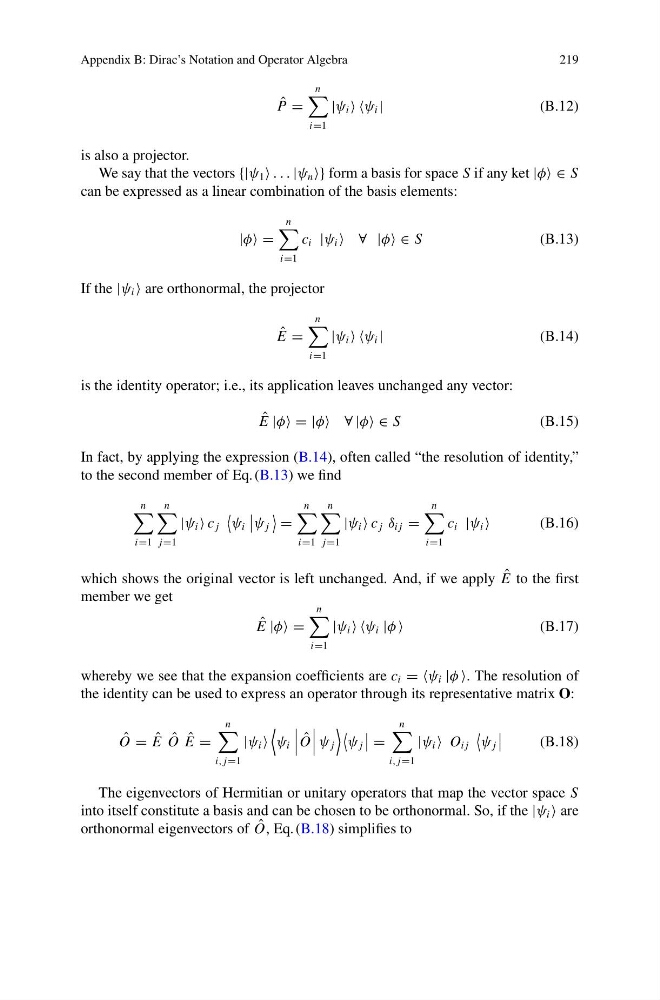
is also a projector.
We say that the vectors {|ψ 1 . . . |ψ n } form a basis for space S if any ket |φ ∈ S
can be expressed as a linear combination of the basis elements:
|φ =
n
i=1
c i |ψ i ∀ |φ ∈ S
(B.13)
If the |ψ i are orthonormal, the projector
ˆ
E =
n
i=1
|ψ i ψ i |
(B.14)
is the identity operator; i.e., its application leaves unchanged any vector:
ˆ
E |φ = |φ ∀ |φ ∈ S
(B.15)
In fact, by applying the expression (B.14), often called “the resolution of identity,”
to the second member of Eq. (B.13) we find
n
i=1
n
j=1
|ψ i c j
ψ i
ψ j
=
n
i=1
n
j=1
|ψ i c j δ i j =
n
i=1
c i |ψ i
(B.16)
which shows the original vector is left unchanged. And, if we apply ˆ
E to the first
member we get
ˆ
E |φ =
n
i=1
|ψ i ψ i |φ
(B.17)
whereby we see that the expansion coefficients are c i = ψ i |φ . The resolution of
the identity can be used to express an operator through its representative matrix O:
ˆ
O = ˆ
E ˆ
O ˆ
E =
n
i, j=1
|ψ i
ψ i
ˆ
O
ψ j
ψ j
=
n
i, j=1
|ψ i O i j
ψ j
(B.18)
The eigenvectors of Hermitian or unitary operators that map the vector space S
into itself constitute a basis and can be chosen to be orthonormal. So, if the |ψ i are
orthonormal eigenvectors of ˆ
O, Eq. (B.18) simplifies to
219
ˆ
P =
n
i=1
|ψ i ψ i |
(B.12)
is also a projector.
We say that the vectors {|ψ 1 . . . |ψ n } form a basis for space S if any ket |φ ∈ S
can be expressed as a linear combination of the basis elements:
|φ =
n
i=1
c i |ψ i ∀ |φ ∈ S
(B.13)
If the |ψ i are orthonormal, the projector
ˆ
E =
n
i=1
|ψ i ψ i |
(B.14)
is the identity operator; i.e., its application leaves unchanged any vector:
ˆ
E |φ = |φ ∀ |φ ∈ S
(B.15)
In fact, by applying the expression (B.14), often called “the resolution of identity,”
to the second member of Eq. (B.13) we find
n
i=1
n
j=1
|ψ i c j
ψ i
ψ j
=
n
i=1
n
j=1
|ψ i c j δ i j =
n
i=1
c i |ψ i
(B.16)
which shows the original vector is left unchanged. And, if we apply ˆ
E to the first
member we get
ˆ
E |φ =
n
i=1
|ψ i ψ i |φ
(B.17)
whereby we see that the expansion coefficients are c i = ψ i |φ . The resolution of
the identity can be used to express an operator through its representative matrix O:
ˆ
O = ˆ
E ˆ
O ˆ
E =
n
i, j=1
|ψ i
ψ i
ˆ
O
ψ j
ψ j
=
n
i, j=1
|ψ i O i j
ψ j
(B.18)
The eigenvectors of Hermitian or unitary operators that map the vector space S
into itself constitute a basis and can be chosen to be orthonormal. So, if the |ψ i are
orthonormal eigenvectors of ˆ
O, Eq. (B.18) simplifies to