

220
Appendix B: Dirac’s Notation and Operator Algebra
ˆ
O =
n
i=1
|ψ i λ i ψ i |
(B.19)
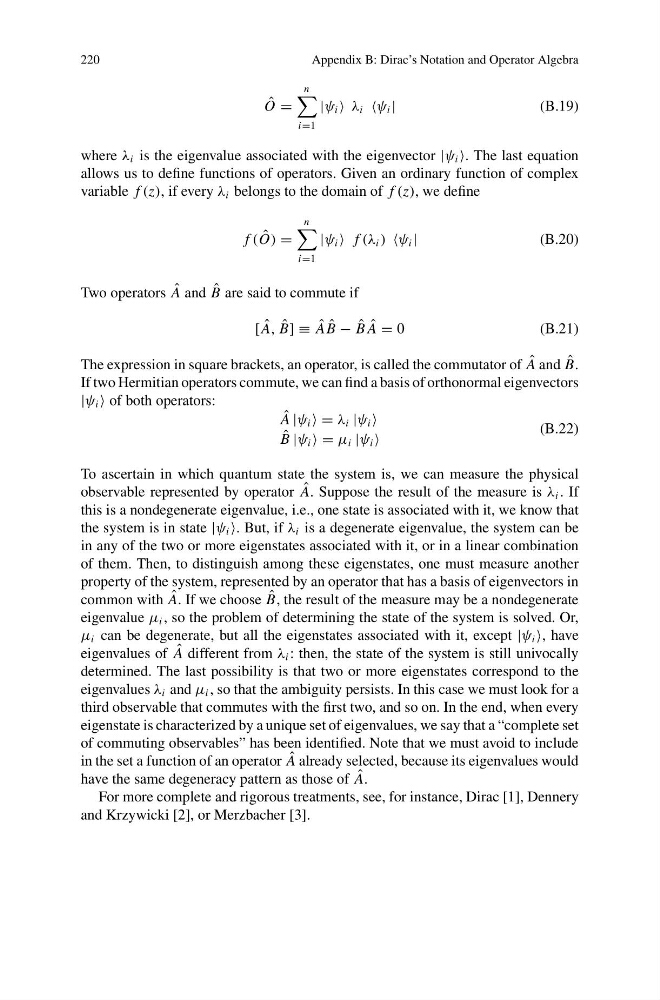
where λ i is the eigenvalue associated with the eigenvector |ψ i . The last equation
allows us to define functions of operators. Given an ordinary function of complex
variable f (z), if every λ i belongs to the domain of f (z), we define
f ( ˆ
O) =
n
i=1
|ψ i f (λ i ) ψ i |
(B.20)
Two operators ˆ
A and ˆ
B are said to commute if
[ ˆ
A, ˆ
B] ≡ ˆ
A ˆ
B − ˆ
B ˆ
A = 0
(B.21)
The expression in square brackets, an operator, is called the commutator of ˆ
A and ˆ
B.
If two Hermitian operators commute, we can find a basis of orthonormal eigenvectors
|ψ i of both operators:
ˆ
A |ψ i = λ i |ψ i
ˆ
B |ψ i = μ i |ψ i
(B.22)
To ascertain in which quantum state the system is, we can measure the physical
observable represented by operator ˆ
A. Suppose the result of the measure is λ i . If
this is a nondegenerate eigenvalue, i.e., one state is associated with it, we know that
the system is in state |ψ i . But, if λ i is a degenerate eigenvalue, the system can be
in any of the two or more eigenstates associated with it, or in a linear combination
of them. Then, to distinguish among these eigenstates, one must measure another
property of the system, represented by an operator that has a basis of eigenvectors in
common with ˆ
A. If we choose ˆ
B, the result of the measure may be a nondegenerate
eigenvalue μ i , so the problem of determining the state of the system is solved. Or,
μ i can be degenerate, but all the eigenstates associated with it, except |ψ i , have
eigenvalues of ˆ
A different from λ i : then, the state of the system is still univocally
determined. The last possibility is that two or more eigenstates correspond to the
eigenvalues λ i and μ i , so that the ambiguity persists. In this case we must look for a
third observable that commutes with the first two, and so on. In the end, when every
eigenstate is characterized by a unique set of eigenvalues, we say that a “complete set
of commuting observables” has been identified. Note that we must avoid to include
in the set a function of an operator ˆ
A already selected, because its eigenvalues would
have the same degeneracy pattern as those of ˆ
A.
For more complete and rigorous treatments, see, for instance, Dirac [1], Dennery
and Krzywicki [2], or Merzbacher [3].
Appendix B: Dirac’s Notation and Operator Algebra
ˆ
O =
n
i=1
|ψ i λ i ψ i |
(B.19)
where λ i is the eigenvalue associated with the eigenvector |ψ i . The last equation
allows us to define functions of operators. Given an ordinary function of complex
variable f (z), if every λ i belongs to the domain of f (z), we define
f ( ˆ
O) =
n
i=1
|ψ i f (λ i ) ψ i |
(B.20)
Two operators ˆ
A and ˆ
B are said to commute if
[ ˆ
A, ˆ
B] ≡ ˆ
A ˆ
B − ˆ
B ˆ
A = 0
(B.21)
The expression in square brackets, an operator, is called the commutator of ˆ
A and ˆ
B.
If two Hermitian operators commute, we can find a basis of orthonormal eigenvectors
|ψ i of both operators:
ˆ
A |ψ i = λ i |ψ i
ˆ
B |ψ i = μ i |ψ i
(B.22)
To ascertain in which quantum state the system is, we can measure the physical
observable represented by operator ˆ
A. Suppose the result of the measure is λ i . If
this is a nondegenerate eigenvalue, i.e., one state is associated with it, we know that
the system is in state |ψ i . But, if λ i is a degenerate eigenvalue, the system can be
in any of the two or more eigenstates associated with it, or in a linear combination
of them. Then, to distinguish among these eigenstates, one must measure another
property of the system, represented by an operator that has a basis of eigenvectors in
common with ˆ
A. If we choose ˆ
B, the result of the measure may be a nondegenerate
eigenvalue μ i , so the problem of determining the state of the system is solved. Or,
μ i can be degenerate, but all the eigenstates associated with it, except |ψ i , have
eigenvalues of ˆ
A different from λ i : then, the state of the system is still univocally
determined. The last possibility is that two or more eigenstates correspond to the
eigenvalues λ i and μ i , so that the ambiguity persists. In this case we must look for a
third observable that commutes with the first two, and so on. In the end, when every
eigenstate is characterized by a unique set of eigenvalues, we say that a “complete set
of commuting observables” has been identified. Note that we must avoid to include
in the set a function of an operator ˆ
A already selected, because its eigenvalues would
have the same degeneracy pattern as those of ˆ
A.
For more complete and rigorous treatments, see, for instance, Dirac [1], Dennery
and Krzywicki [2], or Merzbacher [3].