

218
Appendix B: Dirac’s Notation and Operator Algebra
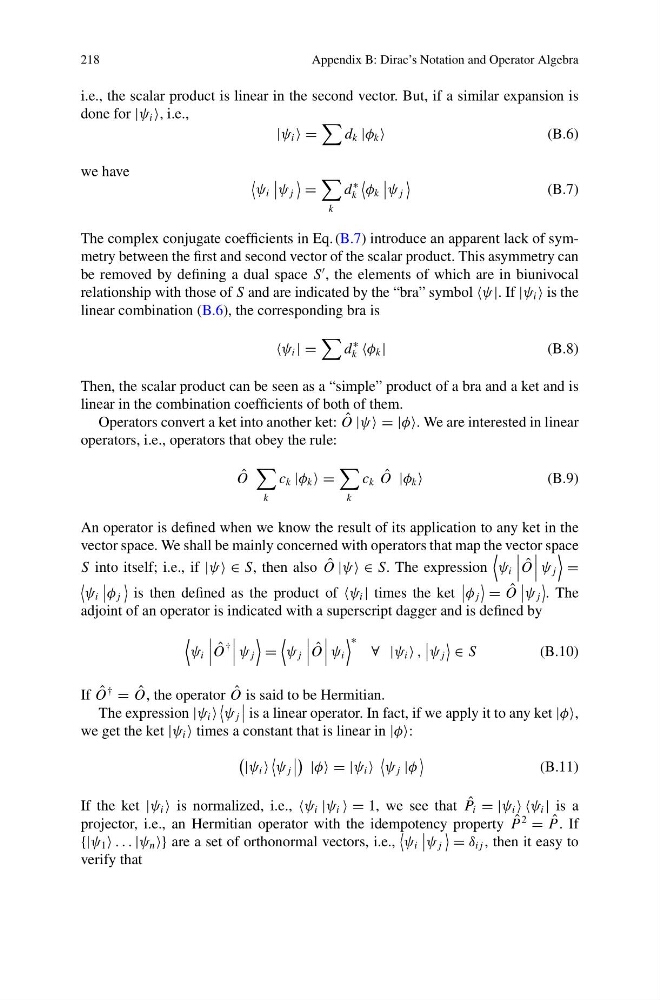
i.e., the scalar product is linear in the second vector. But, if a similar expansion is
done for |ψ i , i.e.,
|ψ i =
d k |φ k
(B.6)
we have
ψ i
ψ j
=
k
d
∗
k
φ k
ψ j
(B.7)
The complex conjugate coefficients in Eq. (B.7) introduce an apparent lack of symmetry between the first and second vector of the scalar product. This asymmetry can
be removed by defining a dual space S
, the elements of which are in biunivocal
relationship with those of S and are indicated by the “bra” symbol ψ|. If |ψ i is the
linear combination (B.6), the corresponding bra is
ψ i | =
d
∗
k φ k |
(B.8)
Then, the scalar product can be seen as a “simple” product of a bra and a ket and is
linear in the combination coefficients of both of them.
Operators convert a ket into another ket: ˆ
O |ψ = |φ. We are interested in linear
operators, i.e., operators that obey the rule:
ˆ
O
k
c k |φ k =
k
c k ˆ
O |φ k
(B.9)
An operator is defined when we know the result of its application to any ket in the
vector space. We shall be mainly concerned with operators that map the vector space
S into itself; i.e., if |ψ ∈ S, then also ˆ
O |ψ ∈ S. The expression
ψ i
ˆ
O
ψ j
=
ψ i
φ j
is then defined as the product of ψ i | times the ket
φ j
= ˆ
O
ψ j
. The
adjoint of an operator is indicated with a superscript dagger and is defined by
ψ i
ˆ
O
†
ψ j
=
ψ j
ˆ
O
ψ i
∗ ∀ |ψ i ,
ψ j
∈ S
(B.10)
If ˆ
O
†
= ˆ
O, the operator ˆ
O is said to be Hermitian.
The expression |ψ i
ψ j
is a linear operator. In fact, if we apply it to any ket |φ,
we get the ket |ψ i times a constant that is linear in |φ:
|ψ i
ψ j
|φ = |ψ i
ψ j |φ
(B.11)
If the ket |ψ i is normalized, i.e., ψ i |ψ i = 1, we see that ˆ
P i = |ψ i ψ i | is a
projector, i.e., an Hermitian operator with the idempotency property ˆ
P
2
= ˆ
P. If
{|ψ 1 . . . |ψ n } are a set of orthonormal vectors, i.e.,
ψ i
ψ j
= δ i j , then it easy to
verify that
Appendix B: Dirac’s Notation and Operator Algebra
i.e., the scalar product is linear in the second vector. But, if a similar expansion is
done for |ψ i , i.e.,
|ψ i =
d k |φ k
(B.6)
we have
ψ i
ψ j
=
k
d
∗
k
φ k
ψ j
(B.7)
The complex conjugate coefficients in Eq. (B.7) introduce an apparent lack of symmetry between the first and second vector of the scalar product. This asymmetry can
be removed by defining a dual space S
, the elements of which are in biunivocal
relationship with those of S and are indicated by the “bra” symbol ψ|. If |ψ i is the
linear combination (B.6), the corresponding bra is
ψ i | =
d
∗
k φ k |
(B.8)
Then, the scalar product can be seen as a “simple” product of a bra and a ket and is
linear in the combination coefficients of both of them.
Operators convert a ket into another ket: ˆ
O |ψ = |φ. We are interested in linear
operators, i.e., operators that obey the rule:
ˆ
O
k
c k |φ k =
k
c k ˆ
O |φ k
(B.9)
An operator is defined when we know the result of its application to any ket in the
vector space. We shall be mainly concerned with operators that map the vector space
S into itself; i.e., if |ψ ∈ S, then also ˆ
O |ψ ∈ S. The expression
ψ i
ˆ
O
ψ j
=
ψ i
φ j
is then defined as the product of ψ i | times the ket
φ j
= ˆ
O
ψ j
. The
adjoint of an operator is indicated with a superscript dagger and is defined by
ψ i
ˆ
O
†
ψ j
=
ψ j
ˆ
O
ψ i
∗ ∀ |ψ i ,
ψ j
∈ S
(B.10)
If ˆ
O
†
= ˆ
O, the operator ˆ
O is said to be Hermitian.
The expression |ψ i
ψ j
is a linear operator. In fact, if we apply it to any ket |φ,
we get the ket |ψ i times a constant that is linear in |φ:
|ψ i
ψ j
|φ = |ψ i
ψ j |φ
(B.11)
If the ket |ψ i is normalized, i.e., ψ i |ψ i = 1, we see that ˆ
P i = |ψ i ψ i | is a
projector, i.e., an Hermitian operator with the idempotency property ˆ
P
2
= ˆ
P. If
{|ψ 1 . . . |ψ n } are a set of orthonormal vectors, i.e.,
ψ i
ψ j
= δ i j , then it easy to
verify that