

200
6 Charge and Energy Transfer Processes
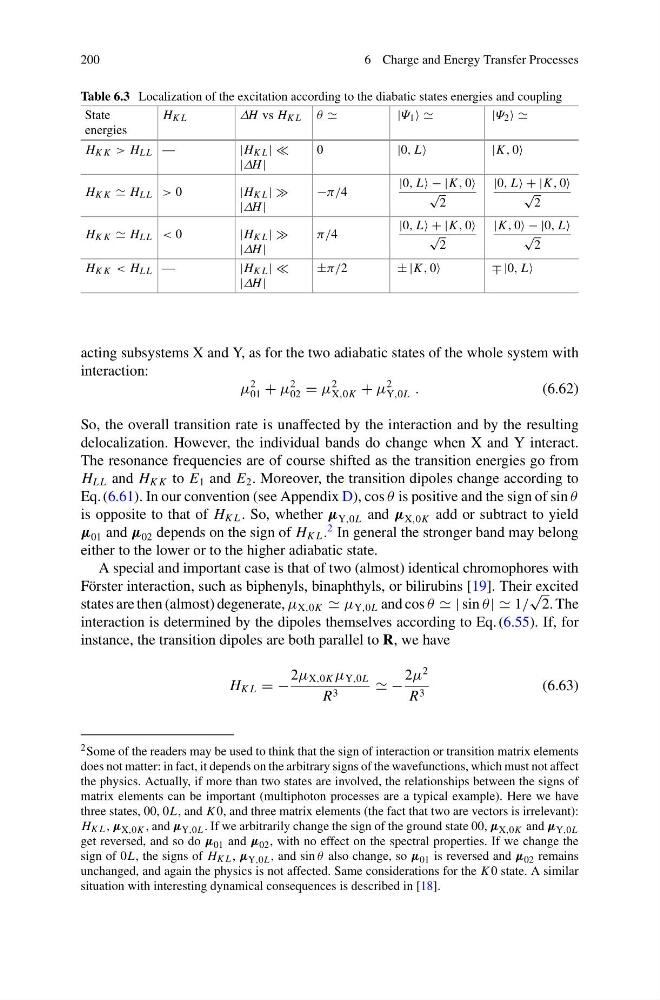
Table 6.3 Localization of the excitation according to the diabatic states energies and coupling
State
energies
H K L
ΔH vs H K L θ
|Ψ 1
|Ψ 2
H K K > H L L —
|H K L | |
|ΔH |
0
|0, L
|K , 0
H K K H L L > 0
|H K L | |
|ΔH |
−π/4
|0, L − |K , 0
√
2
|0, L + |K , 0
√
2
H K K H L L < 0
|H K L | |
|ΔH |
π/4
|0, L + |K , 0
√
2
|K , 0 − |0, L
√
2
H K K < H L L —
|H K L | |
|ΔH |
±π/2
± |K , 0
∓ |0, L
acting subsystems X and Y, as for the two adiabatic states of the whole system with
interaction:
μ
2
01 + μ
2
02 = μ
2
X,0K + μ
2
Y,0L .
(6.62)
So, the overall transition rate is unaffected by the interaction and by the resulting
delocalization. However, the individual bands do change when X and Y interact.
The resonance frequencies are of course shifted as the transition energies go from
H L L and H K K to E 1 and E 2 . Moreover, the transition dipoles change according to
Eq. (6.61). In our convention (see Appendix D), cos θ is positive and the sign of sin θ
is opposite to that of H K L . So, whether µ Y,0L and µ X,0K add or subtract to yield
µ 01 and µ 02 depends on the sign of H K L .
2 In general the stronger band may belong
either to the lower or to the higher adiabatic state.
A special and important case is that of two (almost) identical chromophores with
Förster interaction, such as biphenyls, binaphthyls, or bilirubins [19]. Their excited
states are then (almost) degenerate, μ X,0K μ Y,0L and cos θ | sin θ | | 1/
√
2. The
interaction is determined by the dipoles themselves according to Eq. (6.55). If, for
instance, the transition dipoles are both parallel to R, we have
H K L = −
2μ X,0K μ Y,0L
R 3
−
2μ
2
R 3
(6.63)
2 Some of the readers may be used to think that the sign of interaction or transition matrix elements
does not matter: in fact, it depends on the arbitrary signs of the wavefunctions, which must not affect
the physics. Actually, if more than two states are involved, the relationships between the signs of
matrix elements can be important (multiphoton processes are a typical example). Here we have
three states, 00, 0L, and K 0, and three matrix elements (the fact that two are vectors is irrelevant):
H K L , µ X,0K , and µ Y,0L . If we arbitrarily change the sign of the ground state 00, µ X,0K and µ Y,0L
get reversed, and so do µ 01 and µ 02 , with no effect on the spectral properties. If we change the
sign of 0L, the signs of H K L , µ Y,0L , and sin θ also change, so µ 01 is reversed and µ 02 remains
unchanged, and again the physics is not affected. Same considerations for the K 0 state. A similar
situation with interesting dynamical consequences is described in [18].
6 Charge and Energy Transfer Processes
Table 6.3 Localization of the excitation according to the diabatic states energies and coupling
State
energies
H K L
ΔH vs H K L θ
|Ψ 1
|Ψ 2
H K K > H L L —
|H K L | |
|ΔH |
0
|0, L
|K , 0
H K K H L L > 0
|H K L | |
|ΔH |
−π/4
|0, L − |K , 0
√
2
|0, L + |K , 0
√
2
H K K H L L < 0
|H K L | |
|ΔH |
π/4
|0, L + |K , 0
√
2
|K , 0 − |0, L
√
2
H K K < H L L —
|H K L | |
|ΔH |
±π/2
± |K , 0
∓ |0, L
acting subsystems X and Y, as for the two adiabatic states of the whole system with
interaction:
μ
2
01 + μ
2
02 = μ
2
X,0K + μ
2
Y,0L .
(6.62)
So, the overall transition rate is unaffected by the interaction and by the resulting
delocalization. However, the individual bands do change when X and Y interact.
The resonance frequencies are of course shifted as the transition energies go from
H L L and H K K to E 1 and E 2 . Moreover, the transition dipoles change according to
Eq. (6.61). In our convention (see Appendix D), cos θ is positive and the sign of sin θ
is opposite to that of H K L . So, whether µ Y,0L and µ X,0K add or subtract to yield
µ 01 and µ 02 depends on the sign of H K L .
2 In general the stronger band may belong
either to the lower or to the higher adiabatic state.
A special and important case is that of two (almost) identical chromophores with
Förster interaction, such as biphenyls, binaphthyls, or bilirubins [19]. Their excited
states are then (almost) degenerate, μ X,0K μ Y,0L and cos θ | sin θ | | 1/
√
2. The
interaction is determined by the dipoles themselves according to Eq. (6.55). If, for
instance, the transition dipoles are both parallel to R, we have
H K L = −
2μ X,0K μ Y,0L
R 3
−
2μ
2
R 3
(6.63)
2 Some of the readers may be used to think that the sign of interaction or transition matrix elements
does not matter: in fact, it depends on the arbitrary signs of the wavefunctions, which must not affect
the physics. Actually, if more than two states are involved, the relationships between the signs of
matrix elements can be important (multiphoton processes are a typical example). Here we have
three states, 00, 0L, and K 0, and three matrix elements (the fact that two are vectors is irrelevant):
H K L , µ X,0K , and µ Y,0L . If we arbitrarily change the sign of the ground state 00, µ X,0K and µ Y,0L
get reversed, and so do µ 01 and µ 02 , with no effect on the spectral properties. If we change the
sign of 0L, the signs of H K L , µ Y,0L , and sin θ also change, so µ 01 is reversed and µ 02 remains
unchanged, and again the physics is not affected. Same considerations for the K 0 state. A similar
situation with interesting dynamical consequences is described in [18].