

6.4 Localized Excitations and Energy Transfer Mechanisms
201
where μ is the geometrical average of μ X,0K and μ Y,0L . Then, μ 01
√
2μ and
μ 02 0. This means the lower state is bright and the upper state is dark. A more
frequent situation is that both dipoles are perpendicular to R. This is the case, e.g.,
for π → π
∗ transitions in planar π systems superimposed (“stacked”) face-to-face,
such configurations being stabilized by dispersion interactions. Then
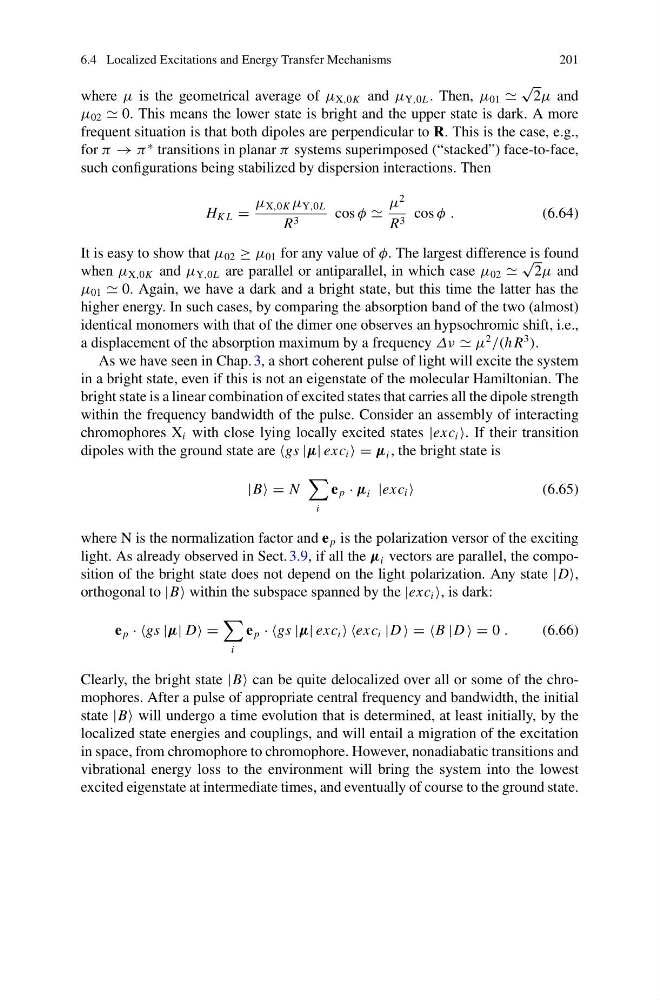
H K L =
μ X,0K μ Y,0L
R 3
cos φ
μ
2
R 3 cos φ .
(6.64)
It is easy to show that μ 02 ≥ μ 01 for any value of φ. The largest difference is found
when μ X,0K and μ Y,0L are parallel or antiparallel, in which case μ 02
√
2μ and
μ 01 0. Again, we have a dark and a bright state, but this time the latter has the
higher energy. In such cases, by comparing the absorption band of the two (almost)
identical monomers with that of the dimer one observes an hypsochromic shift, i.e.,
a displacement of the absorption maximum by a frequency Δν μ
2
/(h R
3
).
As we have seen in Chap. 3, a short coherent pulse of light will excite the system
in a bright state, even if this is not an eigenstate of the molecular Hamiltonian. The
bright state is a linear combination of excited states that carries all the dipole strength
within the frequency bandwidth of the pulse. Consider an assembly of interacting
chromophores X i with close lying locally excited states |exc i . If their transition
dipoles with the ground state are gs |µ| exc i = µ i , the bright state is
|B = N
i
e p · µ i |exc i
(6.65)
where N is the normalization factor and e p is the polarization versor of the exciting
light. As already observed in Sect. 3.9, if all the µ i vectors are parallel, the composition of the bright state does not depend on the light polarization. Any state |D,
orthogonal to |B within the subspace spanned by the |exc i , is dark:
e p · gs |µ| D =
i
e p · gs |µ| exc i exc i |D = B |D = 0 .
(6.66)
Clearly, the bright state |B can be quite delocalized over all or some of the chromophores. After a pulse of appropriate central frequency and bandwidth, the initial
state |B will undergo a time evolution that is determined, at least initially, by the
localized state energies and couplings, and will entail a migration of the excitation
in space, from chromophore to chromophore. However, nonadiabatic transitions and
vibrational energy loss to the environment will bring the system into the lowest
excited eigenstate at intermediate times, and eventually of course to the ground state.
201
where μ is the geometrical average of μ X,0K and μ Y,0L . Then, μ 01
√
2μ and
μ 02 0. This means the lower state is bright and the upper state is dark. A more
frequent situation is that both dipoles are perpendicular to R. This is the case, e.g.,
for π → π
∗ transitions in planar π systems superimposed (“stacked”) face-to-face,
such configurations being stabilized by dispersion interactions. Then
H K L =
μ X,0K μ Y,0L
R 3
cos φ
μ
2
R 3 cos φ .
(6.64)
It is easy to show that μ 02 ≥ μ 01 for any value of φ. The largest difference is found
when μ X,0K and μ Y,0L are parallel or antiparallel, in which case μ 02
√
2μ and
μ 01 0. Again, we have a dark and a bright state, but this time the latter has the
higher energy. In such cases, by comparing the absorption band of the two (almost)
identical monomers with that of the dimer one observes an hypsochromic shift, i.e.,
a displacement of the absorption maximum by a frequency Δν μ
2
/(h R
3
).
As we have seen in Chap. 3, a short coherent pulse of light will excite the system
in a bright state, even if this is not an eigenstate of the molecular Hamiltonian. The
bright state is a linear combination of excited states that carries all the dipole strength
within the frequency bandwidth of the pulse. Consider an assembly of interacting
chromophores X i with close lying locally excited states |exc i . If their transition
dipoles with the ground state are gs |µ| exc i = µ i , the bright state is
|B = N
i
e p · µ i |exc i
(6.65)
where N is the normalization factor and e p is the polarization versor of the exciting
light. As already observed in Sect. 3.9, if all the µ i vectors are parallel, the composition of the bright state does not depend on the light polarization. Any state |D,
orthogonal to |B within the subspace spanned by the |exc i , is dark:
e p · gs |µ| D =
i
e p · gs |µ| exc i exc i |D = B |D = 0 .
(6.66)
Clearly, the bright state |B can be quite delocalized over all or some of the chromophores. After a pulse of appropriate central frequency and bandwidth, the initial
state |B will undergo a time evolution that is determined, at least initially, by the
localized state energies and couplings, and will entail a migration of the excitation
in space, from chromophore to chromophore. However, nonadiabatic transitions and
vibrational energy loss to the environment will bring the system into the lowest
excited eigenstate at intermediate times, and eventually of course to the ground state.