

192
6 Charge and Energy Transfer Processes
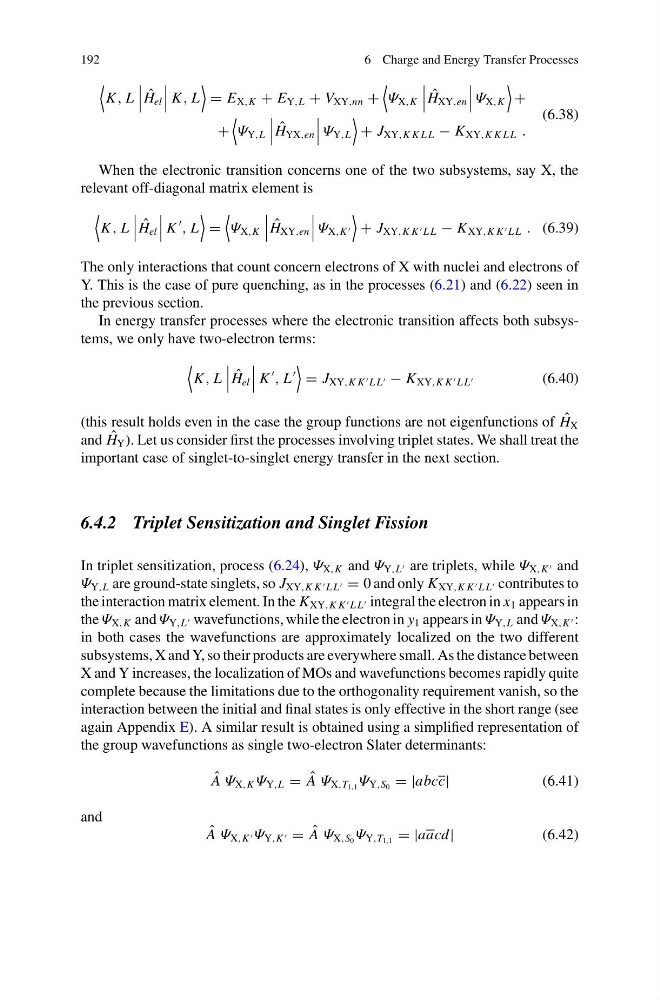
K , L
ˆ
H el
K , L
= E X,K + E Y,L + V XY,nn +
Ψ X,K
ˆ
H XY,en
Ψ X,K
+
+
Ψ Y,L
ˆ
H YX,en
Ψ Y,L
+ J XY,K K L L − K XY,K K L L .
(6.38)
When the electronic transition concerns one of the two subsystems, say X, the
relevant off-diagonal matrix element is
K , L
ˆ
H el
K
, L
=
Ψ X,K
ˆ
H XY,en
Ψ X,K
+ J XY,K K L L − K XY,K K L L . (6.39)
The only interactions that count concern electrons of X with nuclei and electrons of
Y. This is the case of pure quenching, as in the processes (6.21) and (6.22) seen in
the previous section.
In energy transfer processes where the electronic transition affects both subsystems, we only have two-electron terms:
K , L
ˆ
H el
K
, L
= J XY,K K L L − K XY,K K L L
(6.40)
(this result holds even in the case the group functions are not eigenfunctions of ˆ
H X
and ˆ
H Y ). Let us consider first the processes involving triplet states. We shall treat the
important case of singlet-to-singlet energy transfer in the next section.
6.4.2 Triplet Sensitization and Singlet Fission
In triplet sensitization, process (6.24), Ψ X,K and Ψ Y,L are triplets, while Ψ X,K and
Ψ Y,L are ground-state singlets, so J XY,K K L L = 0 and only K XY,K K L L contributes to
the interaction matrix element. In the K XY,K K L L integral the electron in x 1 appears in
the Ψ X,K and Ψ Y,L wavefunctions, while the electron in y 1 appears in Ψ Y,L and Ψ X,K :
in both cases the wavefunctions are approximately localized on the two different
subsystems, X and Y, so their products are everywhere small. As the distance between
X and Y increases, the localization of MOs and wavefunctions becomes rapidly quite
complete because the limitations due to the orthogonality requirement vanish, so the
interaction between the initial and final states is only effective in the short range (see
again Appendix E). A similar result is obtained using a simplified representation of
the group wavefunctions as single two-electron Slater determinants:
ˆ
A Ψ X,K Ψ Y,L = ˆ
A Ψ X,T 1,1 Ψ Y,S 0 = |abcc|
(6.41)
and
ˆ
A Ψ X,K Ψ Y,K = ˆ
A Ψ X,S 0 Ψ Y,T 1,1 = |aacd|
(6.42)
6 Charge and Energy Transfer Processes
K , L
ˆ
H el
K , L
= E X,K + E Y,L + V XY,nn +
Ψ X,K
ˆ
H XY,en
Ψ X,K
+
+
Ψ Y,L
ˆ
H YX,en
Ψ Y,L
+ J XY,K K L L − K XY,K K L L .
(6.38)
When the electronic transition concerns one of the two subsystems, say X, the
relevant off-diagonal matrix element is
K , L
ˆ
H el
K
, L
=
Ψ X,K
ˆ
H XY,en
Ψ X,K
+ J XY,K K L L − K XY,K K L L . (6.39)
The only interactions that count concern electrons of X with nuclei and electrons of
Y. This is the case of pure quenching, as in the processes (6.21) and (6.22) seen in
the previous section.
In energy transfer processes where the electronic transition affects both subsystems, we only have two-electron terms:
K , L
ˆ
H el
K
, L
= J XY,K K L L − K XY,K K L L
(6.40)
(this result holds even in the case the group functions are not eigenfunctions of ˆ
H X
and ˆ
H Y ). Let us consider first the processes involving triplet states. We shall treat the
important case of singlet-to-singlet energy transfer in the next section.
6.4.2 Triplet Sensitization and Singlet Fission
In triplet sensitization, process (6.24), Ψ X,K and Ψ Y,L are triplets, while Ψ X,K and
Ψ Y,L are ground-state singlets, so J XY,K K L L = 0 and only K XY,K K L L contributes to
the interaction matrix element. In the K XY,K K L L integral the electron in x 1 appears in
the Ψ X,K and Ψ Y,L wavefunctions, while the electron in y 1 appears in Ψ Y,L and Ψ X,K :
in both cases the wavefunctions are approximately localized on the two different
subsystems, X and Y, so their products are everywhere small. As the distance between
X and Y increases, the localization of MOs and wavefunctions becomes rapidly quite
complete because the limitations due to the orthogonality requirement vanish, so the
interaction between the initial and final states is only effective in the short range (see
again Appendix E). A similar result is obtained using a simplified representation of
the group wavefunctions as single two-electron Slater determinants:
ˆ
A Ψ X,K Ψ Y,L = ˆ
A Ψ X,T 1,1 Ψ Y,S 0 = |abcc|
(6.41)
and
ˆ
A Ψ X,K Ψ Y,K = ˆ
A Ψ X,S 0 Ψ Y,T 1,1 = |aacd|
(6.42)