

6.4 Localized Excitations and Energy Transfer Mechanisms
191
ˆ
H X and ˆ
H Y are the electronic Hamiltonians of X and Y, respectively, including
the respective nuclear repulsion terms. If α and β number the nuclei of X and Y,
respectively:
V XY,nn =
α∈X
β∈Y
Z α Z β
r αβ
(6.32)
ˆ
H XY,en = −
n X
i=1
β∈Y
Z β
r βi
(6.33)
ˆ
H YX,en = −
n Y
j=1
α∈X
Z α
r α j
(6.34)
ˆ
H XY,ee =
n X
i=1
n Y
j=1
1
r i j
(6.35)
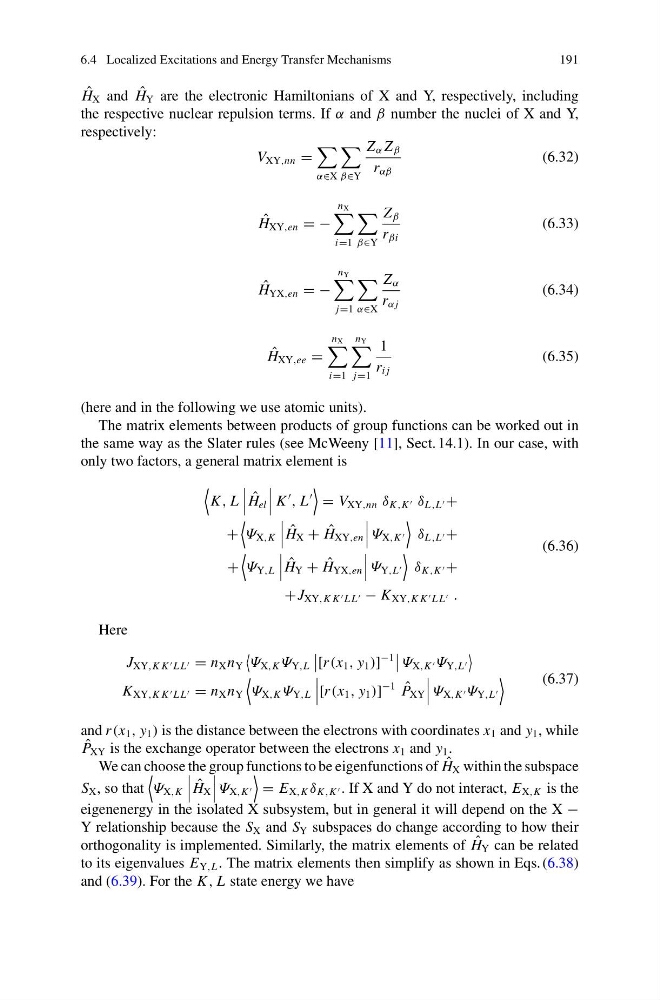
(here and in the following we use atomic units).
The matrix elements between products of group functions can be worked out in
the same way as the Slater rules (see McWeeny [11], Sect. 14.1). In our case, with
only two factors, a general matrix element is
K , L
ˆ
H el
K
, L
= V XY,nn δ K ,K δ L ,L +
+
Ψ X,K
ˆ
H X + ˆ
H XY,en
Ψ X,K
δ L ,L +
+
Ψ Y,L
ˆ
H Y + ˆ
H YX,en
Ψ Y,L
δ K ,K +
+J XY,K K L L − K XY,K K L L .
(6.36)
Here
J XY,K K L L = n X n Y
Ψ X,K Ψ Y,L
[r (x 1 , y 1 )]
−1
Ψ X,K Ψ Y,L
K XY,K K L L = n X n Y
Ψ X,K Ψ Y,L
[r (x 1 , y 1 )]
−1 ˆ
P XY
Ψ X,K Ψ Y,L
(6.37)
and r (x 1 , y 1 ) is the distance between the electrons with coordinates x 1 and y 1 , while
ˆ
P XY is the exchange operator between the electrons x 1 and y 1 .
We can choose the group functions to be eigenfunctions of ˆ
H X within the subspace
S X , so that
Ψ X,K
ˆ
H X
Ψ X,K
= E X,K δ K ,K . If X and Y do not interact, E X,K is the
eigenenergy in the isolated X subsystem, but in general it will depend on the X −
Y relationship because the S X and S Y subspaces do change according to how their
orthogonality is implemented. Similarly, the matrix elements of ˆ
H Y can be related
to its eigenvalues E Y,L . The matrix elements then simplify as shown in Eqs. (6.38)
and (6.39). For the K , L state energy we have
191
ˆ
H X and ˆ
H Y are the electronic Hamiltonians of X and Y, respectively, including
the respective nuclear repulsion terms. If α and β number the nuclei of X and Y,
respectively:
V XY,nn =
α∈X
β∈Y
Z α Z β
r αβ
(6.32)
ˆ
H XY,en = −
n X
i=1
β∈Y
Z β
r βi
(6.33)
ˆ
H YX,en = −
n Y
j=1
α∈X
Z α
r α j
(6.34)
ˆ
H XY,ee =
n X
i=1
n Y
j=1
1
r i j
(6.35)
(here and in the following we use atomic units).
The matrix elements between products of group functions can be worked out in
the same way as the Slater rules (see McWeeny [11], Sect. 14.1). In our case, with
only two factors, a general matrix element is
K , L
ˆ
H el
K
, L
= V XY,nn δ K ,K δ L ,L +
+
Ψ X,K
ˆ
H X + ˆ
H XY,en
Ψ X,K
δ L ,L +
+
Ψ Y,L
ˆ
H Y + ˆ
H YX,en
Ψ Y,L
δ K ,K +
+J XY,K K L L − K XY,K K L L .
(6.36)
Here
J XY,K K L L = n X n Y
Ψ X,K Ψ Y,L
[r (x 1 , y 1 )]
−1
Ψ X,K Ψ Y,L
K XY,K K L L = n X n Y
Ψ X,K Ψ Y,L
[r (x 1 , y 1 )]
−1 ˆ
P XY
Ψ X,K Ψ Y,L
(6.37)
and r (x 1 , y 1 ) is the distance between the electrons with coordinates x 1 and y 1 , while
ˆ
P XY is the exchange operator between the electrons x 1 and y 1 .
We can choose the group functions to be eigenfunctions of ˆ
H X within the subspace
S X , so that
Ψ X,K
ˆ
H X
Ψ X,K
= E X,K δ K ,K . If X and Y do not interact, E X,K is the
eigenenergy in the isolated X subsystem, but in general it will depend on the X −
Y relationship because the S X and S Y subspaces do change according to how their
orthogonality is implemented. Similarly, the matrix elements of ˆ
H Y can be related
to its eigenvalues E Y,L . The matrix elements then simplify as shown in Eqs. (6.38)
and (6.39). For the K , L state energy we have