

6.4 Localized Excitations and Energy Transfer Mechanisms
193
+
d
c
Y, T 1 (M S = 0)
b
a
X, S 0
d
c
Y, S 0
+
b
a
X, T 1 (M S = 0)
d
c
Y, T 1 (M S = 1)
b
a
X, S 0
d
c
Y, S 0
b
a
X, T 1 (M S = 1)
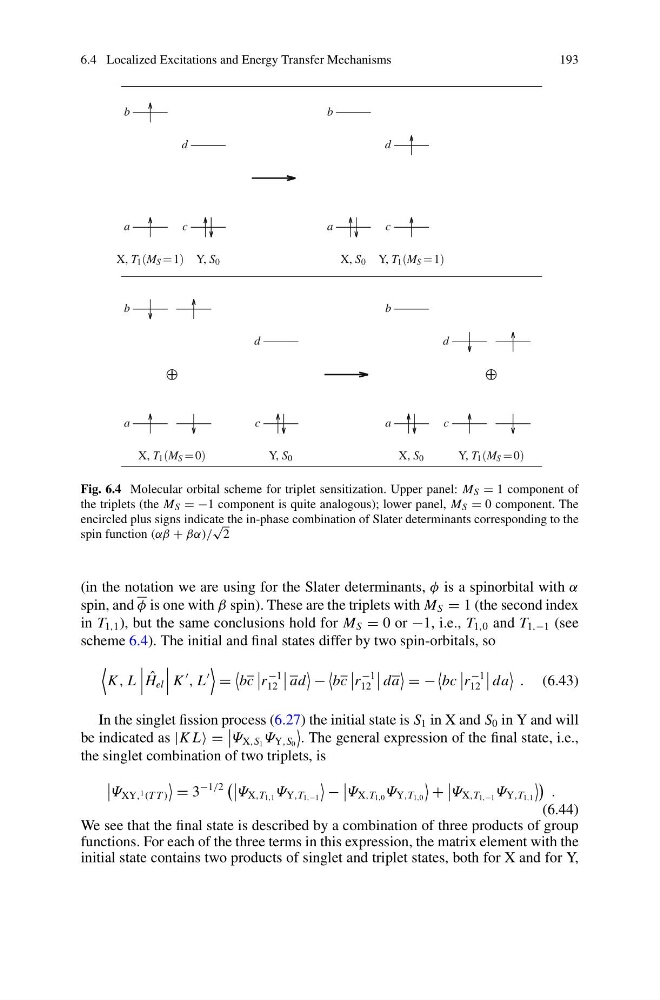
Fig. 6.4 Molecular orbital scheme for triplet sensitization. Upper panel: M S = 1 component of
the triplets (the M S = −1 component is quite analogous); lower panel, M S = 0 component. The
encircled plus signs indicate the in-phase combination of Slater determinants corresponding to the
spin function (αβ + βα)/
√
2
(in the notation we are using for the Slater determinants, φ is a spinorbital with α
spin, and φ is one with β spin). These are the triplets with M S = 1 (the second index
in T 1,1 ), but the same conclusions hold for M S = 0 or −1, i.e., T 1,0 and T 1,−1 (see
scheme 6.4). The initial and final states differ by two spin-orbitals, so
K , L
ˆ
H el
K
, L
=
bc
r
−1
12
ad
−
bc
r
−1
12
da
= −
bc
r
−1
12
da
. (6.43)
In the singlet fission process (6.27) the initial state is S 1 in X and S 0 in Y and will
be indicated as |K L =
Ψ X,S 1 Ψ Y,S 0
. The general expression of the final state, i.e.,
the singlet combination of two triplets, is
Ψ XY, 1 (T T )
= 3
−1/2
Ψ X,T 1,1 Ψ Y,T 1,−1
−
Ψ X,T 1,0 Ψ Y,T 1,0
+
Ψ X,T 1,−1 Ψ Y,T 1,1
.
(6.44)
We see that the final state is described by a combination of three products of group
functions. For each of the three terms in this expression, the matrix element with the
initial state contains two products of singlet and triplet states, both for X and for Y,
193
+
d
c
Y, T 1 (M S = 0)
b
a
X, S 0
d
c
Y, S 0
+
b
a
X, T 1 (M S = 0)
d
c
Y, T 1 (M S = 1)
b
a
X, S 0
d
c
Y, S 0
b
a
X, T 1 (M S = 1)
Fig. 6.4 Molecular orbital scheme for triplet sensitization. Upper panel: M S = 1 component of
the triplets (the M S = −1 component is quite analogous); lower panel, M S = 0 component. The
encircled plus signs indicate the in-phase combination of Slater determinants corresponding to the
spin function (αβ + βα)/
√
2
(in the notation we are using for the Slater determinants, φ is a spinorbital with α
spin, and φ is one with β spin). These are the triplets with M S = 1 (the second index
in T 1,1 ), but the same conclusions hold for M S = 0 or −1, i.e., T 1,0 and T 1,−1 (see
scheme 6.4). The initial and final states differ by two spin-orbitals, so
K , L
ˆ
H el
K
, L
=
bc
r
−1
12
ad
−
bc
r
−1
12
da
= −
bc
r
−1
12
da
. (6.43)
In the singlet fission process (6.27) the initial state is S 1 in X and S 0 in Y and will
be indicated as |K L =
Ψ X,S 1 Ψ Y,S 0
. The general expression of the final state, i.e.,
the singlet combination of two triplets, is
Ψ XY, 1 (T T )
= 3
−1/2
Ψ X,T 1,1 Ψ Y,T 1,−1
−
Ψ X,T 1,0 Ψ Y,T 1,0
+
Ψ X,T 1,−1 Ψ Y,T 1,1
.
(6.44)
We see that the final state is described by a combination of three products of group
functions. For each of the three terms in this expression, the matrix element with the
initial state contains two products of singlet and triplet states, both for X and for Y,