

174
5 Fast Nonadiabatic Dynamics
In fact, the nuclei are expected to follow the (uniquely determined) adiabatic PESs
rather than the diabatic ones, at least far from strong interaction regions (curve or
surface crossings). Moreover, it is evident that the picture of sudden hops is physically
sound only if the interaction between electronic states is highly localized in space, as
is the case for the adiabatic representation (see Fig. 5.1). Otherwise, the mean-field
approach would be better suited.
One of the most serious drawbacks in mixed quantum–classical methods like
surface hopping or mean-field is the lack of “quantum decoherence”. Let us consider
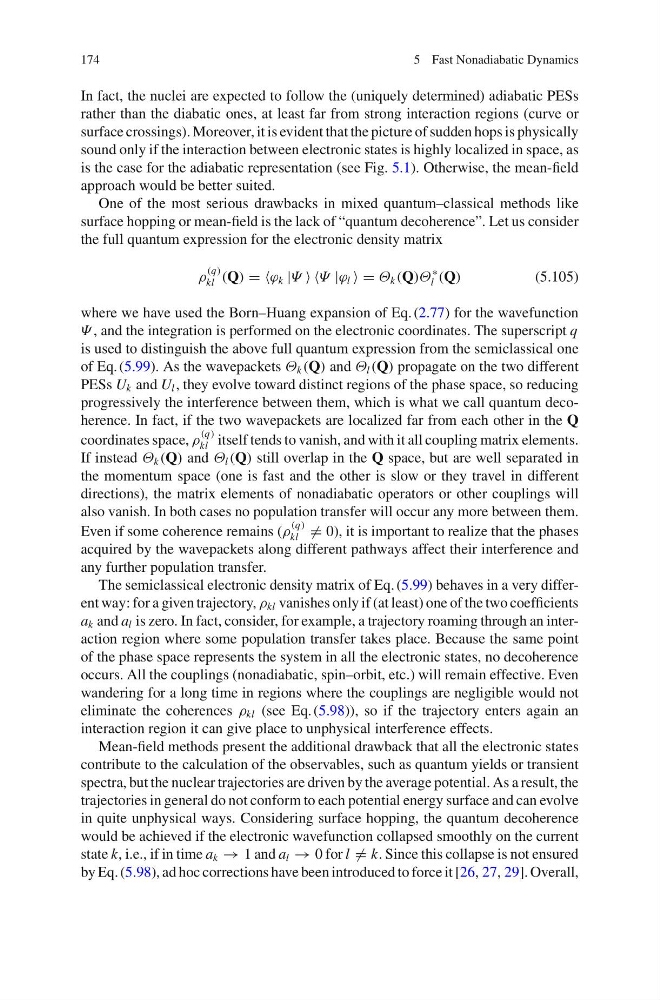
the full quantum expression for the electronic density matrix
ρ
(q)
kl (Q) = ϕ k |Ψ Ψ |ϕ l = Θ k (Q)Θ
∗
l (Q)
(5.105)
where we have used the Born–Huang expansion of Eq. (2.77) for the wavefunction
Ψ , and the integration is performed on the electronic coordinates. The superscript q
is used to distinguish the above full quantum expression from the semiclassical one
of Eq. (5.99). As the wavepackets Θ k (Q) and Θ l (Q) propagate on the two different
PESs U k and U l , they evolve toward distinct regions of the phase space, so reducing
progressively the interference between them, which is what we call quantum decoherence. In fact, if the two wavepackets are localized far from each other in the Q
coordinates space, ρ
(q)
kl itself tends to vanish, and with it all coupling matrix elements.
If instead Θ k (Q) and Θ l (Q) still overlap in the Q space, but are well separated in
the momentum space (one is fast and the other is slow or they travel in different
directions), the matrix elements of nonadiabatic operators or other couplings will
also vanish. In both cases no population transfer will occur any more between them.
Even if some coherence remains (ρ
(q)
kl = 0), it is important to realize that the phases
acquired by the wavepackets along different pathways affect their interference and
any further population transfer.
The semiclassical electronic density matrix of Eq. (5.99) behaves in a very different way: for a given trajectory, ρ kl vanishes only if (at least) one of the two coefficients
a k and a l is zero. In fact, consider, for example, a trajectory roaming through an interaction region where some population transfer takes place. Because the same point
of the phase space represents the system in all the electronic states, no decoherence
occurs. All the couplings (nonadiabatic, spin–orbit, etc.) will remain effective. Even
wandering for a long time in regions where the couplings are negligible would not
eliminate the coherences ρ kl (see Eq. (5.98)), so if the trajectory enters again an
interaction region it can give place to unphysical interference effects.
Mean-field methods present the additional drawback that all the electronic states
contribute to the calculation of the observables, such as quantum yields or transient
spectra, but the nuclear trajectories are driven by the average potential. As a result, the
trajectories in general do not conform to each potential energy surface and can evolve
in quite unphysical ways. Considering surface hopping, the quantum decoherence
would be achieved if the electronic wavefunction collapsed smoothly on the current
state k, i.e., if in time a k → 1 and a l → 0 for l = k. Since this collapse is not ensured
by Eq. (5.98), ad hoc corrections have been introduced to force it [26, 27, 29]. Overall,
5 Fast Nonadiabatic Dynamics
In fact, the nuclei are expected to follow the (uniquely determined) adiabatic PESs
rather than the diabatic ones, at least far from strong interaction regions (curve or
surface crossings). Moreover, it is evident that the picture of sudden hops is physically
sound only if the interaction between electronic states is highly localized in space, as
is the case for the adiabatic representation (see Fig. 5.1). Otherwise, the mean-field
approach would be better suited.
One of the most serious drawbacks in mixed quantum–classical methods like
surface hopping or mean-field is the lack of “quantum decoherence”. Let us consider
the full quantum expression for the electronic density matrix
ρ
(q)
kl (Q) = ϕ k |Ψ Ψ |ϕ l = Θ k (Q)Θ
∗
l (Q)
(5.105)
where we have used the Born–Huang expansion of Eq. (2.77) for the wavefunction
Ψ , and the integration is performed on the electronic coordinates. The superscript q
is used to distinguish the above full quantum expression from the semiclassical one
of Eq. (5.99). As the wavepackets Θ k (Q) and Θ l (Q) propagate on the two different
PESs U k and U l , they evolve toward distinct regions of the phase space, so reducing
progressively the interference between them, which is what we call quantum decoherence. In fact, if the two wavepackets are localized far from each other in the Q
coordinates space, ρ
(q)
kl itself tends to vanish, and with it all coupling matrix elements.
If instead Θ k (Q) and Θ l (Q) still overlap in the Q space, but are well separated in
the momentum space (one is fast and the other is slow or they travel in different
directions), the matrix elements of nonadiabatic operators or other couplings will
also vanish. In both cases no population transfer will occur any more between them.
Even if some coherence remains (ρ
(q)
kl = 0), it is important to realize that the phases
acquired by the wavepackets along different pathways affect their interference and
any further population transfer.
The semiclassical electronic density matrix of Eq. (5.99) behaves in a very different way: for a given trajectory, ρ kl vanishes only if (at least) one of the two coefficients
a k and a l is zero. In fact, consider, for example, a trajectory roaming through an interaction region where some population transfer takes place. Because the same point
of the phase space represents the system in all the electronic states, no decoherence
occurs. All the couplings (nonadiabatic, spin–orbit, etc.) will remain effective. Even
wandering for a long time in regions where the couplings are negligible would not
eliminate the coherences ρ kl (see Eq. (5.98)), so if the trajectory enters again an
interaction region it can give place to unphysical interference effects.
Mean-field methods present the additional drawback that all the electronic states
contribute to the calculation of the observables, such as quantum yields or transient
spectra, but the nuclear trajectories are driven by the average potential. As a result, the
trajectories in general do not conform to each potential energy surface and can evolve
in quite unphysical ways. Considering surface hopping, the quantum decoherence
would be achieved if the electronic wavefunction collapsed smoothly on the current
state k, i.e., if in time a k → 1 and a l → 0 for l = k. Since this collapse is not ensured
by Eq. (5.98), ad hoc corrections have been introduced to force it [26, 27, 29]. Overall,