

5.5 Computational Note: Methods for Nonadiabatic Dynamics
175
apart from cases where interference or tunneling effects play a major role, usually the
surface hopping method (with corrections for decoherence) describes correctly the
ultrafast nonadiabatic dynamics of molecular systems. Slower processes are more
difficult to reproduce because of other drawbacks, in part analyzed in Chap. 4.
Problems
5.1 Consider the ionic/neutral avoided crossing in NaCl (see Fig. 5.1). Evaluate,
considering Na and Cl atoms at room temperature (T = 300 K), the probability
P adia to stay on the neutral state when the avoided crossing is gone through, using
the Landau–Zener formula. Use the data given in Sect. 5.1 for H 12 and F.
5.2 Consider a collision between the two ions Na
+ and Cl
− . Evaluate the probability
to have, after the collision, Na
+ and Cl
− . As in the previous problem, use the data
given in Sect. 5.1 and neglect any thermal contribution to the kinetic energy in
evaluating the nuclear velocity. Note that in a collision the molecule goes twice
through the avoided crossing region.
5.3 Find the transformation of the two diabatic states |η 1 and |η 2 which makes
orthogonal the vectors q and h of Eq. (5.36). Consider a real Hamiltonian.
5.4 For a system with only two electronic states, express the second derivative
couplings t
(α)
i j (i, j = 1, 2) as functions of g
(α)
12 , assuming the adiabatic functions ϕ 1
and ϕ 2 to be real-valued. Use this result to find an explicit expression for t 12 (i)
for the Landau–Zener model and (ii) close to a conical intersection (use Eq. (5.42),
considering only the two coordinates x and y, and assuming q = h). In the latter case,
which kind of singularity have at the conical intersection U 1 and the “corrected” PES
U
1 of equation (2.65)?
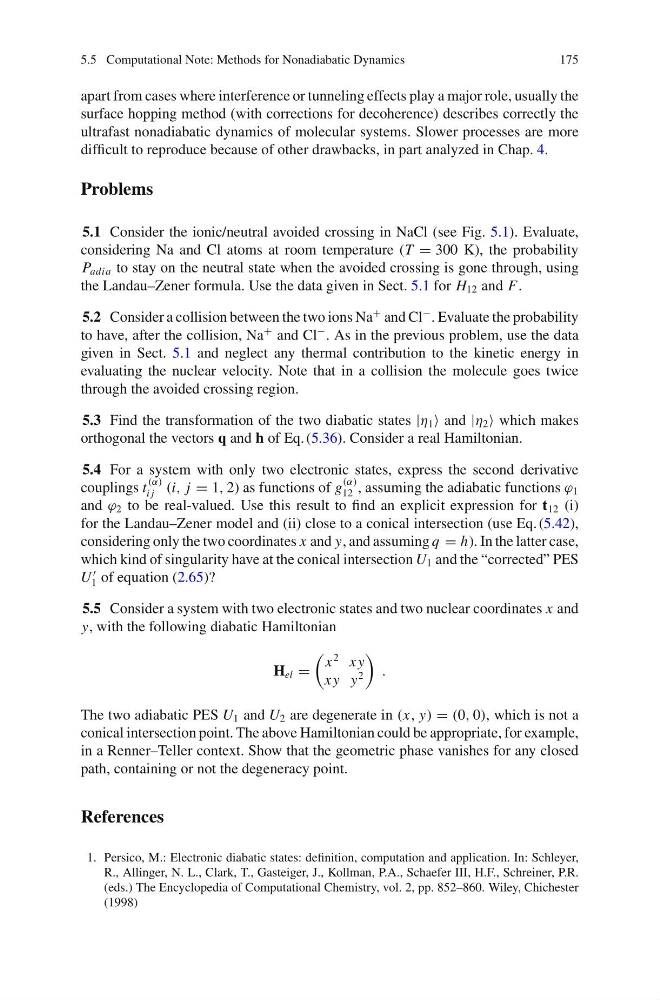
5.5 Consider a system with two electronic states and two nuclear coordinates x and
y, with the following diabatic Hamiltonian
H el =
x
2 x y
x y y
2
.
The two adiabatic PES U 1 and U 2 are degenerate in (x, y) = (0, 0), which is not a
conical intersection point. The above Hamiltonian could be appropriate, for example,
in a Renner–Teller context. Show that the geometric phase vanishes for any closed
path, containing or not the degeneracy point.
References
1. Persico, M.: Electronic diabatic states: definition, computation and application. In: Schleyer,
R., Allinger, N. L., Clark, T., Gasteiger, J., Kollman, P.A., Schaefer III, H.F., Schreiner, P.R.
(eds.) The Encyclopedia of Computational Chemistry, vol. 2, pp. 852–860. Wiley, Chichester
(1998)
175
apart from cases where interference or tunneling effects play a major role, usually the
surface hopping method (with corrections for decoherence) describes correctly the
ultrafast nonadiabatic dynamics of molecular systems. Slower processes are more
difficult to reproduce because of other drawbacks, in part analyzed in Chap. 4.
Problems
5.1 Consider the ionic/neutral avoided crossing in NaCl (see Fig. 5.1). Evaluate,
considering Na and Cl atoms at room temperature (T = 300 K), the probability
P adia to stay on the neutral state when the avoided crossing is gone through, using
the Landau–Zener formula. Use the data given in Sect. 5.1 for H 12 and F.
5.2 Consider a collision between the two ions Na
+ and Cl
− . Evaluate the probability
to have, after the collision, Na
+ and Cl
− . As in the previous problem, use the data
given in Sect. 5.1 and neglect any thermal contribution to the kinetic energy in
evaluating the nuclear velocity. Note that in a collision the molecule goes twice
through the avoided crossing region.
5.3 Find the transformation of the two diabatic states |η 1 and |η 2 which makes
orthogonal the vectors q and h of Eq. (5.36). Consider a real Hamiltonian.
5.4 For a system with only two electronic states, express the second derivative
couplings t
(α)
i j (i, j = 1, 2) as functions of g
(α)
12 , assuming the adiabatic functions ϕ 1
and ϕ 2 to be real-valued. Use this result to find an explicit expression for t 12 (i)
for the Landau–Zener model and (ii) close to a conical intersection (use Eq. (5.42),
considering only the two coordinates x and y, and assuming q = h). In the latter case,
which kind of singularity have at the conical intersection U 1 and the “corrected” PES
U
1 of equation (2.65)?
5.5 Consider a system with two electronic states and two nuclear coordinates x and
y, with the following diabatic Hamiltonian
H el =
x
2 x y
x y y
2
.
The two adiabatic PES U 1 and U 2 are degenerate in (x, y) = (0, 0), which is not a
conical intersection point. The above Hamiltonian could be appropriate, for example,
in a Renner–Teller context. Show that the geometric phase vanishes for any closed
path, containing or not the degeneracy point.
References
1. Persico, M.: Electronic diabatic states: definition, computation and application. In: Schleyer,
R., Allinger, N. L., Clark, T., Gasteiger, J., Kollman, P.A., Schaefer III, H.F., Schreiner, P.R.
(eds.) The Encyclopedia of Computational Chemistry, vol. 2, pp. 852–860. Wiley, Chichester
(1998)