

172
5 Fast Nonadiabatic Dynamics
5.5.2 Nonadiabatic Classical Trajectories
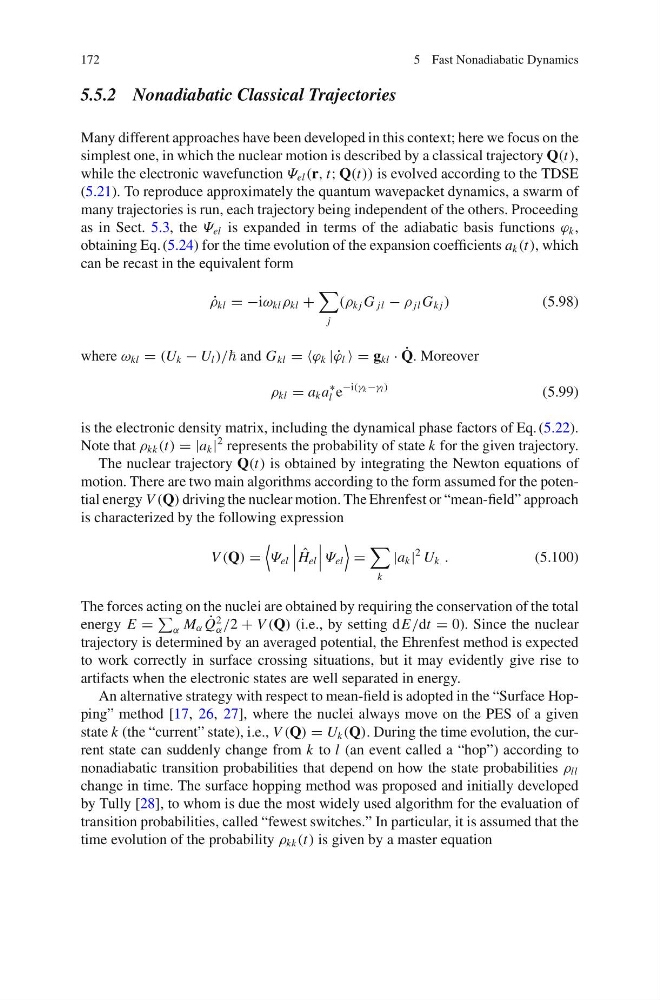
Many different approaches have been developed in this context; here we focus on the
simplest one, in which the nuclear motion is described by a classical trajectory Q(t),
while the electronic wavefunction Ψ el (r, t; Q(t)) is evolved according to the TDSE
(5.21). To reproduce approximately the quantum wavepacket dynamics, a swarm of
many trajectories is run, each trajectory being independent of the others. Proceeding
as in Sect. 5.3, the Ψ el is expanded in terms of the adiabatic basis functions ϕ k ,
obtaining Eq. (5.24) for the time evolution of the expansion coefficients a k (t), which
can be recast in the equivalent form
˙
ρ kl = −iω kl ρ kl +
j
(ρ k j G jl − ρ jl G k j )
(5.98)
where ω kl = (U k − U l )/ and G kl = ϕ k | ˙
ϕ l = g kl · ˙
Q. Moreover
ρ kl = a k a
∗
l e
−i(γ k −γ l )
(5.99)
is the electronic density matrix, including the dynamical phase factors of Eq. (5.22).
Note that ρ kk (t) = |a k |
2 represents the probability of state k for the given trajectory.
The nuclear trajectory Q(t) is obtained by integrating the Newton equations of
motion. There are two main algorithms according to the form assumed for the potential energy V (Q) driving the nuclear motion. The Ehrenfest or “mean-field” approach
is characterized by the following expression
V (Q) =
Ψ el
ˆ
H el
Ψ el
=
k
|a k |
2 U k .
(5.100)
The forces acting on the nuclei are obtained by requiring the conservation of the total
energy E =
α M α ˙
Q
2
α /2 + V (Q) (i.e., by setting dE/dt = 0). Since the nuclear
trajectory is determined by an averaged potential, the Ehrenfest method is expected
to work correctly in surface crossing situations, but it may evidently give rise to
artifacts when the electronic states are well separated in energy.
An alternative strategy with respect to mean-field is adopted in the “Surface Hopping” method [17, 26, 27], where the nuclei always move on the PES of a given
state k (the “current” state), i.e., V (Q) = U k (Q). During the time evolution, the current state can suddenly change from k to l (an event called a “hop”) according to
nonadiabatic transition probabilities that depend on how the state probabilities ρ ll
change in time. The surface hopping method was proposed and initially developed
by Tully [28], to whom is due the most widely used algorithm for the evaluation of
transition probabilities, called “fewest switches.” In particular, it is assumed that the
time evolution of the probability ρ kk (t) is given by a master equation
5 Fast Nonadiabatic Dynamics
5.5.2 Nonadiabatic Classical Trajectories
Many different approaches have been developed in this context; here we focus on the
simplest one, in which the nuclear motion is described by a classical trajectory Q(t),
while the electronic wavefunction Ψ el (r, t; Q(t)) is evolved according to the TDSE
(5.21). To reproduce approximately the quantum wavepacket dynamics, a swarm of
many trajectories is run, each trajectory being independent of the others. Proceeding
as in Sect. 5.3, the Ψ el is expanded in terms of the adiabatic basis functions ϕ k ,
obtaining Eq. (5.24) for the time evolution of the expansion coefficients a k (t), which
can be recast in the equivalent form
˙
ρ kl = −iω kl ρ kl +
j
(ρ k j G jl − ρ jl G k j )
(5.98)
where ω kl = (U k − U l )/ and G kl = ϕ k | ˙
ϕ l = g kl · ˙
Q. Moreover
ρ kl = a k a
∗
l e
−i(γ k −γ l )
(5.99)
is the electronic density matrix, including the dynamical phase factors of Eq. (5.22).
Note that ρ kk (t) = |a k |
2 represents the probability of state k for the given trajectory.
The nuclear trajectory Q(t) is obtained by integrating the Newton equations of
motion. There are two main algorithms according to the form assumed for the potential energy V (Q) driving the nuclear motion. The Ehrenfest or “mean-field” approach
is characterized by the following expression
V (Q) =
Ψ el
ˆ
H el
Ψ el
=
k
|a k |
2 U k .
(5.100)
The forces acting on the nuclei are obtained by requiring the conservation of the total
energy E =
α M α ˙
Q
2
α /2 + V (Q) (i.e., by setting dE/dt = 0). Since the nuclear
trajectory is determined by an averaged potential, the Ehrenfest method is expected
to work correctly in surface crossing situations, but it may evidently give rise to
artifacts when the electronic states are well separated in energy.
An alternative strategy with respect to mean-field is adopted in the “Surface Hopping” method [17, 26, 27], where the nuclei always move on the PES of a given
state k (the “current” state), i.e., V (Q) = U k (Q). During the time evolution, the current state can suddenly change from k to l (an event called a “hop”) according to
nonadiabatic transition probabilities that depend on how the state probabilities ρ ll
change in time. The surface hopping method was proposed and initially developed
by Tully [28], to whom is due the most widely used algorithm for the evaluation of
transition probabilities, called “fewest switches.” In particular, it is assumed that the
time evolution of the probability ρ kk (t) is given by a master equation