

164
5 Fast Nonadiabatic Dynamics
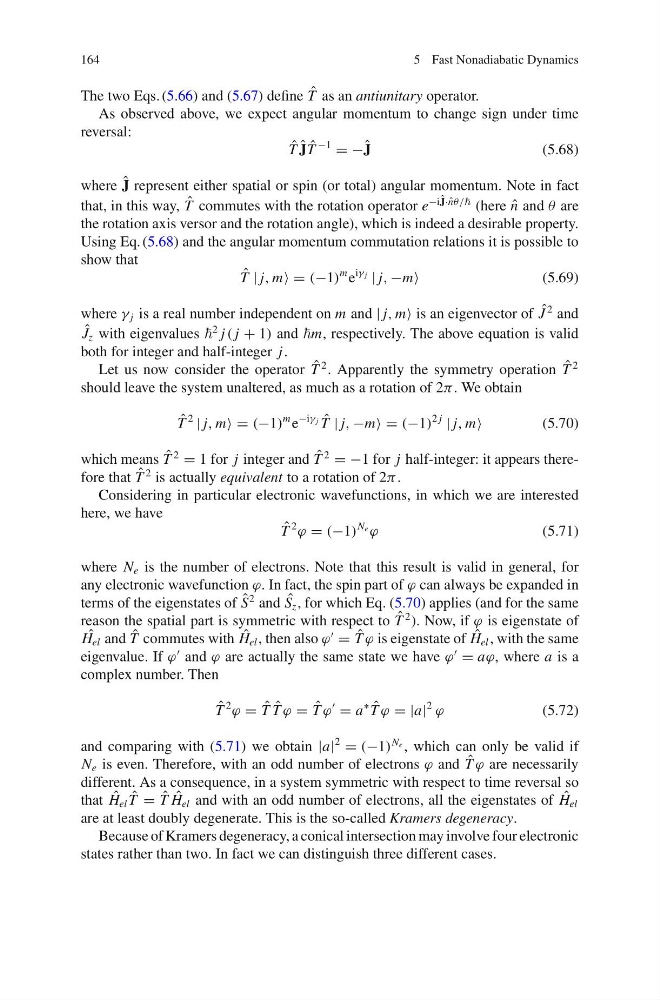
The two Eqs. (5.66) and (5.67) define ˆ
T as an antiunitary operator.
As observed above, we expect angular momentum to change sign under time
reversal:
ˆ
T ˆ
J ˆ
T
−1
= − ˆ
J
(5.68)
where ˆ
J represent either spatial or spin (or total) angular momentum. Note in fact
that, in this way, ˆ
T commutes with the rotation operator e
−i ˆ
J· ˆ
nθ/ (here ˆ
n and θ are
the rotation axis versor and the rotation angle), which is indeed a desirable property.
Using Eq. (5.68) and the angular momentum commutation relations it is possible to
show that
ˆ
T | j, m = (−1)
m e
iγ j | j, −m
(5.69)
where γ j is a real number independent on m and | j, m is an eigenvector of ˆ
J
2 and
ˆ
J z with eigenvalues
2 j ( j + 1) and m, respectively. The above equation is valid
both for integer and half-integer j.
Let us now consider the operator ˆ
T
2 . Apparently the symmetry operation ˆ
T
2
should leave the system unaltered, as much as a rotation of 2π . We obtain
ˆ
T
2
| j, m = (−1)
m e
−iγ j ˆ
T | j, −m = (−1)
2 j
| j, m
(5.70)
which means ˆ
T
2
= 1 for j integer and ˆ
T
2
= −1 for j half-integer: it appears therefore that ˆ
T
2 is actually equivalent to a rotation of 2π .
Considering in particular electronic wavefunctions, in which we are interested
here, we have
ˆ
T
2
ϕ = (−1)
N e ϕ
(5.71)
where N e is the number of electrons. Note that this result is valid in general, for
any electronic wavefunction ϕ. In fact, the spin part of ϕ can always be expanded in
terms of the eigenstates of ˆ
S
2 and ˆ
S z , for which Eq. (5.70) applies (and for the same
reason the spatial part is symmetric with respect to ˆ
T
2 ). Now, if ϕ is eigenstate of
ˆ
H el and ˆ
T commutes with ˆ
H el , then also ϕ
= ˆ
T ϕ is eigenstate of ˆ
H el , with the same
eigenvalue. If ϕ
and ϕ are actually the same state we have ϕ
= aϕ, where a is a
complex number. Then
ˆ
T
2
ϕ = ˆ
T ˆ
T ϕ = ˆ
T ϕ
= a
∗ ˆ
T ϕ = |a|
2
ϕ
(5.72)
and comparing with (5.71) we obtain |a|
2
= (−1)
N e , which can only be valid if
N e is even. Therefore, with an odd number of electrons ϕ and ˆ
T ϕ are necessarily
different. As a consequence, in a system symmetric with respect to time reversal so
that ˆ
H el ˆ
T = ˆ
T ˆ
H el and with an odd number of electrons, all the eigenstates of ˆ
H el
are at least doubly degenerate. This is the so-called Kramers degeneracy.
Because of Kramers degeneracy, a conical intersection may involve four electronic
states rather than two. In fact we can distinguish three different cases.
5 Fast Nonadiabatic Dynamics
The two Eqs. (5.66) and (5.67) define ˆ
T as an antiunitary operator.
As observed above, we expect angular momentum to change sign under time
reversal:
ˆ
T ˆ
J ˆ
T
−1
= − ˆ
J
(5.68)
where ˆ
J represent either spatial or spin (or total) angular momentum. Note in fact
that, in this way, ˆ
T commutes with the rotation operator e
−i ˆ
J· ˆ
nθ/ (here ˆ
n and θ are
the rotation axis versor and the rotation angle), which is indeed a desirable property.
Using Eq. (5.68) and the angular momentum commutation relations it is possible to
show that
ˆ
T | j, m = (−1)
m e
iγ j | j, −m
(5.69)
where γ j is a real number independent on m and | j, m is an eigenvector of ˆ
J
2 and
ˆ
J z with eigenvalues
2 j ( j + 1) and m, respectively. The above equation is valid
both for integer and half-integer j.
Let us now consider the operator ˆ
T
2 . Apparently the symmetry operation ˆ
T
2
should leave the system unaltered, as much as a rotation of 2π . We obtain
ˆ
T
2
| j, m = (−1)
m e
−iγ j ˆ
T | j, −m = (−1)
2 j
| j, m
(5.70)
which means ˆ
T
2
= 1 for j integer and ˆ
T
2
= −1 for j half-integer: it appears therefore that ˆ
T
2 is actually equivalent to a rotation of 2π .
Considering in particular electronic wavefunctions, in which we are interested
here, we have
ˆ
T
2
ϕ = (−1)
N e ϕ
(5.71)
where N e is the number of electrons. Note that this result is valid in general, for
any electronic wavefunction ϕ. In fact, the spin part of ϕ can always be expanded in
terms of the eigenstates of ˆ
S
2 and ˆ
S z , for which Eq. (5.70) applies (and for the same
reason the spatial part is symmetric with respect to ˆ
T
2 ). Now, if ϕ is eigenstate of
ˆ
H el and ˆ
T commutes with ˆ
H el , then also ϕ
= ˆ
T ϕ is eigenstate of ˆ
H el , with the same
eigenvalue. If ϕ
and ϕ are actually the same state we have ϕ
= aϕ, where a is a
complex number. Then
ˆ
T
2
ϕ = ˆ
T ˆ
T ϕ = ˆ
T ϕ
= a
∗ ˆ
T ϕ = |a|
2
ϕ
(5.72)
and comparing with (5.71) we obtain |a|
2
= (−1)
N e , which can only be valid if
N e is even. Therefore, with an odd number of electrons ϕ and ˆ
T ϕ are necessarily
different. As a consequence, in a system symmetric with respect to time reversal so
that ˆ
H el ˆ
T = ˆ
T ˆ
H el and with an odd number of electrons, all the eigenstates of ˆ
H el
are at least doubly degenerate. This is the so-called Kramers degeneracy.
Because of Kramers degeneracy, a conical intersection may involve four electronic
states rather than two. In fact we can distinguish three different cases.