

5.4 Conical Intersections
165
Case A. System symmetric with respect to time reversal ( ˆ
H el ˆ
T = ˆ
T ˆ
H el ) with an
even number of electrons. We have ˆ
T
2
= 1 and we can always choose a time-reversal
adapted basis of electronic functions η i such that ˆ
T η i = η i . Then
η i
ˆ
H el
η j
=
ˆ
T η i
ˆ
H el
ˆ
T η j
=
ˆ
T η i
ˆ
T ˆ
H el η j
=
η i
ˆ
H el
η j
∗
(5.73)
where the last equality follows from (5.67). Therefore, all the matrix elements of
ˆ
H el are real, irrespective of the form of ˆ
H el itself. This is the case which has been
considered in the previous sections of this chapter.
Case B. System symmetric with respect to time reversal with an odd number
of electrons. Because of Kramers degeneracy, a crossing of two potential energy
surfaces U 1 and U 2 actually involves not two but four states: ϕ 1 , ϕ 2 , ˆ
T ϕ 1 , and ˆ
T ϕ 2 .
We consider then the time-reversal adapted basis of electronic functions η 1 , η 2 , ˆ
T η 1 ,
and ˆ
T η 2 . The matrix of ˆ
H el in the time-reversal adapted basis can be simplified taking
into account that, in the present case, ˆ
T
2
= −1 and ˆ
T commutes with ˆ
H el
ˆ
T η i
ˆ
H el
ˆ
T η j
=
ˆ
T
2
η i
ˆ
T ˆ
H el ˆ
T η j
∗ =
ˆ
T
2
η i
ˆ
H el
ˆ
T
2
η j
∗ = H
∗
i j
(5.74)
where, as usual,
η i
ˆ
H el
η j
= H i j and we also exploited (5.67) in the first equality.
Proceeding in the same way we obtain
ˆ
T η i
ˆ
H el
η i
= 0
ˆ
T η i
ˆ
H el
η j
= −H
∗
i T j
(i = j)
(5.75)
were H i T j =
η i
ˆ
H el
ˆ
T η j
. The matrix of ˆ
H el in the basis η 1 , η 2 , ˆ
T η 1 and ˆ
T η 2 is
therefore
⎛
⎜
⎜
⎝
H 11 H 12
0
H 1T 2
H
∗
12
H 22 −H 1T 2 0
0 −H
∗
1T 2
H 11 H
∗
12
H
∗
1T 2
0
H 12 H 22
⎞
⎟
⎟
⎠
(5.76)
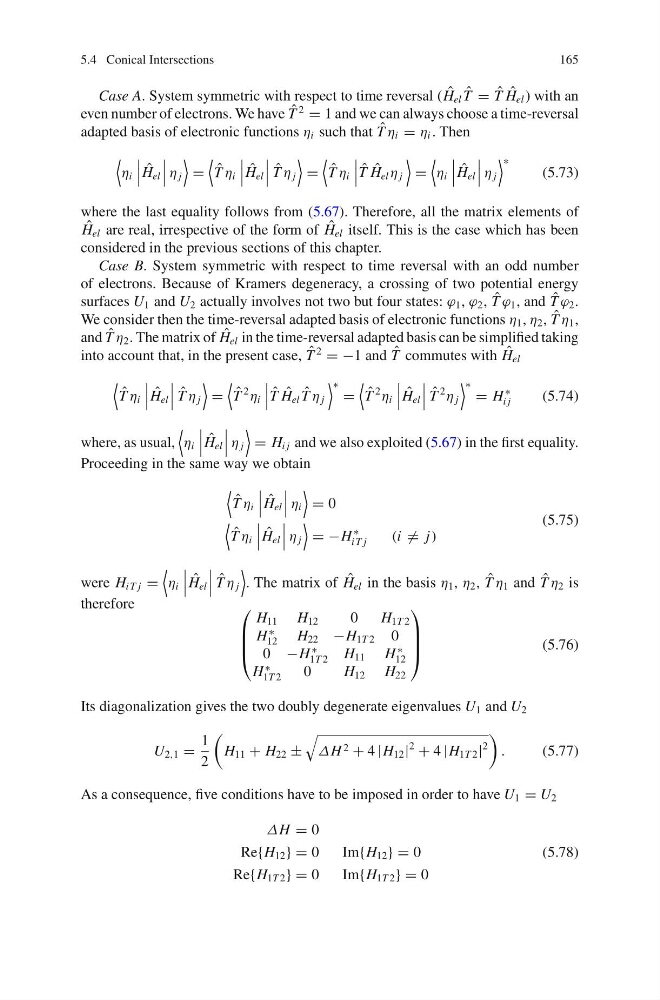
Its diagonalization gives the two doubly degenerate eigenvalues U 1 and U 2
U 2,1 =
1
2
H 11 + H 22 ±
ΔH 2 + 4 |H 12 |
2
+ 4 |H 1T 2 |
2
.
(5.77)
As a consequence, five conditions have to be imposed in order to have U 1 = U 2
ΔH = 0
Re{H 12 } = 0
Im{H 12 } = 0
Re{H 1T 2 } = 0
Im{H 1T 2 } = 0
(5.78)
165
Case A. System symmetric with respect to time reversal ( ˆ
H el ˆ
T = ˆ
T ˆ
H el ) with an
even number of electrons. We have ˆ
T
2
= 1 and we can always choose a time-reversal
adapted basis of electronic functions η i such that ˆ
T η i = η i . Then
η i
ˆ
H el
η j
=
ˆ
T η i
ˆ
H el
ˆ
T η j
=
ˆ
T η i
ˆ
T ˆ
H el η j
=
η i
ˆ
H el
η j
∗
(5.73)
where the last equality follows from (5.67). Therefore, all the matrix elements of
ˆ
H el are real, irrespective of the form of ˆ
H el itself. This is the case which has been
considered in the previous sections of this chapter.
Case B. System symmetric with respect to time reversal with an odd number
of electrons. Because of Kramers degeneracy, a crossing of two potential energy
surfaces U 1 and U 2 actually involves not two but four states: ϕ 1 , ϕ 2 , ˆ
T ϕ 1 , and ˆ
T ϕ 2 .
We consider then the time-reversal adapted basis of electronic functions η 1 , η 2 , ˆ
T η 1 ,
and ˆ
T η 2 . The matrix of ˆ
H el in the time-reversal adapted basis can be simplified taking
into account that, in the present case, ˆ
T
2
= −1 and ˆ
T commutes with ˆ
H el
ˆ
T η i
ˆ
H el
ˆ
T η j
=
ˆ
T
2
η i
ˆ
T ˆ
H el ˆ
T η j
∗ =
ˆ
T
2
η i
ˆ
H el
ˆ
T
2
η j
∗ = H
∗
i j
(5.74)
where, as usual,
η i
ˆ
H el
η j
= H i j and we also exploited (5.67) in the first equality.
Proceeding in the same way we obtain
ˆ
T η i
ˆ
H el
η i
= 0
ˆ
T η i
ˆ
H el
η j
= −H
∗
i T j
(i = j)
(5.75)
were H i T j =
η i
ˆ
H el
ˆ
T η j
. The matrix of ˆ
H el in the basis η 1 , η 2 , ˆ
T η 1 and ˆ
T η 2 is
therefore
⎛
⎜
⎜
⎝
H 11 H 12
0
H 1T 2
H
∗
12
H 22 −H 1T 2 0
0 −H
∗
1T 2
H 11 H
∗
12
H
∗
1T 2
0
H 12 H 22
⎞
⎟
⎟
⎠
(5.76)
Its diagonalization gives the two doubly degenerate eigenvalues U 1 and U 2
U 2,1 =
1
2
H 11 + H 22 ±
ΔH 2 + 4 |H 12 |
2
+ 4 |H 1T 2 |
2
.
(5.77)
As a consequence, five conditions have to be imposed in order to have U 1 = U 2
ΔH = 0
Re{H 12 } = 0
Im{H 12 } = 0
Re{H 1T 2 } = 0
Im{H 1T 2 } = 0
(5.78)