

5.4 Conical Intersections
163
On the contrary, for linear polyatomic molecules in degenerate electronic states
(i.e., belonging to one of the bidimensional irreducible representations , Δ, etc.,
of C ∞v or D ∞v symmetry groups) the linear terms (5.64) are zero by symmetry. The
degeneracy is removed upon bending at the second order (the Renner–Teller effect).
In this case the intersection between U 1 and U 2 is not of the conical type, and in fact
the geometric phase effect is absent.
5.4.5 Complex Hamiltonian and Kramers Degeneracy
In the previous section of the present chapter we always assumed that, at least in the
vicinity of the crossing, a two-state system can be used as a reasonable approximation,
and that H 12 is a real-valued function. However, in the general case both assumptions
must be relaxed. To understand why, it is convenient to consider the time-reversal
symmetry.
The symmetry operation called time reversal changes the sign of time, so it has
the effect to reverse the motion of the system, inverting the sign of linear and angular
momentum (see, for example, Sakurai [10] or Merzbacher [16]). As in classical
mechanics, an isolated system (or even a system subject to an external conservative
field) is symmetric under time reversal. In particular, if ˆ
T is the time-reversal operator,
for a system symmetric with respect to time reversal we must obtain the same result
if the system is evolved for a time dt and then ˆ
T is applied, or applying first the time
reversal and then evolving for a time −dt. Using the infinitesimal time evolution
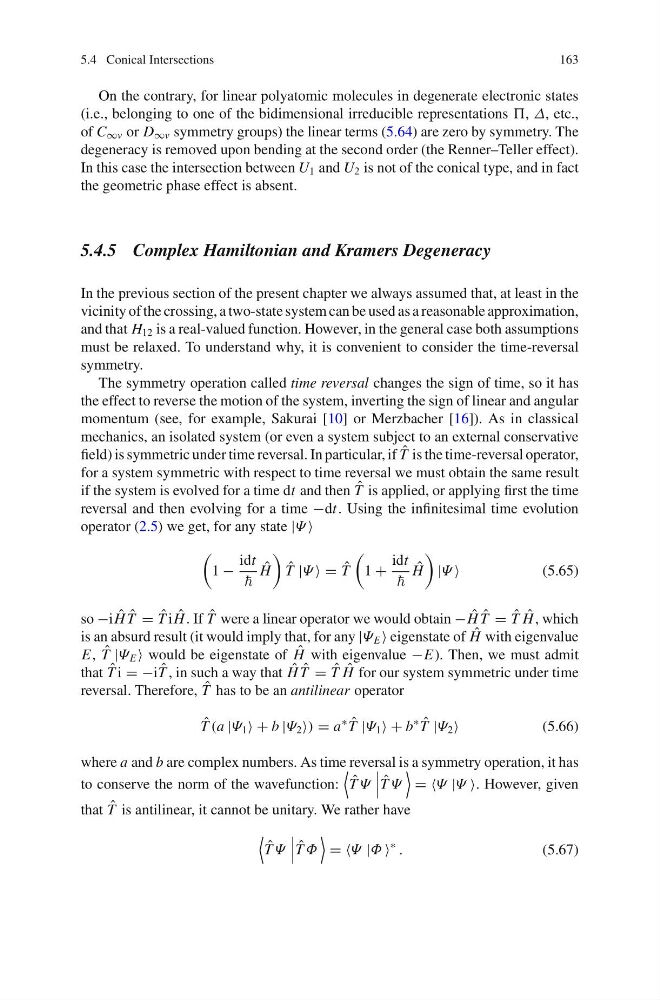
operator (2.5) we get, for any state |Ψ
1 −
idt
ˆ
H
ˆ
T |Ψ = ˆ
T
1 +
idt
ˆ
H
|Ψ
(5.65)
so −i ˆ
H ˆ
T = ˆ
T i ˆ
H . If ˆ
T were a linear operator we would obtain − ˆ
H ˆ
T = ˆ
T ˆ
H , which
is an absurd result (it would imply that, for any |Ψ E eigenstate of ˆ
H with eigenvalue
E, ˆ
T |Ψ E would be eigenstate of ˆ
H with eigenvalue −E). Then, we must admit
that ˆ
T i = −i ˆ
T , in such a way that ˆ
H ˆ
T = ˆ
T ˆ
H for our system symmetric under time
reversal. Therefore, ˆ
T has to be an antilinear operator
ˆ
T (a |Ψ 1 + b |Ψ 2 ) = a
∗ ˆ
T |Ψ 1 + b
∗ ˆ
T |Ψ 2
(5.66)
where a and b are complex numbers. As time reversal is a symmetry operation, it has
to conserve the norm of the wavefunction:
ˆ
T Ψ
ˆ
T Ψ
= Ψ |Ψ . However, given
that ˆ
T is antilinear, it cannot be unitary. We rather have
ˆ
T Ψ
ˆ
T Φ
= Ψ |Φ
∗
.
(5.67)
163
On the contrary, for linear polyatomic molecules in degenerate electronic states
(i.e., belonging to one of the bidimensional irreducible representations , Δ, etc.,
of C ∞v or D ∞v symmetry groups) the linear terms (5.64) are zero by symmetry. The
degeneracy is removed upon bending at the second order (the Renner–Teller effect).
In this case the intersection between U 1 and U 2 is not of the conical type, and in fact
the geometric phase effect is absent.
5.4.5 Complex Hamiltonian and Kramers Degeneracy
In the previous section of the present chapter we always assumed that, at least in the
vicinity of the crossing, a two-state system can be used as a reasonable approximation,
and that H 12 is a real-valued function. However, in the general case both assumptions
must be relaxed. To understand why, it is convenient to consider the time-reversal
symmetry.
The symmetry operation called time reversal changes the sign of time, so it has
the effect to reverse the motion of the system, inverting the sign of linear and angular
momentum (see, for example, Sakurai [10] or Merzbacher [16]). As in classical
mechanics, an isolated system (or even a system subject to an external conservative
field) is symmetric under time reversal. In particular, if ˆ
T is the time-reversal operator,
for a system symmetric with respect to time reversal we must obtain the same result
if the system is evolved for a time dt and then ˆ
T is applied, or applying first the time
reversal and then evolving for a time −dt. Using the infinitesimal time evolution
operator (2.5) we get, for any state |Ψ
1 −
idt
ˆ
H
ˆ
T |Ψ = ˆ
T
1 +
idt
ˆ
H
|Ψ
(5.65)
so −i ˆ
H ˆ
T = ˆ
T i ˆ
H . If ˆ
T were a linear operator we would obtain − ˆ
H ˆ
T = ˆ
T ˆ
H , which
is an absurd result (it would imply that, for any |Ψ E eigenstate of ˆ
H with eigenvalue
E, ˆ
T |Ψ E would be eigenstate of ˆ
H with eigenvalue −E). Then, we must admit
that ˆ
T i = −i ˆ
T , in such a way that ˆ
H ˆ
T = ˆ
T ˆ
H for our system symmetric under time
reversal. Therefore, ˆ
T has to be an antilinear operator
ˆ
T (a |Ψ 1 + b |Ψ 2 ) = a
∗ ˆ
T |Ψ 1 + b
∗ ˆ
T |Ψ 2
(5.66)
where a and b are complex numbers. As time reversal is a symmetry operation, it has
to conserve the norm of the wavefunction:
ˆ
T Ψ
ˆ
T Ψ
= Ψ |Ψ . However, given
that ˆ
T is antilinear, it cannot be unitary. We rather have
ˆ
T Ψ
ˆ
T Φ
= Ψ |Φ
∗
.
(5.67)