

162
5 Fast Nonadiabatic Dynamics
the intersection on opposite sides, gain opposite phases, giving rise to destructive
interference.
When performing numerical calculations of wavepacket dynamics using
Eq. (2.78), of course one wants to deal with single-valued nuclear wavepackets. Then,
the adiabatic Born–Huang expansion of Eq. (2.77) has to be expressed in terms of
the single-valued electronic functions ˜
ϕ k . In this way, to correctly deal with conical
intersections, the geometric phase factors e
iΩ k have to be explicitly introduced in
the wavepacket dynamics. On the contrary, no special care is needed when working
in the diabatic basis (Eq. (5.20)), which is not made of eigenfunctions of ˆ
H el and
therefore is free from the complexities associated with energy degeneracies.
5.4.4 The Jahn–Teller Effect
We consider a case in which the two states ϕ 1 and ϕ 2 , in the degeneracy point Q x ,
belong to the same degenerate irreducible representation Γ ϕ of a non-Abelian point
group. Our aim is to establish if Q x is a stable conformation against a deformation
which reduces the symmetry and removes the degeneracy (i.e., whether Q x can be
a stationary point for U 1 and U 2 ). At first order in the displacement ΔQ = Q − Q x ,
the matrix elements H i j of ˆ
H el in the diabatic basis are given by
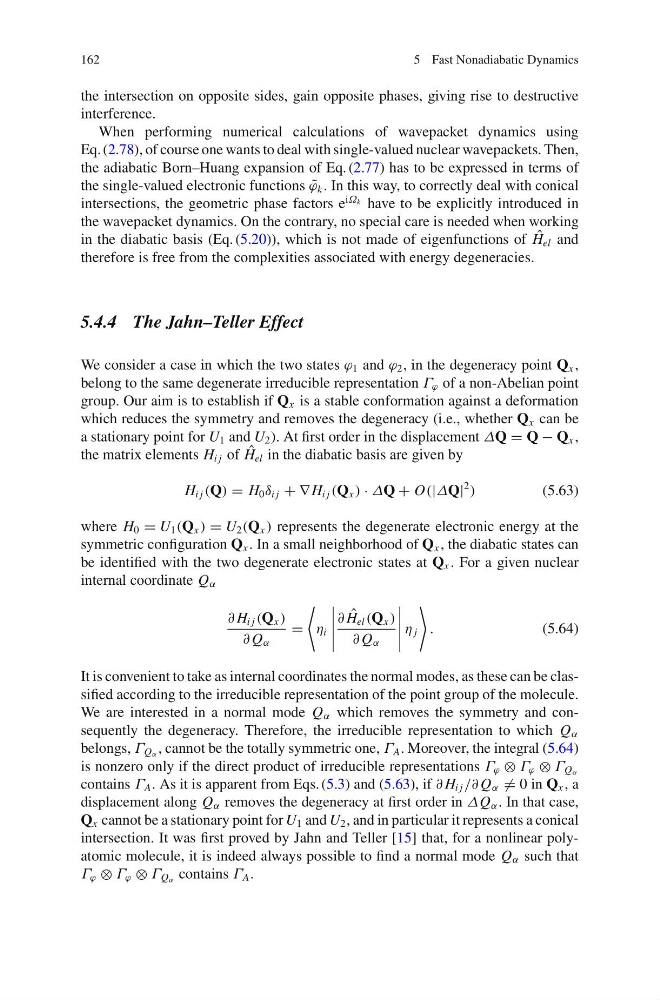
H i j (Q) = H 0 δ i j + ∇ H i j (Q x ) · ΔQ + O(|ΔQ|
2
)
(5.63)
where H 0 = U 1 (Q x ) = U 2 (Q x ) represents the degenerate electronic energy at the
symmetric configuration Q x . In a small neighborhood of Q x , the diabatic states can
be identified with the two degenerate electronic states at Q x . For a given nuclear
internal coordinate Q α
∂ H i j (Q x )
∂ Q α
=
η i
∂ ˆ
H el (Q x )
∂ Q α
η j
.
(5.64)
It is convenient to take as internal coordinates the normal modes, as these can be classified according to the irreducible representation of the point group of the molecule.
We are interested in a normal mode Q α which removes the symmetry and consequently the degeneracy. Therefore, the irreducible representation to which Q α
belongs, Γ Q α , cannot be the totally symmetric one, Γ A . Moreover, the integral (5.64)
is nonzero only if the direct product of irreducible representations Γ ϕ ⊗ Γ ϕ ⊗ Γ Q α
contains Γ A . As it is apparent from Eqs. (5.3) and (5.63), if ∂ H i j /∂ Q α = 0 in Q x , a
displacement along Q α removes the degeneracy at first order in ΔQ α . In that case,
Q x cannot be a stationary point for U 1 and U 2 , and in particular it represents a conical
intersection. It was first proved by Jahn and Teller [15] that, for a nonlinear polyatomic molecule, it is indeed always possible to find a normal mode Q α such that
Γ ϕ ⊗ Γ ϕ ⊗ Γ Q α contains Γ A .
5 Fast Nonadiabatic Dynamics
the intersection on opposite sides, gain opposite phases, giving rise to destructive
interference.
When performing numerical calculations of wavepacket dynamics using
Eq. (2.78), of course one wants to deal with single-valued nuclear wavepackets. Then,
the adiabatic Born–Huang expansion of Eq. (2.77) has to be expressed in terms of
the single-valued electronic functions ˜
ϕ k . In this way, to correctly deal with conical
intersections, the geometric phase factors e
iΩ k have to be explicitly introduced in
the wavepacket dynamics. On the contrary, no special care is needed when working
in the diabatic basis (Eq. (5.20)), which is not made of eigenfunctions of ˆ
H el and
therefore is free from the complexities associated with energy degeneracies.
5.4.4 The Jahn–Teller Effect
We consider a case in which the two states ϕ 1 and ϕ 2 , in the degeneracy point Q x ,
belong to the same degenerate irreducible representation Γ ϕ of a non-Abelian point
group. Our aim is to establish if Q x is a stable conformation against a deformation
which reduces the symmetry and removes the degeneracy (i.e., whether Q x can be
a stationary point for U 1 and U 2 ). At first order in the displacement ΔQ = Q − Q x ,
the matrix elements H i j of ˆ
H el in the diabatic basis are given by
H i j (Q) = H 0 δ i j + ∇ H i j (Q x ) · ΔQ + O(|ΔQ|
2
)
(5.63)
where H 0 = U 1 (Q x ) = U 2 (Q x ) represents the degenerate electronic energy at the
symmetric configuration Q x . In a small neighborhood of Q x , the diabatic states can
be identified with the two degenerate electronic states at Q x . For a given nuclear
internal coordinate Q α
∂ H i j (Q x )
∂ Q α
=
η i
∂ ˆ
H el (Q x )
∂ Q α
η j
.
(5.64)
It is convenient to take as internal coordinates the normal modes, as these can be classified according to the irreducible representation of the point group of the molecule.
We are interested in a normal mode Q α which removes the symmetry and consequently the degeneracy. Therefore, the irreducible representation to which Q α
belongs, Γ Q α , cannot be the totally symmetric one, Γ A . Moreover, the integral (5.64)
is nonzero only if the direct product of irreducible representations Γ ϕ ⊗ Γ ϕ ⊗ Γ Q α
contains Γ A . As it is apparent from Eqs. (5.3) and (5.63), if ∂ H i j /∂ Q α = 0 in Q x , a
displacement along Q α removes the degeneracy at first order in ΔQ α . In that case,
Q x cannot be a stationary point for U 1 and U 2 , and in particular it represents a conical
intersection. It was first proved by Jahn and Teller [15] that, for a nonlinear polyatomic molecule, it is indeed always possible to find a normal mode Q α such that
Γ ϕ ⊗ Γ ϕ ⊗ Γ Q α contains Γ A .