

158
5 Fast Nonadiabatic Dynamics
ϕ 1 (O) =
1
√
2
(Φ 1 − Φ 2 )
ϕ 2 (O) =
1
√
6
(2Φ 3 − Φ 1 − Φ 2 ) .
(5.50)
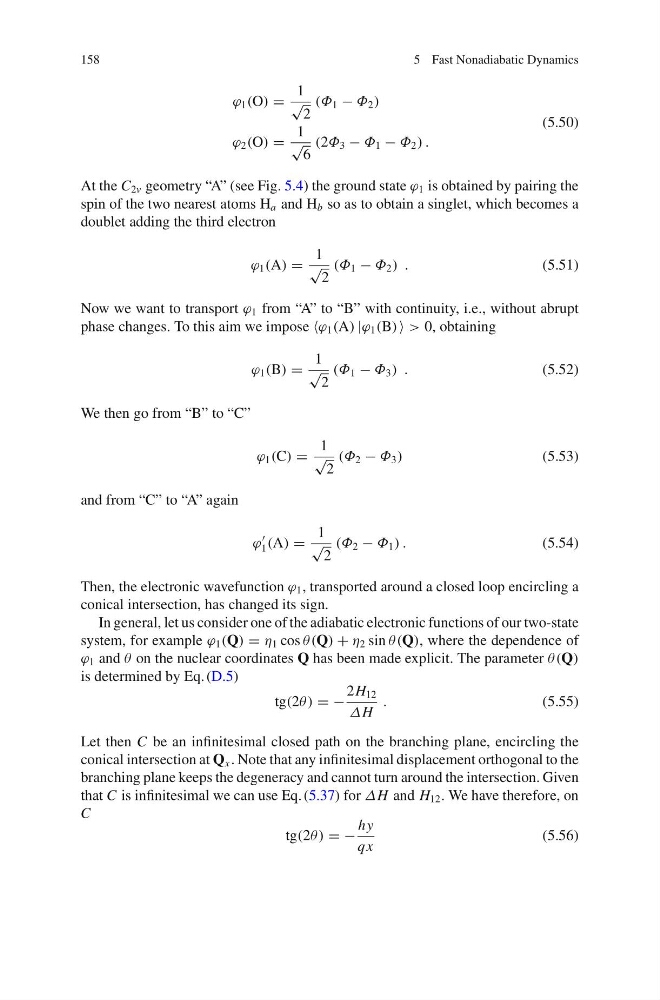
At the C 2v geometry “A” (see Fig. 5.4) the ground state ϕ 1 is obtained by pairing the
spin of the two nearest atoms H a and H b so as to obtain a singlet, which becomes a
doublet adding the third electron
ϕ 1 (A) =
1
√
2
(Φ 1 − Φ 2 ) .
(5.51)
Now we want to transport ϕ 1 from “A” to “B” with continuity, i.e., without abrupt
phase changes. To this aim we impose ϕ 1 (A) |ϕ 1 (B) > 0, obtaining
ϕ 1 (B) =
1
√
2
(Φ 1 − Φ 3 ) .
(5.52)
We then go from “B” to “C”
ϕ 1 (C) =
1
√
2
(Φ 2 − Φ 3 )
(5.53)
and from “C” to “A” again
ϕ
1 (A) =
1
√
2
(Φ 2 − Φ 1 ) .
(5.54)
Then, the electronic wavefunction ϕ 1 , transported around a closed loop encircling a
conical intersection, has changed its sign.
In general, let us consider one of the adiabatic electronic functions of our two-state
system, for example ϕ 1 (Q) = η 1 cos θ(Q) + η 2 sin θ(Q), where the dependence of
ϕ 1 and θ on the nuclear coordinates Q has been made explicit. The parameter θ(Q)
is determined by Eq. (D.5)
tg(2θ) = −
2H 12
ΔH
.
(5.55)
Let then C be an infinitesimal closed path on the branching plane, encircling the
conical intersection at Q x . Note that any infinitesimal displacement orthogonal to the
branching plane keeps the degeneracy and cannot turn around the intersection. Given
that C is infinitesimal we can use Eq. (5.37) for ΔH and H 12 . We have therefore, on
C
tg(2θ) = −
hy
qx
(5.56)
5 Fast Nonadiabatic Dynamics
ϕ 1 (O) =
1
√
2
(Φ 1 − Φ 2 )
ϕ 2 (O) =
1
√
6
(2Φ 3 − Φ 1 − Φ 2 ) .
(5.50)
At the C 2v geometry “A” (see Fig. 5.4) the ground state ϕ 1 is obtained by pairing the
spin of the two nearest atoms H a and H b so as to obtain a singlet, which becomes a
doublet adding the third electron
ϕ 1 (A) =
1
√
2
(Φ 1 − Φ 2 ) .
(5.51)
Now we want to transport ϕ 1 from “A” to “B” with continuity, i.e., without abrupt
phase changes. To this aim we impose ϕ 1 (A) |ϕ 1 (B) > 0, obtaining
ϕ 1 (B) =
1
√
2
(Φ 1 − Φ 3 ) .
(5.52)
We then go from “B” to “C”
ϕ 1 (C) =
1
√
2
(Φ 2 − Φ 3 )
(5.53)
and from “C” to “A” again
ϕ
1 (A) =
1
√
2
(Φ 2 − Φ 1 ) .
(5.54)
Then, the electronic wavefunction ϕ 1 , transported around a closed loop encircling a
conical intersection, has changed its sign.
In general, let us consider one of the adiabatic electronic functions of our two-state
system, for example ϕ 1 (Q) = η 1 cos θ(Q) + η 2 sin θ(Q), where the dependence of
ϕ 1 and θ on the nuclear coordinates Q has been made explicit. The parameter θ(Q)
is determined by Eq. (D.5)
tg(2θ) = −
2H 12
ΔH
.
(5.55)
Let then C be an infinitesimal closed path on the branching plane, encircling the
conical intersection at Q x . Note that any infinitesimal displacement orthogonal to the
branching plane keeps the degeneracy and cannot turn around the intersection. Given
that C is infinitesimal we can use Eq. (5.37) for ΔH and H 12 . We have therefore, on
C
tg(2θ) = −
hy
qx
(5.56)