

5.4 Conical Intersections
157
particular, the phase factor is just +1 and therefore irrelevant, if the loop does not
enclose a conical intersection, but is −1 when the loop contains a conical intersection.
Let us consider first an example to illustrate this behavior. The H 3 molecule,
in the symmetric D 3h conformation, has a degenerate
2 E
electronic ground state.
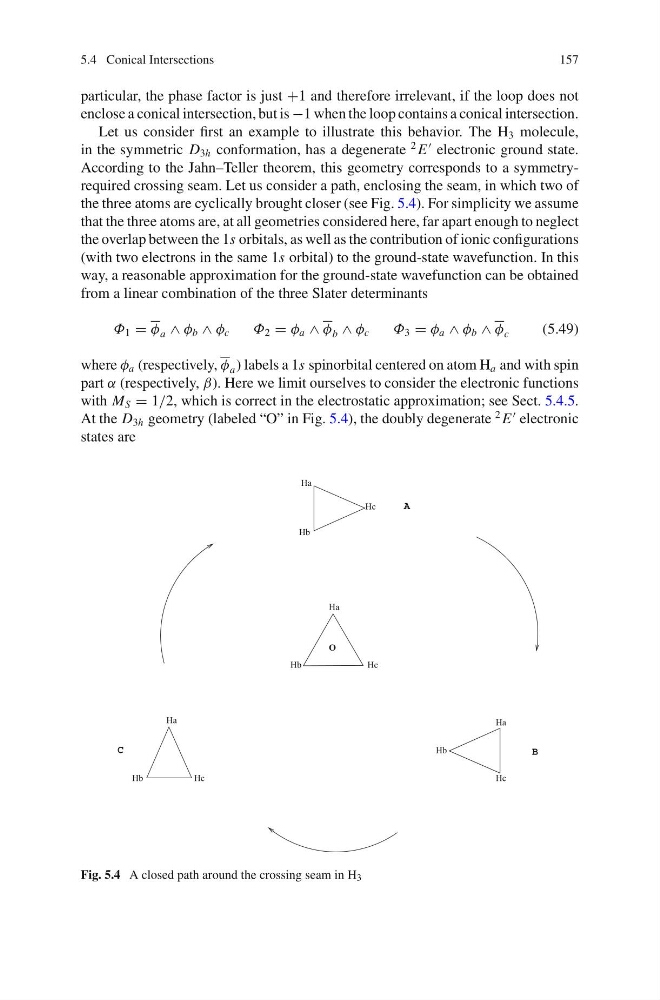
According to the Jahn–Teller theorem, this geometry corresponds to a symmetryrequired crossing seam. Let us consider a path, enclosing the seam, in which two of
the three atoms are cyclically brought closer (see Fig. 5.4). For simplicity we assume
that the three atoms are, at all geometries considered here, far apart enough to neglect
the overlap between the 1s orbitals, as well as the contribution of ionic configurations
(with two electrons in the same 1s orbital) to the ground-state wavefunction. In this
way, a reasonable approximation for the ground-state wavefunction can be obtained
from a linear combination of the three Slater determinants
Φ 1 = φ a ∧ φ b ∧ φ c
Φ 2 = φ a ∧ φ b ∧ φ c
Φ 3 = φ a ∧ φ b ∧ φ c
(5.49)
where φ a (respectively, φ a ) labels a 1s spinorbital centered on atom H a and with spin
part α (respectively, β). Here we limit ourselves to consider the electronic functions
with M S = 1/2, which is correct in the electrostatic approximation; see Sect. 5.4.5.
At the D 3h geometry (labeled “O” in Fig. 5.4), the doubly degenerate
2 E
electronic
states are
Ha
Ha
Ha
Hb
Hb
Hb
Hb
Hc
Hc
Hc
Hc
Ha
O
Fig. 5.4 A closed path around the crossing seam in H 3
157
particular, the phase factor is just +1 and therefore irrelevant, if the loop does not
enclose a conical intersection, but is −1 when the loop contains a conical intersection.
Let us consider first an example to illustrate this behavior. The H 3 molecule,
in the symmetric D 3h conformation, has a degenerate
2 E
electronic ground state.
According to the Jahn–Teller theorem, this geometry corresponds to a symmetryrequired crossing seam. Let us consider a path, enclosing the seam, in which two of
the three atoms are cyclically brought closer (see Fig. 5.4). For simplicity we assume
that the three atoms are, at all geometries considered here, far apart enough to neglect
the overlap between the 1s orbitals, as well as the contribution of ionic configurations
(with two electrons in the same 1s orbital) to the ground-state wavefunction. In this
way, a reasonable approximation for the ground-state wavefunction can be obtained
from a linear combination of the three Slater determinants
Φ 1 = φ a ∧ φ b ∧ φ c
Φ 2 = φ a ∧ φ b ∧ φ c
Φ 3 = φ a ∧ φ b ∧ φ c
(5.49)
where φ a (respectively, φ a ) labels a 1s spinorbital centered on atom H a and with spin
part α (respectively, β). Here we limit ourselves to consider the electronic functions
with M S = 1/2, which is correct in the electrostatic approximation; see Sect. 5.4.5.
At the D 3h geometry (labeled “O” in Fig. 5.4), the doubly degenerate
2 E
electronic
states are
Ha
Ha
Ha
Hb
Hb
Hb
Hb
Hc
Hc
Hc
Hc
Ha
O
Fig. 5.4 A closed path around the crossing seam in H 3