

156
5 Fast Nonadiabatic Dynamics
if the displacement is orthogonal to q and h; see Eq.(5.35). The branching plane
represents therefore the space, of dimension 2, where the degeneracy of a conical
intersection is removed at first order. We stress here that this is just the most common
possibility, as conical intersections with branching spaces of dimension 3 or 5 do
exist (see Sect. 5.4.5).
Given the arbitrariness in the definition of the diabatic basis, the identification
of the branching plane is easier if the two vectors q and h are expressed in terms
of adiabatic quantities. To this aim, we first observe that, near an intersection point,
Eq. (5.18) can be rewritten as
(U l − U k )g kl = C
+
k ∇HC l
(5.45)
Note that, as U l − U k tends to zero, g kl diverges, whereas the term (U l − U k )C
+
k ν
(α) C l
vanishes. Moreover, from the Hellmann–Feynman theorem we have
∇U k = C
+
k ∇HC k .
(5.46)
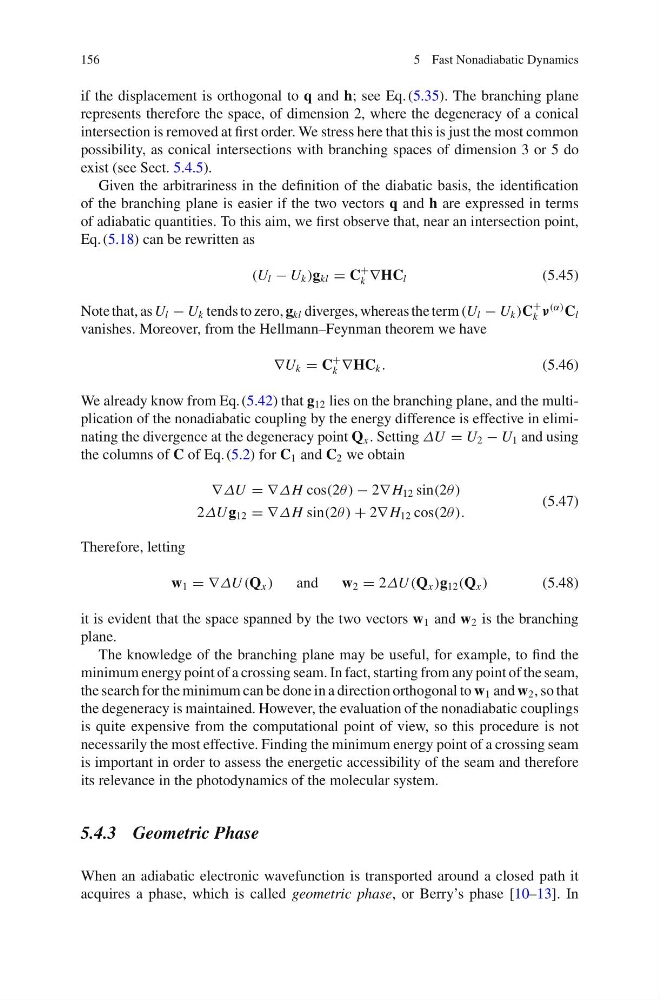
We already know from Eq. (5.42) that g 12 lies on the branching plane, and the multiplication of the nonadiabatic coupling by the energy difference is effective in eliminating the divergence at the degeneracy point Q x . Setting ΔU = U 2 − U 1 and using
the columns of C of Eq. (5.2) for C 1 and C 2 we obtain
∇ΔU = ∇ΔH cos(2θ) − 2∇ H 12 sin(2θ)
2ΔU g 12 = ∇ΔH sin(2θ) + 2∇ H 12 cos(2θ).
(5.47)
Therefore, letting
w 1 = ∇ΔU (Q x )
and
w 2 = 2ΔU (Q x )g 12 (Q x )
(5.48)
it is evident that the space spanned by the two vectors w 1 and w 2 is the branching
plane.
The knowledge of the branching plane may be useful, for example, to find the
minimum energy point of a crossing seam. In fact, starting from any point of the seam,
the search for the minimum can be done in a direction orthogonal to w 1 and w 2 , so that
the degeneracy is maintained. However, the evaluation of the nonadiabatic couplings
is quite expensive from the computational point of view, so this procedure is not
necessarily the most effective. Finding the minimum energy point of a crossing seam
is important in order to assess the energetic accessibility of the seam and therefore
its relevance in the photodynamics of the molecular system.
5.4.3 Geometric Phase
When an adiabatic electronic wavefunction is transported around a closed path it
acquires a phase, which is called geometric phase, or Berry’s phase [10–13]. In
5 Fast Nonadiabatic Dynamics
if the displacement is orthogonal to q and h; see Eq.(5.35). The branching plane
represents therefore the space, of dimension 2, where the degeneracy of a conical
intersection is removed at first order. We stress here that this is just the most common
possibility, as conical intersections with branching spaces of dimension 3 or 5 do
exist (see Sect. 5.4.5).
Given the arbitrariness in the definition of the diabatic basis, the identification
of the branching plane is easier if the two vectors q and h are expressed in terms
of adiabatic quantities. To this aim, we first observe that, near an intersection point,
Eq. (5.18) can be rewritten as
(U l − U k )g kl = C
+
k ∇HC l
(5.45)
Note that, as U l − U k tends to zero, g kl diverges, whereas the term (U l − U k )C
+
k ν
(α) C l
vanishes. Moreover, from the Hellmann–Feynman theorem we have
∇U k = C
+
k ∇HC k .
(5.46)
We already know from Eq. (5.42) that g 12 lies on the branching plane, and the multiplication of the nonadiabatic coupling by the energy difference is effective in eliminating the divergence at the degeneracy point Q x . Setting ΔU = U 2 − U 1 and using
the columns of C of Eq. (5.2) for C 1 and C 2 we obtain
∇ΔU = ∇ΔH cos(2θ) − 2∇ H 12 sin(2θ)
2ΔU g 12 = ∇ΔH sin(2θ) + 2∇ H 12 cos(2θ).
(5.47)
Therefore, letting
w 1 = ∇ΔU (Q x )
and
w 2 = 2ΔU (Q x )g 12 (Q x )
(5.48)
it is evident that the space spanned by the two vectors w 1 and w 2 is the branching
plane.
The knowledge of the branching plane may be useful, for example, to find the
minimum energy point of a crossing seam. In fact, starting from any point of the seam,
the search for the minimum can be done in a direction orthogonal to w 1 and w 2 , so that
the degeneracy is maintained. However, the evaluation of the nonadiabatic couplings
is quite expensive from the computational point of view, so this procedure is not
necessarily the most effective. Finding the minimum energy point of a crossing seam
is important in order to assess the energetic accessibility of the seam and therefore
its relevance in the photodynamics of the molecular system.
5.4.3 Geometric Phase
When an adiabatic electronic wavefunction is transported around a closed path it
acquires a phase, which is called geometric phase, or Berry’s phase [10–13]. In