

5.4 Conical Intersections
153
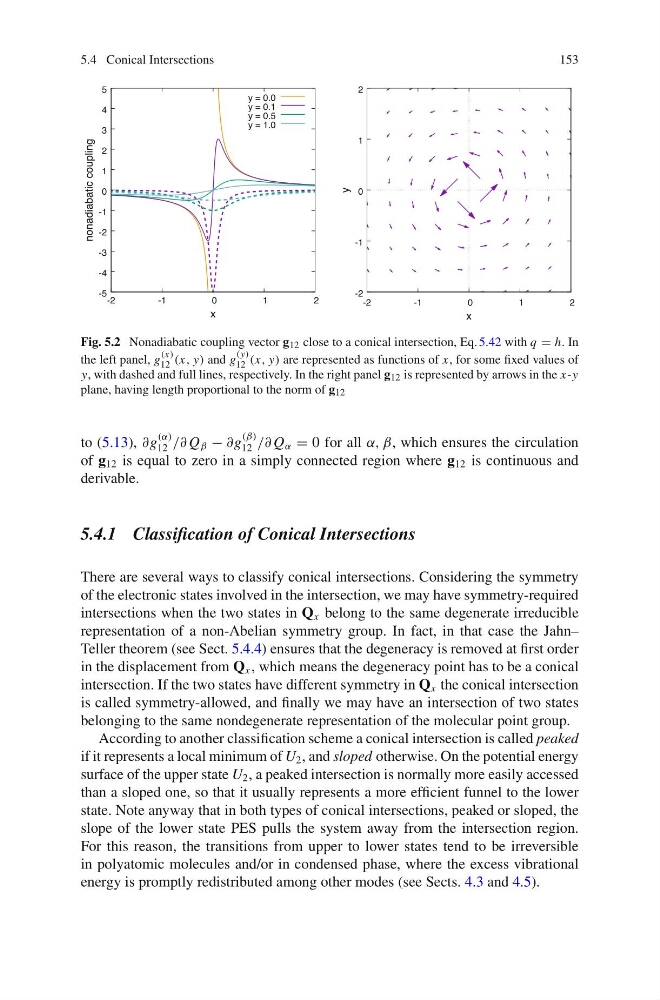
Fig. 5.2 Nonadiabatic coupling vector g 12 close to a conical intersection, Eq. 5.42 with q = h. In
the left panel, g
(x)
12 (x, y) and g
(y)
12 (x, y) are represented as functions of x, for some fixed values of
y, with dashed and full lines, respectively. In the right panel g 12 is represented by arrows in the x-y
plane, having length proportional to the norm of g 12
to (5.13), ∂g
(α)
12 /∂ Q β − ∂g
(β)
12 /∂ Q α = 0 for all α, β, which ensures the circulation
of g 12 is equal to zero in a simply connected region where g 12 is continuous and
derivable.
5.4.1 Classification of Conical Intersections
There are several ways to classify conical intersections. Considering the symmetry
of the electronic states involved in the intersection, we may have symmetry-required
intersections when the two states in Q x belong to the same degenerate irreducible
representation of a non-Abelian symmetry group. In fact, in that case the Jahn–
Teller theorem (see Sect. 5.4.4) ensures that the degeneracy is removed at first order
in the displacement from Q x , which means the degeneracy point has to be a conical
intersection. If the two states have different symmetry in Q x the conical intersection
is called symmetry-allowed, and finally we may have an intersection of two states
belonging to the same nondegenerate representation of the molecular point group.
According to another classification scheme a conical intersection is called peaked
if it represents a local minimum of U 2 , and sloped otherwise. On the potential energy
surface of the upper state U 2 , a peaked intersection is normally more easily accessed
than a sloped one, so that it usually represents a more efficient funnel to the lower
state. Note anyway that in both types of conical intersections, peaked or sloped, the
slope of the lower state PES pulls the system away from the intersection region.
For this reason, the transitions from upper to lower states tend to be irreversible
in polyatomic molecules and/or in condensed phase, where the excess vibrational
energy is promptly redistributed among other modes (see Sects. 4.3 and 4.5).
153
Fig. 5.2 Nonadiabatic coupling vector g 12 close to a conical intersection, Eq. 5.42 with q = h. In
the left panel, g
(x)
12 (x, y) and g
(y)
12 (x, y) are represented as functions of x, for some fixed values of
y, with dashed and full lines, respectively. In the right panel g 12 is represented by arrows in the x-y
plane, having length proportional to the norm of g 12
to (5.13), ∂g
(α)
12 /∂ Q β − ∂g
(β)
12 /∂ Q α = 0 for all α, β, which ensures the circulation
of g 12 is equal to zero in a simply connected region where g 12 is continuous and
derivable.
5.4.1 Classification of Conical Intersections
There are several ways to classify conical intersections. Considering the symmetry
of the electronic states involved in the intersection, we may have symmetry-required
intersections when the two states in Q x belong to the same degenerate irreducible
representation of a non-Abelian symmetry group. In fact, in that case the Jahn–
Teller theorem (see Sect. 5.4.4) ensures that the degeneracy is removed at first order
in the displacement from Q x , which means the degeneracy point has to be a conical
intersection. If the two states have different symmetry in Q x the conical intersection
is called symmetry-allowed, and finally we may have an intersection of two states
belonging to the same nondegenerate representation of the molecular point group.
According to another classification scheme a conical intersection is called peaked
if it represents a local minimum of U 2 , and sloped otherwise. On the potential energy
surface of the upper state U 2 , a peaked intersection is normally more easily accessed
than a sloped one, so that it usually represents a more efficient funnel to the lower
state. Note anyway that in both types of conical intersections, peaked or sloped, the
slope of the lower state PES pulls the system away from the intersection region.
For this reason, the transitions from upper to lower states tend to be irreversible
in polyatomic molecules and/or in condensed phase, where the excess vibrational
energy is promptly redistributed among other modes (see Sects. 4.3 and 4.5).