

154
5 Fast Nonadiabatic Dynamics
energy (Kcal/mol)
a s y m m e tr ic b e n d
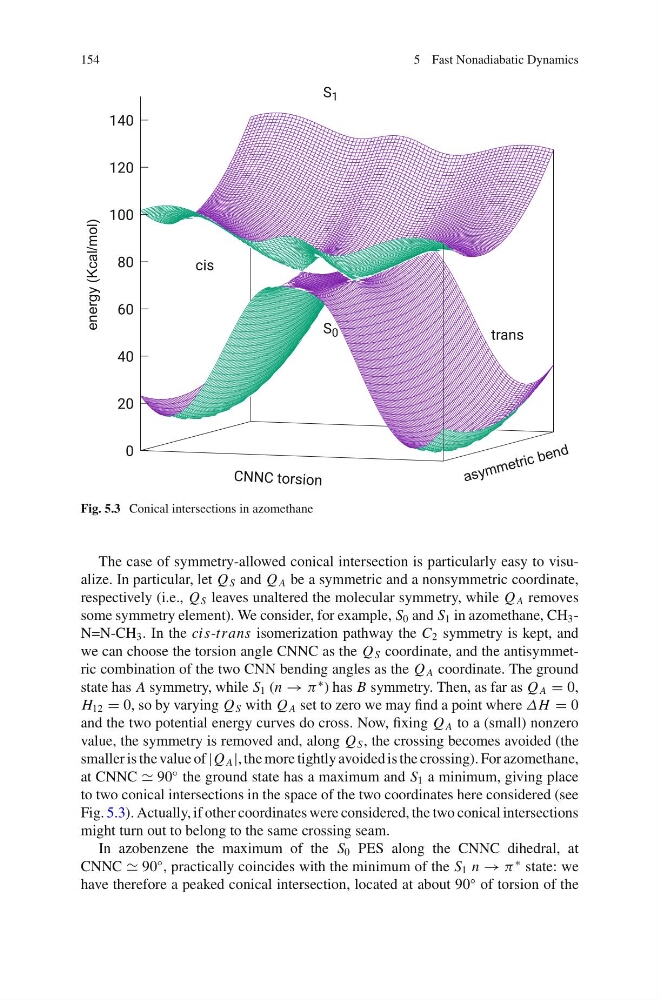
Fig. 5.3 Conical intersections in azomethane
The case of symmetry-allowed conical intersection is particularly easy to visualize. In particular, let Q S and Q A be a symmetric and a nonsymmetric coordinate,
respectively (i.e., Q S leaves unaltered the molecular symmetry, while Q A removes
some symmetry element). We consider, for example, S 0 and S 1 in azomethane, CH 3 -
N=N-CH 3 . In the cis-trans isomerization pathway the C 2 symmetry is kept, and
we can choose the torsion angle CNNC as the Q S coordinate, and the antisymmetric combination of the two CNN bending angles as the Q A coordinate. The ground
state has A symmetry, while S 1 (n → π
∗ ) has B symmetry. Then, as far as Q A = 0,
H 12 = 0, so by varying Q S with Q A set to zero we may find a point where ΔH = 0
and the two potential energy curves do cross. Now, fixing Q A to a (small) nonzero
value, the symmetry is removed and, along Q S , the crossing becomes avoided (the
smaller is the value of |Q A |, the more tightly avoided is the crossing). For azomethane,
at CNNC 90
◦ the ground state has a maximum and S 1 a minimum, giving place
to two conical intersections in the space of the two coordinates here considered (see
Fig. 5.3). Actually, if other coordinates were considered, the two conical intersections
might turn out to belong to the same crossing seam.
In azobenzene the maximum of the S 0 PES along the CNNC dihedral, at
CNNC 90
◦ , practically coincides with the minimum of the S 1 n → π
∗ state: we
have therefore a peaked conical intersection, located at about 90
◦ of torsion of the
5 Fast Nonadiabatic Dynamics
energy (Kcal/mol)
a s y m m e tr ic b e n d
Fig. 5.3 Conical intersections in azomethane
The case of symmetry-allowed conical intersection is particularly easy to visualize. In particular, let Q S and Q A be a symmetric and a nonsymmetric coordinate,
respectively (i.e., Q S leaves unaltered the molecular symmetry, while Q A removes
some symmetry element). We consider, for example, S 0 and S 1 in azomethane, CH 3 -
N=N-CH 3 . In the cis-trans isomerization pathway the C 2 symmetry is kept, and
we can choose the torsion angle CNNC as the Q S coordinate, and the antisymmetric combination of the two CNN bending angles as the Q A coordinate. The ground
state has A symmetry, while S 1 (n → π
∗ ) has B symmetry. Then, as far as Q A = 0,
H 12 = 0, so by varying Q S with Q A set to zero we may find a point where ΔH = 0
and the two potential energy curves do cross. Now, fixing Q A to a (small) nonzero
value, the symmetry is removed and, along Q S , the crossing becomes avoided (the
smaller is the value of |Q A |, the more tightly avoided is the crossing). For azomethane,
at CNNC 90
◦ the ground state has a maximum and S 1 a minimum, giving place
to two conical intersections in the space of the two coordinates here considered (see
Fig. 5.3). Actually, if other coordinates were considered, the two conical intersections
might turn out to belong to the same crossing seam.
In azobenzene the maximum of the S 0 PES along the CNNC dihedral, at
CNNC 90
◦ , practically coincides with the minimum of the S 1 n → π
∗ state: we
have therefore a peaked conical intersection, located at about 90
◦ of torsion of the