

152
5 Fast Nonadiabatic Dynamics
With s = 0, the above function of x and y is a double cone of which U 1 and U 2 are the
upper and the lower part and touch in the vertex. The double cone is circular if q = h
and elliptic if q = h. The term s · (Q − Q x ) can be split into two contributions: one
is due to the component of Q − Q x lying in the plane spanned by the vectors q and
h, and the other is due to the orthogonal component. The first contribution is linear
in x and y and has the effect to tilt the axis of the double cone, while the second does
not depend on x and y and therefore leaves the double cone geometry unaltered.
If ∇ΔH (Q x ) = 0 and ∇ H 12 (Q x ) = 0 the degeneracy point Q x is called conical
intersection [8]. The set of points of dimension s − 2 where U 1 = U 2 , i.e., the conical
intersection points, is called crossing seam. Because in the vicinity of a crossing seam
nonadiabatic transitions are very likely, the lowest parts of the crossing seam in the
upper adiabatic PES act as a funnel, i.e., a region of the PES where decay to lower
states is fast.
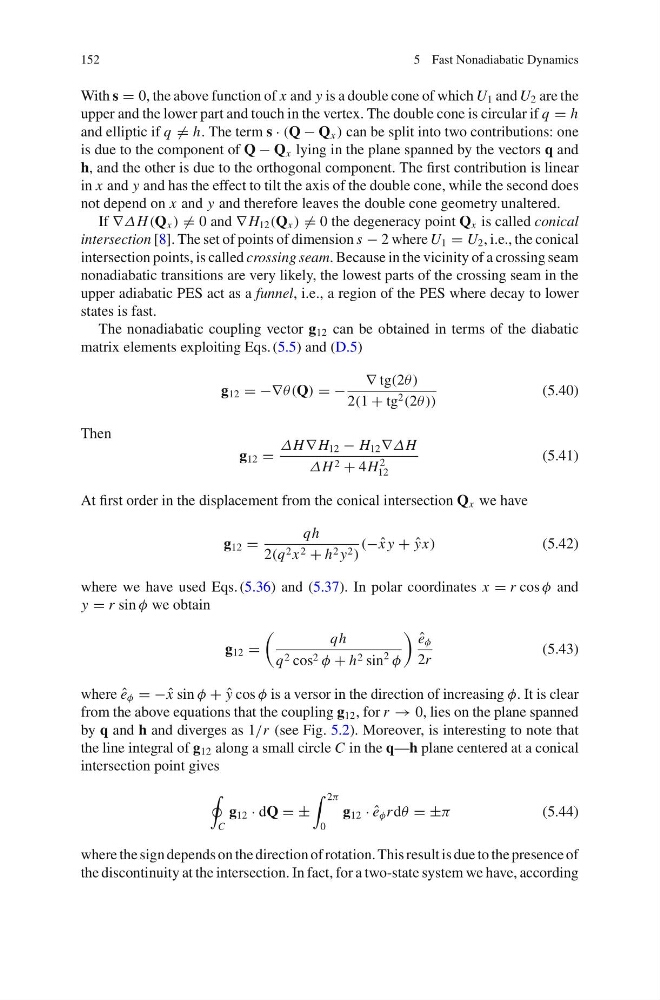
The nonadiabatic coupling vector g 12 can be obtained in terms of the diabatic
matrix elements exploiting Eqs. (5.5) and (D.5)
g 12 = −∇θ(Q) = −
∇ tg(2θ)
2(1 + tg 2 (2θ))
(5.40)
Then
g 12 =
ΔH ∇ H 12 − H 12 ∇ΔH
ΔH 2 + 4H
2
12
(5.41)
At first order in the displacement from the conical intersection Q x we have
g 12 =
qh
2(q 2 x 2 + h 2 y 2 )
(− ˆ
x y + ˆ
yx)
(5.42)
where we have used Eqs.(5.36) and (5.37). In polar coordinates x = r cos φ and
y = r sin φ we obtain
g 12 =
qh
q 2 cos 2 φ + h 2 sin
2
φ
ˆ
e φ
2r
(5.43)
where ˆ
e φ = − ˆ
x sin φ + ˆ
y cos φ is a versor in the direction of increasing φ. It is clear
from the above equations that the coupling g 12 , for r → 0, lies on the plane spanned
by q and h and diverges as 1/r (see Fig. 5.2). Moreover, is interesting to note that
the line integral of g 12 along a small circle C in the q—h plane centered at a conical
intersection point gives
C
g 12 · dQ = ±
2π
0
g 12 · ˆ
e φ r dθ = ±π
(5.44)
where the sign depends on the direction of rotation. This result is due to the presence of
the discontinuity at the intersection. In fact, for a two-state system we have, according
5 Fast Nonadiabatic Dynamics
With s = 0, the above function of x and y is a double cone of which U 1 and U 2 are the
upper and the lower part and touch in the vertex. The double cone is circular if q = h
and elliptic if q = h. The term s · (Q − Q x ) can be split into two contributions: one
is due to the component of Q − Q x lying in the plane spanned by the vectors q and
h, and the other is due to the orthogonal component. The first contribution is linear
in x and y and has the effect to tilt the axis of the double cone, while the second does
not depend on x and y and therefore leaves the double cone geometry unaltered.
If ∇ΔH (Q x ) = 0 and ∇ H 12 (Q x ) = 0 the degeneracy point Q x is called conical
intersection [8]. The set of points of dimension s − 2 where U 1 = U 2 , i.e., the conical
intersection points, is called crossing seam. Because in the vicinity of a crossing seam
nonadiabatic transitions are very likely, the lowest parts of the crossing seam in the
upper adiabatic PES act as a funnel, i.e., a region of the PES where decay to lower
states is fast.
The nonadiabatic coupling vector g 12 can be obtained in terms of the diabatic
matrix elements exploiting Eqs. (5.5) and (D.5)
g 12 = −∇θ(Q) = −
∇ tg(2θ)
2(1 + tg 2 (2θ))
(5.40)
Then
g 12 =
ΔH ∇ H 12 − H 12 ∇ΔH
ΔH 2 + 4H
2
12
(5.41)
At first order in the displacement from the conical intersection Q x we have
g 12 =
qh
2(q 2 x 2 + h 2 y 2 )
(− ˆ
x y + ˆ
yx)
(5.42)
where we have used Eqs.(5.36) and (5.37). In polar coordinates x = r cos φ and
y = r sin φ we obtain
g 12 =
qh
q 2 cos 2 φ + h 2 sin
2
φ
ˆ
e φ
2r
(5.43)
where ˆ
e φ = − ˆ
x sin φ + ˆ
y cos φ is a versor in the direction of increasing φ. It is clear
from the above equations that the coupling g 12 , for r → 0, lies on the plane spanned
by q and h and diverges as 1/r (see Fig. 5.2). Moreover, is interesting to note that
the line integral of g 12 along a small circle C in the q—h plane centered at a conical
intersection point gives
C
g 12 · dQ = ±
2π
0
g 12 · ˆ
e φ r dθ = ±π
(5.44)
where the sign depends on the direction of rotation. This result is due to the presence of
the discontinuity at the intersection. In fact, for a two-state system we have, according