

144
5 Fast Nonadiabatic Dynamics
g 12 = C
+
1
η
∂
∂ Q
η
C 2
= ν 12 + C
+
1
∂C 2
∂ Q
= ν 12 −
∂θ
∂ Q
(5.5)
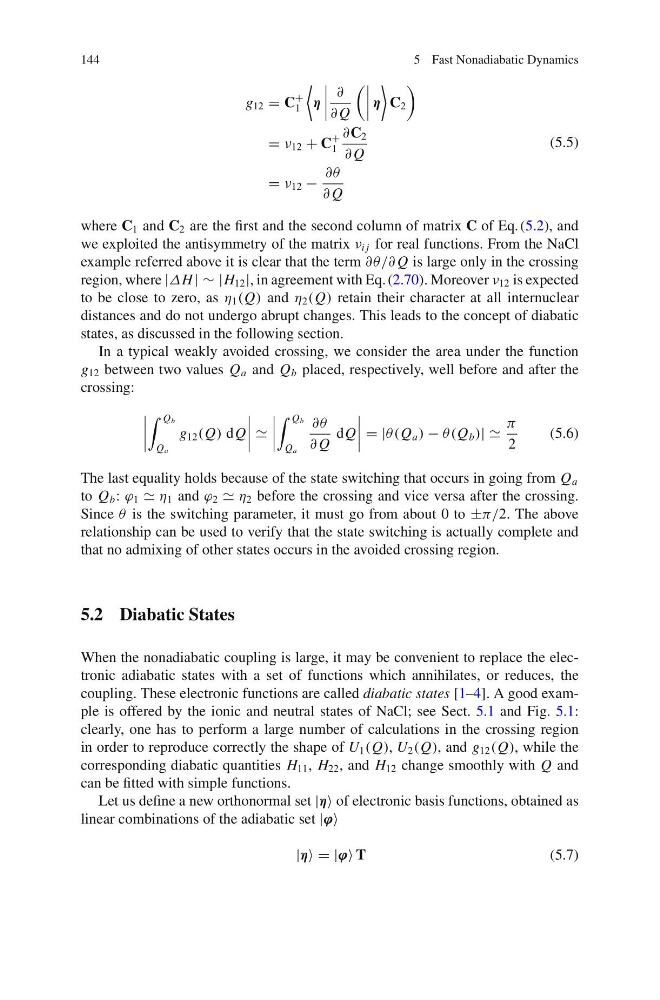
where C 1 and C 2 are the first and the second column of matrix C of Eq. (5.2), and
we exploited the antisymmetry of the matrix ν i j for real functions. From the NaCl
example referred above it is clear that the term ∂θ/∂ Q is large only in the crossing
region, where |ΔH | ∼ |H 12 |, in agreement with Eq. (2.70). Moreover ν 12 is expected
to be close to zero, as η 1 (Q) and η 2 (Q) retain their character at all internuclear
distances and do not undergo abrupt changes. This leads to the concept of diabatic
states, as discussed in the following section.
In a typical weakly avoided crossing, we consider the area under the function
g 12 between two values Q a and Q b placed, respectively, well before and after the
crossing:
Q b
Q a
g 12 (Q) dQ
Q b
Q a
∂θ
∂ Q
dQ
= |θ(Q a ) − θ(Q b )| |
π
2
(5.6)
The last equality holds because of the state switching that occurs in going from Q a
to Q b : ϕ 1 η 1 and ϕ 2 η 2 before the crossing and vice versa after the crossing.
Since θ is the switching parameter, it must go from about 0 to ±π/2. The above
relationship can be used to verify that the state switching is actually complete and
that no admixing of other states occurs in the avoided crossing region.
5.2 Diabatic States
When the nonadiabatic coupling is large, it may be convenient to replace the electronic adiabatic states with a set of functions which annihilates, or reduces, the
coupling. These electronic functions are called diabatic states [1–4]. A good example is offered by the ionic and neutral states of NaCl; see Sect. 5.1 and Fig. 5.1:
clearly, one has to perform a large number of calculations in the crossing region
in order to reproduce correctly the shape of U 1 (Q), U 2 (Q), and g 12 (Q), while the
corresponding diabatic quantities H 11 , H 22 , and H 12 change smoothly with Q and
can be fitted with simple functions.
Let us define a new orthonormal set |η of electronic basis functions, obtained as
linear combinations of the adiabatic set |ϕ
|η = |ϕ T
(5.7)
5 Fast Nonadiabatic Dynamics
g 12 = C
+
1
η
∂
∂ Q
η
C 2
= ν 12 + C
+
1
∂C 2
∂ Q
= ν 12 −
∂θ
∂ Q
(5.5)
where C 1 and C 2 are the first and the second column of matrix C of Eq. (5.2), and
we exploited the antisymmetry of the matrix ν i j for real functions. From the NaCl
example referred above it is clear that the term ∂θ/∂ Q is large only in the crossing
region, where |ΔH | ∼ |H 12 |, in agreement with Eq. (2.70). Moreover ν 12 is expected
to be close to zero, as η 1 (Q) and η 2 (Q) retain their character at all internuclear
distances and do not undergo abrupt changes. This leads to the concept of diabatic
states, as discussed in the following section.
In a typical weakly avoided crossing, we consider the area under the function
g 12 between two values Q a and Q b placed, respectively, well before and after the
crossing:
Q b
Q a
g 12 (Q) dQ
Q b
Q a
∂θ
∂ Q
dQ
= |θ(Q a ) − θ(Q b )| |
π
2
(5.6)
The last equality holds because of the state switching that occurs in going from Q a
to Q b : ϕ 1 η 1 and ϕ 2 η 2 before the crossing and vice versa after the crossing.
Since θ is the switching parameter, it must go from about 0 to ±π/2. The above
relationship can be used to verify that the state switching is actually complete and
that no admixing of other states occurs in the avoided crossing region.
5.2 Diabatic States
When the nonadiabatic coupling is large, it may be convenient to replace the electronic adiabatic states with a set of functions which annihilates, or reduces, the
coupling. These electronic functions are called diabatic states [1–4]. A good example is offered by the ionic and neutral states of NaCl; see Sect. 5.1 and Fig. 5.1:
clearly, one has to perform a large number of calculations in the crossing region
in order to reproduce correctly the shape of U 1 (Q), U 2 (Q), and g 12 (Q), while the
corresponding diabatic quantities H 11 , H 22 , and H 12 change smoothly with Q and
can be fitted with simple functions.
Let us define a new orthonormal set |η of electronic basis functions, obtained as
linear combinations of the adiabatic set |ϕ
|η = |ϕ T
(5.7)