

5.1 Noncrossing Rule and Avoided Crossings
143
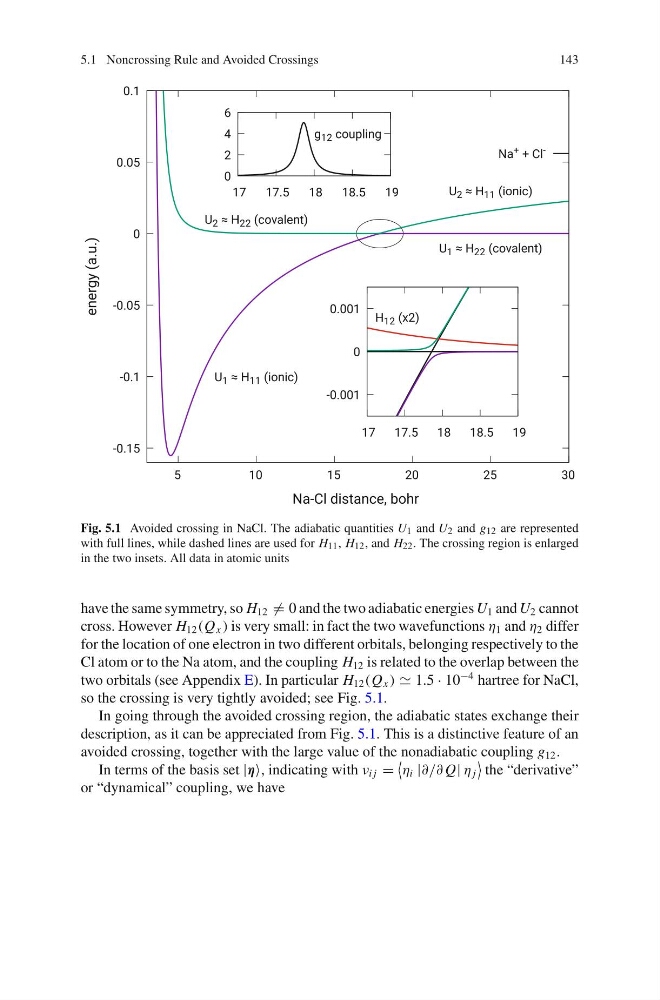
Fig. 5.1 Avoided crossing in NaCl. The adiabatic quantities U 1 and U 2 and g 12 are represented
with full lines, while dashed lines are used for H 11 , H 12 , and H 22 . The crossing region is enlarged
in the two insets. All data in atomic units
have the same symmetry, so H 12 = 0 and the two adiabatic energies U 1 and U 2 cannot
cross. However H 12 (Q x ) is very small: in fact the two wavefunctions η 1 and η 2 differ
for the location of one electron in two different orbitals, belonging respectively to the
Cl atom or to the Na atom, and the coupling H 12 is related to the overlap between the
two orbitals (see Appendix E). In particular H 12 (Q x ) 1.5 · 10
−4 hartree for NaCl,
so the crossing is very tightly avoided; see Fig. 5.1.
In going through the avoided crossing region, the adiabatic states exchange their
description, as it can be appreciated from Fig. 5.1. This is a distinctive feature of an
avoided crossing, together with the large value of the nonadiabatic coupling g 12 .
In terms of the basis set |η, indicating with ν i j =
η i |∂/∂ Q| η j
the “derivative”
or “dynamical” coupling, we have
143
Fig. 5.1 Avoided crossing in NaCl. The adiabatic quantities U 1 and U 2 and g 12 are represented
with full lines, while dashed lines are used for H 11 , H 12 , and H 22 . The crossing region is enlarged
in the two insets. All data in atomic units
have the same symmetry, so H 12 = 0 and the two adiabatic energies U 1 and U 2 cannot
cross. However H 12 (Q x ) is very small: in fact the two wavefunctions η 1 and η 2 differ
for the location of one electron in two different orbitals, belonging respectively to the
Cl atom or to the Na atom, and the coupling H 12 is related to the overlap between the
two orbitals (see Appendix E). In particular H 12 (Q x ) 1.5 · 10
−4 hartree for NaCl,
so the crossing is very tightly avoided; see Fig. 5.1.
In going through the avoided crossing region, the adiabatic states exchange their
description, as it can be appreciated from Fig. 5.1. This is a distinctive feature of an
avoided crossing, together with the large value of the nonadiabatic coupling g 12 .
In terms of the basis set |η, indicating with ν i j =
η i |∂/∂ Q| η j
the “derivative”
or “dynamical” coupling, we have