

142
5 Fast Nonadiabatic Dynamics
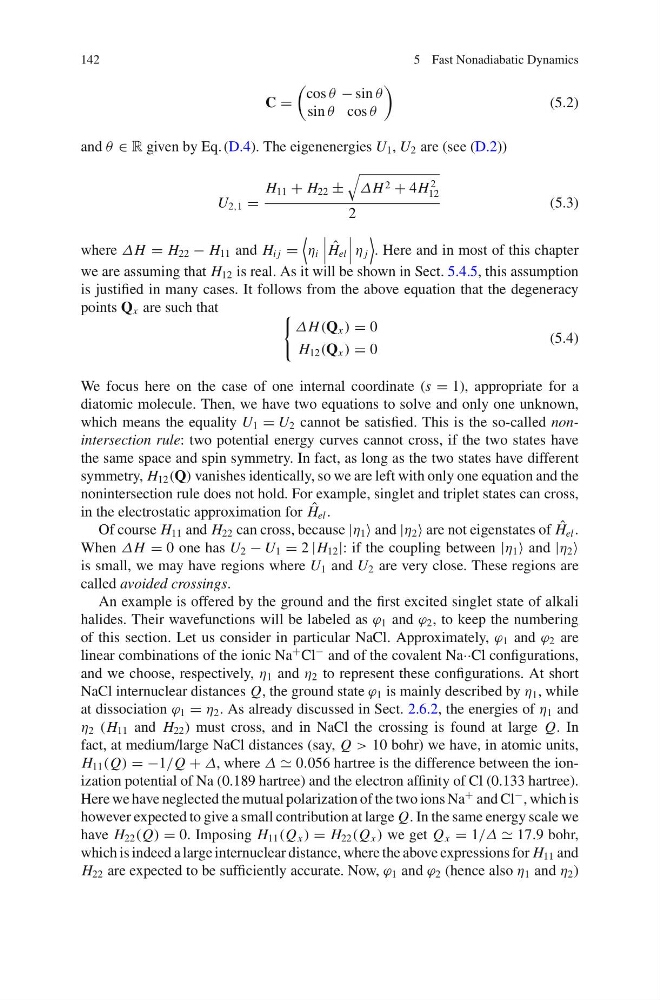
C =
cos θ − sin θ
sin θ cos θ
(5.2)
and θ ∈ R given by Eq. (D.4). The eigenenergies U 1 , U 2 are (see (D.2))
U 2,1 =
H 11 + H 22 ±
ΔH 2 + 4H
2
12
2
(5.3)
where ΔH = H 22 − H 11 and H i j =
η i
ˆ
H el
η j
. Here and in most of this chapter
we are assuming that H 12 is real. As it will be shown in Sect. 5.4.5, this assumption
is justified in many cases. It follows from the above equation that the degeneracy
points Q x are such that
ΔH (Q x ) = 0
H 12 (Q x ) = 0
(5.4)
We focus here on the case of one internal coordinate (s = 1), appropriate for a
diatomic molecule. Then, we have two equations to solve and only one unknown,
which means the equality U 1 = U 2 cannot be satisfied. This is the so-called nonintersection rule: two potential energy curves cannot cross, if the two states have
the same space and spin symmetry. In fact, as long as the two states have different
symmetry, H 12 (Q) vanishes identically, so we are left with only one equation and the
nonintersection rule does not hold. For example, singlet and triplet states can cross,
in the electrostatic approximation for ˆ
H el .
Of course H 11 and H 22 can cross, because |η 1 and |η 2 are not eigenstates of ˆ
H el .
When ΔH = 0 one has U 2 − U 1 = 2 |H 12 |: if the coupling between |η 1 and |η 2
is small, we may have regions where U 1 and U 2 are very close. These regions are
called avoided crossings.
An example is offered by the ground and the first excited singlet state of alkali
halides. Their wavefunctions will be labeled as ϕ 1 and ϕ 2 , to keep the numbering
of this section. Let us consider in particular NaCl. Approximately, ϕ 1 and ϕ 2 are
linear combinations of the ionic Na
+ Cl
− and of the covalent Na··Cl configurations,
and we choose, respectively, η 1 and η 2 to represent these configurations. At short
NaCl internuclear distances Q, the ground state ϕ 1 is mainly described by η 1 , while
at dissociation ϕ 1 = η 2 . As already discussed in Sect. 2.6.2, the energies of η 1 and
η 2 (H 11 and H 22 ) must cross, and in NaCl the crossing is found at large Q. In
fact, at medium/large NaCl distances (say, Q > 10 bohr) we have, in atomic units,
H 11 (Q) = −1/Q + Δ, where Δ 0.056 hartree is the difference between the ionization potential of Na (0.189 hartree) and the electron affinity of Cl (0.133 hartree).
Here we have neglected the mutual polarization of the two ions Na
+ and Cl
− , which is
however expected to give a small contribution at large Q. In the same energy scale we
have H 22 (Q) = 0. Imposing H 11 (Q x ) = H 22 (Q x ) we get Q x = 1/Δ 17.9 bohr,
which is indeed a large internuclear distance, where the above expressions for H 11 and
H 22 are expected to be sufficiently accurate. Now, ϕ 1 and ϕ 2 (hence also η 1 and η 2 )
5 Fast Nonadiabatic Dynamics
C =
cos θ − sin θ
sin θ cos θ
(5.2)
and θ ∈ R given by Eq. (D.4). The eigenenergies U 1 , U 2 are (see (D.2))
U 2,1 =
H 11 + H 22 ±
ΔH 2 + 4H
2
12
2
(5.3)
where ΔH = H 22 − H 11 and H i j =
η i
ˆ
H el
η j
. Here and in most of this chapter
we are assuming that H 12 is real. As it will be shown in Sect. 5.4.5, this assumption
is justified in many cases. It follows from the above equation that the degeneracy
points Q x are such that
ΔH (Q x ) = 0
H 12 (Q x ) = 0
(5.4)
We focus here on the case of one internal coordinate (s = 1), appropriate for a
diatomic molecule. Then, we have two equations to solve and only one unknown,
which means the equality U 1 = U 2 cannot be satisfied. This is the so-called nonintersection rule: two potential energy curves cannot cross, if the two states have
the same space and spin symmetry. In fact, as long as the two states have different
symmetry, H 12 (Q) vanishes identically, so we are left with only one equation and the
nonintersection rule does not hold. For example, singlet and triplet states can cross,
in the electrostatic approximation for ˆ
H el .
Of course H 11 and H 22 can cross, because |η 1 and |η 2 are not eigenstates of ˆ
H el .
When ΔH = 0 one has U 2 − U 1 = 2 |H 12 |: if the coupling between |η 1 and |η 2
is small, we may have regions where U 1 and U 2 are very close. These regions are
called avoided crossings.
An example is offered by the ground and the first excited singlet state of alkali
halides. Their wavefunctions will be labeled as ϕ 1 and ϕ 2 , to keep the numbering
of this section. Let us consider in particular NaCl. Approximately, ϕ 1 and ϕ 2 are
linear combinations of the ionic Na
+ Cl
− and of the covalent Na··Cl configurations,
and we choose, respectively, η 1 and η 2 to represent these configurations. At short
NaCl internuclear distances Q, the ground state ϕ 1 is mainly described by η 1 , while
at dissociation ϕ 1 = η 2 . As already discussed in Sect. 2.6.2, the energies of η 1 and
η 2 (H 11 and H 22 ) must cross, and in NaCl the crossing is found at large Q. In
fact, at medium/large NaCl distances (say, Q > 10 bohr) we have, in atomic units,
H 11 (Q) = −1/Q + Δ, where Δ 0.056 hartree is the difference between the ionization potential of Na (0.189 hartree) and the electron affinity of Cl (0.133 hartree).
Here we have neglected the mutual polarization of the two ions Na
+ and Cl
− , which is
however expected to give a small contribution at large Q. In the same energy scale we
have H 22 (Q) = 0. Imposing H 11 (Q x ) = H 22 (Q x ) we get Q x = 1/Δ 17.9 bohr,
which is indeed a large internuclear distance, where the above expressions for H 11 and
H 22 are expected to be sufficiently accurate. Now, ϕ 1 and ϕ 2 (hence also η 1 and η 2 )