

4
1 Introduction to Photochemistry
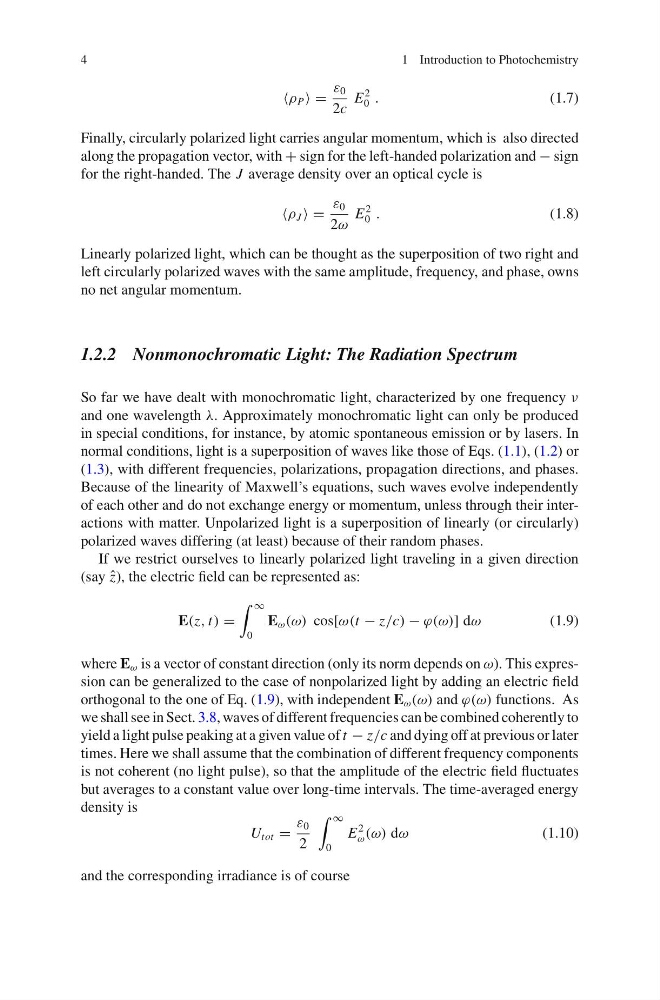
ρ P =
ε 0
2c
E
2
0 .
(1.7)
Finally, circularly polarized light carries angular momentum, which is also directed
along the propagation vector, with + sign for the left-handed polarization and − sign
for the right-handed. The J average density over an optical cycle is
ρ J =
ε 0
2ω
E
2
0 .
(1.8)
Linearly polarized light, which can be thought as the superposition of two right and
left circularly polarized waves with the same amplitude, frequency, and phase, owns
no net angular momentum.
1.2.2 Nonmonochromatic Light: The Radiation Spectrum
So far we have dealt with monochromatic light, characterized by one frequency ν
and one wavelength λ. Approximately monochromatic light can only be produced
in special conditions, for instance, by atomic spontaneous emission or by lasers. In
normal conditions, light is a superposition of waves like those of Eqs. (1.1), (1.2) or
(1.3), with different frequencies, polarizations, propagation directions, and phases.
Because of the linearity of Maxwell’s equations, such waves evolve independently
of each other and do not exchange energy or momentum, unless through their interactions with matter. Unpolarized light is a superposition of linearly (or circularly)
polarized waves differing (at least) because of their random phases.
If we restrict ourselves to linearly polarized light traveling in a given direction
(say ˆ
z), the electric field can be represented as:
E(z, t) =
∞
0
E ω (ω) cos[ω(t − z/c) − ϕ(ω)] dω
(1.9)
where E ω is a vector of constant direction (only its norm depends on ω). This expression can be generalized to the case of nonpolarized light by adding an electric field
orthogonal to the one of Eq. (1.9), with independent E ω (ω) and ϕ(ω) functions. As
we shall see in Sect. 3.8, waves of different frequencies can be combined coherently to
yield a light pulse peaking at a given value of t − z/c and dying off at previous or later
times. Here we shall assume that the combination of different frequency components
is not coherent (no light pulse), so that the amplitude of the electric field fluctuates
but averages to a constant value over long-time intervals. The time-averaged energy
density is
U tot =
ε 0
2
∞
0
E
2
ω (ω) dω
(1.10)
and the corresponding irradiance is of course
1 Introduction to Photochemistry
ρ P =
ε 0
2c
E
2
0 .
(1.7)
Finally, circularly polarized light carries angular momentum, which is also directed
along the propagation vector, with + sign for the left-handed polarization and − sign
for the right-handed. The J average density over an optical cycle is
ρ J =
ε 0
2ω
E
2
0 .
(1.8)
Linearly polarized light, which can be thought as the superposition of two right and
left circularly polarized waves with the same amplitude, frequency, and phase, owns
no net angular momentum.
1.2.2 Nonmonochromatic Light: The Radiation Spectrum
So far we have dealt with monochromatic light, characterized by one frequency ν
and one wavelength λ. Approximately monochromatic light can only be produced
in special conditions, for instance, by atomic spontaneous emission or by lasers. In
normal conditions, light is a superposition of waves like those of Eqs. (1.1), (1.2) or
(1.3), with different frequencies, polarizations, propagation directions, and phases.
Because of the linearity of Maxwell’s equations, such waves evolve independently
of each other and do not exchange energy or momentum, unless through their interactions with matter. Unpolarized light is a superposition of linearly (or circularly)
polarized waves differing (at least) because of their random phases.
If we restrict ourselves to linearly polarized light traveling in a given direction
(say ˆ
z), the electric field can be represented as:
E(z, t) =
∞
0
E ω (ω) cos[ω(t − z/c) − ϕ(ω)] dω
(1.9)
where E ω is a vector of constant direction (only its norm depends on ω). This expression can be generalized to the case of nonpolarized light by adding an electric field
orthogonal to the one of Eq. (1.9), with independent E ω (ω) and ϕ(ω) functions. As
we shall see in Sect. 3.8, waves of different frequencies can be combined coherently to
yield a light pulse peaking at a given value of t − z/c and dying off at previous or later
times. Here we shall assume that the combination of different frequency components
is not coherent (no light pulse), so that the amplitude of the electric field fluctuates
but averages to a constant value over long-time intervals. The time-averaged energy
density is
U tot =
ε 0
2
∞
0
E
2
ω (ω) dω
(1.10)
and the corresponding irradiance is of course