

1.2 Light and Photons
5
I tot =
c ε 0
2
∞
0
E
2
ω (ω) dω .
(1.11)
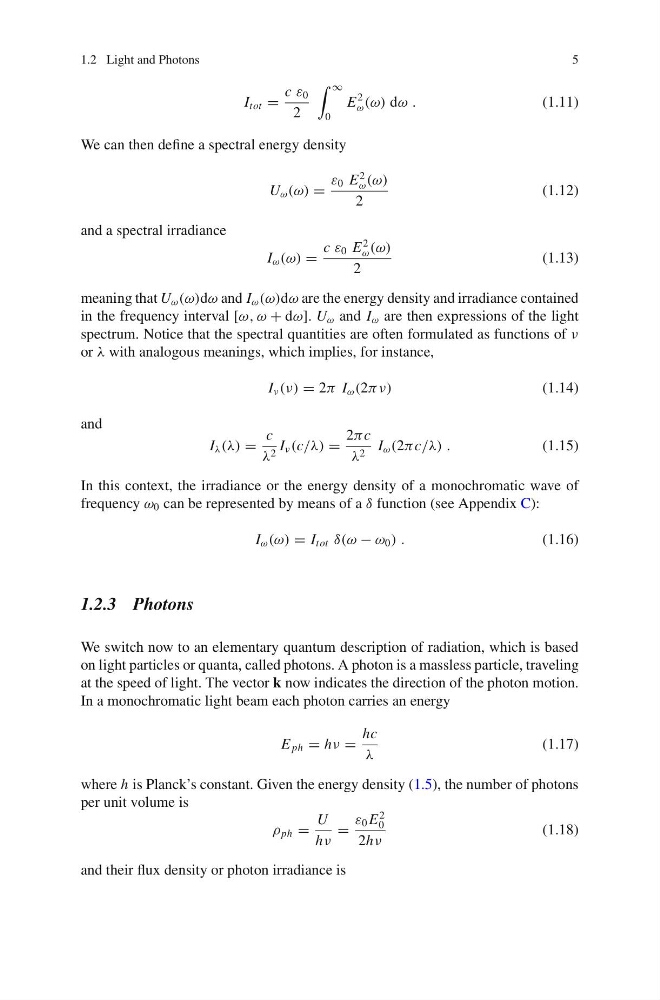
We can then define a spectral energy density
U ω (ω) =
ε 0 E
2
ω (ω)
2
(1.12)
and a spectral irradiance
I ω (ω) =
c ε 0 E
2
ω (ω)
2
(1.13)
meaning that U ω (ω)dω and I ω (ω)dω are the energy density and irradiance contained
in the frequency interval [ω, ω + dω]. U ω and I ω are then expressions of the light
spectrum. Notice that the spectral quantities are often formulated as functions of ν
or λ with analogous meanings, which implies, for instance,
I ν (ν) = 2π I ω (2πν)
(1.14)
and
I λ (λ) =
c
λ 2 I ν (c/λ) =
2π c
λ 2 I ω (2π c/λ) .
(1.15)
In this context, the irradiance or the energy density of a monochromatic wave of
frequency ω 0 can be represented by means of a δ function (see Appendix C):
I ω (ω) = I tot δ(ω − ω 0 ) .
(1.16)
1.2.3 Photons
We switch now to an elementary quantum description of radiation, which is based
on light particles or quanta, called photons. A photon is a massless particle, traveling
at the speed of light. The vector k now indicates the direction of the photon motion.
In a monochromatic light beam each photon carries an energy
E ph = hν =
hc
λ
(1.17)
where h is Planck’s constant. Given the energy density (1.5), the number of photons
per unit volume is
ρ ph =
U
hν
=
ε 0 E
2
0
2hν
(1.18)
and their flux density or photon irradiance is
5
I tot =
c ε 0
2
∞
0
E
2
ω (ω) dω .
(1.11)
We can then define a spectral energy density
U ω (ω) =
ε 0 E
2
ω (ω)
2
(1.12)
and a spectral irradiance
I ω (ω) =
c ε 0 E
2
ω (ω)
2
(1.13)
meaning that U ω (ω)dω and I ω (ω)dω are the energy density and irradiance contained
in the frequency interval [ω, ω + dω]. U ω and I ω are then expressions of the light
spectrum. Notice that the spectral quantities are often formulated as functions of ν
or λ with analogous meanings, which implies, for instance,
I ν (ν) = 2π I ω (2πν)
(1.14)
and
I λ (λ) =
c
λ 2 I ν (c/λ) =
2π c
λ 2 I ω (2π c/λ) .
(1.15)
In this context, the irradiance or the energy density of a monochromatic wave of
frequency ω 0 can be represented by means of a δ function (see Appendix C):
I ω (ω) = I tot δ(ω − ω 0 ) .
(1.16)
1.2.3 Photons
We switch now to an elementary quantum description of radiation, which is based
on light particles or quanta, called photons. A photon is a massless particle, traveling
at the speed of light. The vector k now indicates the direction of the photon motion.
In a monochromatic light beam each photon carries an energy
E ph = hν =
hc
λ
(1.17)
where h is Planck’s constant. Given the energy density (1.5), the number of photons
per unit volume is
ρ ph =
U
hν
=
ε 0 E
2
0
2hν
(1.18)
and their flux density or photon irradiance is