

1.2 Light and Photons
3
1.2.1 Monochromatic Light
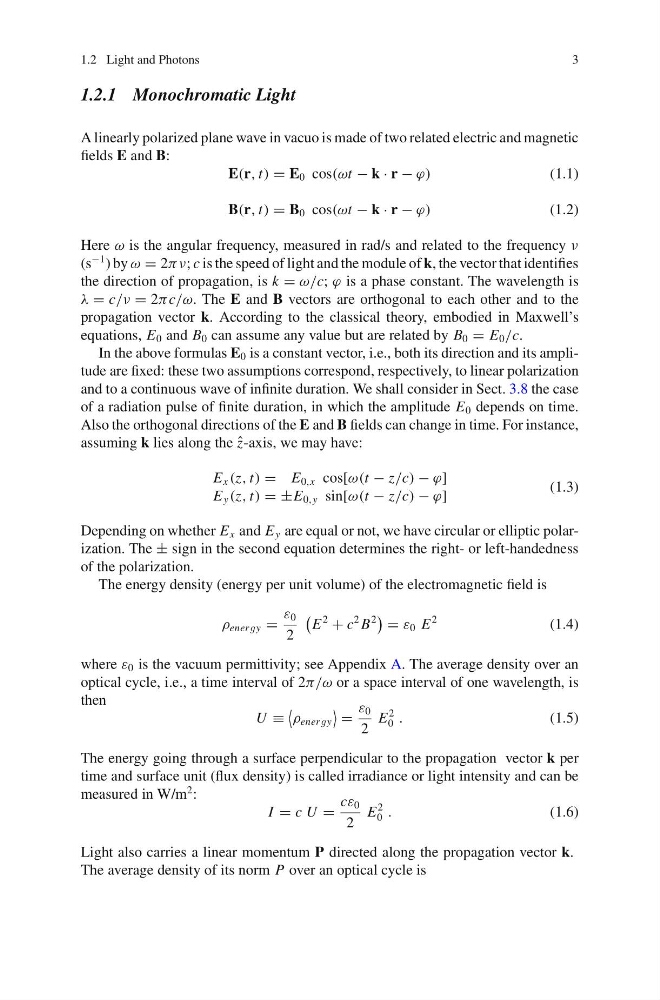
A linearly polarized plane wave in vacuo is made of two related electric and magnetic
fields E and B:
E(r, t) = E 0 cos(ωt − k · r − ϕ)
(1.1)
B(r, t) = B 0 cos(ωt − k · r − ϕ)
(1.2)
Here ω is the angular frequency, measured in rad/s and related to the frequency ν
(s
−1 ) by ω = 2πν; c is the speed of light and the module of k, the vector that identifies
the direction of propagation, is k = ω/c; ϕ is a phase constant. The wavelength is
λ = c/ν = 2π c/ω. The E and B vectors are orthogonal to each other and to the
propagation vector k. According to the classical theory, embodied in Maxwell’s
equations, E 0 and B 0 can assume any value but are related by B 0 = E 0 /c.
In the above formulas E 0 is a constant vector, i.e., both its direction and its amplitude are fixed: these two assumptions correspond, respectively, to linear polarization
and to a continuous wave of infinite duration. We shall consider in Sect. 3.8 the case
of a radiation pulse of finite duration, in which the amplitude E 0 depends on time.
Also the orthogonal directions of the E and B fields can change in time. For instance,
assuming k lies along the ˆ
z-axis, we may have:
E x (z, t) = E 0,x cos[ω(t − z/c) − ϕ]
E y (z, t) = ±E 0,y sin[ω(t − z/c) − ϕ]
(1.3)
Depending on whether E x and E y are equal or not, we have circular or elliptic polarization. The ± sign in the second equation determines the right- or left-handedness
of the polarization.
The energy density (energy per unit volume) of the electromagnetic field is
ρ energ y =
ε 0
2
E
2
+ c
2 B
2
= ε 0 E
2
(1.4)
where ε 0 is the vacuum permittivity; see Appendix A. The average density over an
optical cycle, i.e., a time interval of 2π/ω or a space interval of one wavelength, is
then
U ≡
ρ energ y
=
ε 0
2
E
2
0 .
(1.5)
The energy going through a surface perpendicular to the propagation vector k per
time and surface unit (flux density) is called irradiance or light intensity and can be
measured in W/m
2 :
I = c U =
cε 0
2
E
2
0 .
(1.6)
Light also carries a linear momentum P directed along the propagation vector k.
The average density of its norm P over an optical cycle is
3
1.2.1 Monochromatic Light
A linearly polarized plane wave in vacuo is made of two related electric and magnetic
fields E and B:
E(r, t) = E 0 cos(ωt − k · r − ϕ)
(1.1)
B(r, t) = B 0 cos(ωt − k · r − ϕ)
(1.2)
Here ω is the angular frequency, measured in rad/s and related to the frequency ν
(s
−1 ) by ω = 2πν; c is the speed of light and the module of k, the vector that identifies
the direction of propagation, is k = ω/c; ϕ is a phase constant. The wavelength is
λ = c/ν = 2π c/ω. The E and B vectors are orthogonal to each other and to the
propagation vector k. According to the classical theory, embodied in Maxwell’s
equations, E 0 and B 0 can assume any value but are related by B 0 = E 0 /c.
In the above formulas E 0 is a constant vector, i.e., both its direction and its amplitude are fixed: these two assumptions correspond, respectively, to linear polarization
and to a continuous wave of infinite duration. We shall consider in Sect. 3.8 the case
of a radiation pulse of finite duration, in which the amplitude E 0 depends on time.
Also the orthogonal directions of the E and B fields can change in time. For instance,
assuming k lies along the ˆ
z-axis, we may have:
E x (z, t) = E 0,x cos[ω(t − z/c) − ϕ]
E y (z, t) = ±E 0,y sin[ω(t − z/c) − ϕ]
(1.3)
Depending on whether E x and E y are equal or not, we have circular or elliptic polarization. The ± sign in the second equation determines the right- or left-handedness
of the polarization.
The energy density (energy per unit volume) of the electromagnetic field is
ρ energ y =
ε 0
2
E
2
+ c
2 B
2
= ε 0 E
2
(1.4)
where ε 0 is the vacuum permittivity; see Appendix A. The average density over an
optical cycle, i.e., a time interval of 2π/ω or a space interval of one wavelength, is
then
U ≡
ρ energ y
=
ε 0
2
E
2
0 .
(1.5)
The energy going through a surface perpendicular to the propagation vector k per
time and surface unit (flux density) is called irradiance or light intensity and can be
measured in W/m
2 :
I = c U =
cε 0
2
E
2
0 .
(1.6)
Light also carries a linear momentum P directed along the propagation vector k.
The average density of its norm P over an optical cycle is