

4.5 Dynamic Environmental Effects
135
classical
mode 6
mode 5
mode 4
mode 3
mode 2
mode 1
K B T , cm −1
average energy in each mode E
r
T , cm −1
1000
800
600
400
200
0
1000
800
600
400
200
0
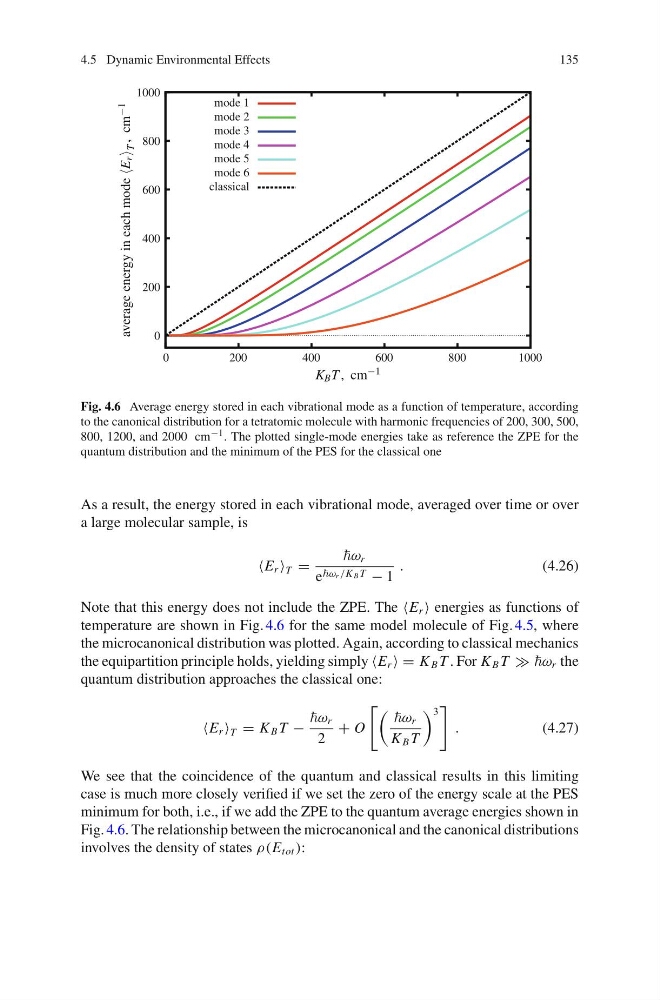
Fig. 4.6 Average energy stored in each vibrational mode as a function of temperature, according
to the canonical distribution for a tetratomic molecule with harmonic frequencies of 200, 300, 500,
800, 1200, and 2000 cm −1 . The plotted single-mode energies take as reference the ZPE for the
quantum distribution and the minimum of the PES for the classical one
As a result, the energy stored in each vibrational mode, averaged over time or over
a large molecular sample, is
E r T =
ω r
e ω r /K B T − 1
.
(4.26)
Note that this energy does not include the ZPE. The E r energies as functions of
temperature are shown in Fig. 4.6 for the same model molecule of Fig. 4.5, where
the microcanonical distribution was plotted. Again, according to classical mechanics
the equipartition principle holds, yielding simply E r = K B T . For K B T ω r the
quantum distribution approaches the classical one:
E r T = K B T −
ω r
2
+ O
ω r
K B T
3
.
(4.27)
We see that the coincidence of the quantum and classical results in this limiting
case is much more closely verified if we set the zero of the energy scale at the PES
minimum for both, i.e., if we add the ZPE to the quantum average energies shown in
Fig. 4.6. The relationship between the microcanonical and the canonical distributions
involves the density of states ρ(E tot ):
135
classical
mode 6
mode 5
mode 4
mode 3
mode 2
mode 1
K B T , cm −1
average energy in each mode E
r
T , cm −1
1000
800
600
400
200
0
1000
800
600
400
200
0
Fig. 4.6 Average energy stored in each vibrational mode as a function of temperature, according
to the canonical distribution for a tetratomic molecule with harmonic frequencies of 200, 300, 500,
800, 1200, and 2000 cm −1 . The plotted single-mode energies take as reference the ZPE for the
quantum distribution and the minimum of the PES for the classical one
As a result, the energy stored in each vibrational mode, averaged over time or over
a large molecular sample, is
E r T =
ω r
e ω r /K B T − 1
.
(4.26)
Note that this energy does not include the ZPE. The E r energies as functions of
temperature are shown in Fig. 4.6 for the same model molecule of Fig. 4.5, where
the microcanonical distribution was plotted. Again, according to classical mechanics
the equipartition principle holds, yielding simply E r = K B T . For K B T ω r the
quantum distribution approaches the classical one:
E r T = K B T −
ω r
2
+ O
ω r
K B T
3
.
(4.27)
We see that the coincidence of the quantum and classical results in this limiting
case is much more closely verified if we set the zero of the energy scale at the PES
minimum for both, i.e., if we add the ZPE to the quantum average energies shown in
Fig. 4.6. The relationship between the microcanonical and the canonical distributions
involves the density of states ρ(E tot ):