

134
4 Wavepacket Dynamics and Geometrical Relaxation
a slow one due to the reorientation and displacement of the solvent molecules. The
fast polarization is frequency dependent and can be quantified by the refraction index,
while the slow one is most important for polar solvents where it yields the largest
contribution to the static permittivity. Fast charge rearrangements of the solute such
as electron or proton transfers may be therefore energetically destabilized because
the medium does not relax dielectrically in comparably short times, causing a sort
of “dielectric friction.” See refs. [5, 7, 10] for deeper discussions on this topic.
To the systematic delay effects discussed above one must add the random thermal
fluctuations of the environment: together, they result in instantaneous interactions that
depart from the mean values corresponding to the statically modified PESs as defined
above and can be labeled as “dynamic” effects. In photochemistry, one ubiquitous
consequence is the energy transfer from the excited chromophores to the medium
or, to a lesser extent, the other way around: only in very rarefied gases or molecular
beams the dynamics of a single molecule can be considered as energy conserving. In
this context, Langevin-type models play a role analogous to the dielectric continuum
ones and are very useful to understand and to predict semiquantitatively the condensed state photodynamics [12, 16, 17]. They mimic the effect of the medium on
the nuclear dynamics by a friction term added to the nuclear equations of motion. As
friction can only subtract energy to the molecule, a corresponding stochastic force
can be added, in order to obtain thermal equilibrium in the long term. We then see
that, within the continuum approximations, static and dynamic effects are perfectly
separated. However, since basically the same intermolecular interactions (electrostatics, dispersion, repulsion, and so on) are involved both in the static and in the
dynamic effects, a rigorous distinction cannot be made without a reference to an
arbitrary equilibrium state or to ad hoc approximations.
The vibrational energy transfer between interacting molecules is conceptually
similar to IVR. One can extend the model discussed in the previous section by considering two or more molecules as a single one. The vibrational Hamiltonian of the
“supermolecule,” in the harmonic approximation, provides the zero-order description of the system, and the anharmonic terms couple the normal modes as before.
However, some differences must be highlighted. First, the relative translational and
rotational motions of the molecules often give place to multiple minima, all accessible at thermal energies, and in a normal mode treatment they usually correspond
to low-frequency modes with very anharmonic potentials: such motions are therefore not correctly treated in the one-minimum harmonic approximation. Second,
the anharmonic interaction terms between modes localized on different molecules
are normally smaller than the intramolecular ones, so the intermolecular vibrational
energy transfer is slower, usually requiring times closer to 10 ps than to 1 ps. Third,
after a sufficiently long time each molecule will be thermally equilibrated with its
environment, i.e., the occupation of each energy level will obey Boltzmann statistics.
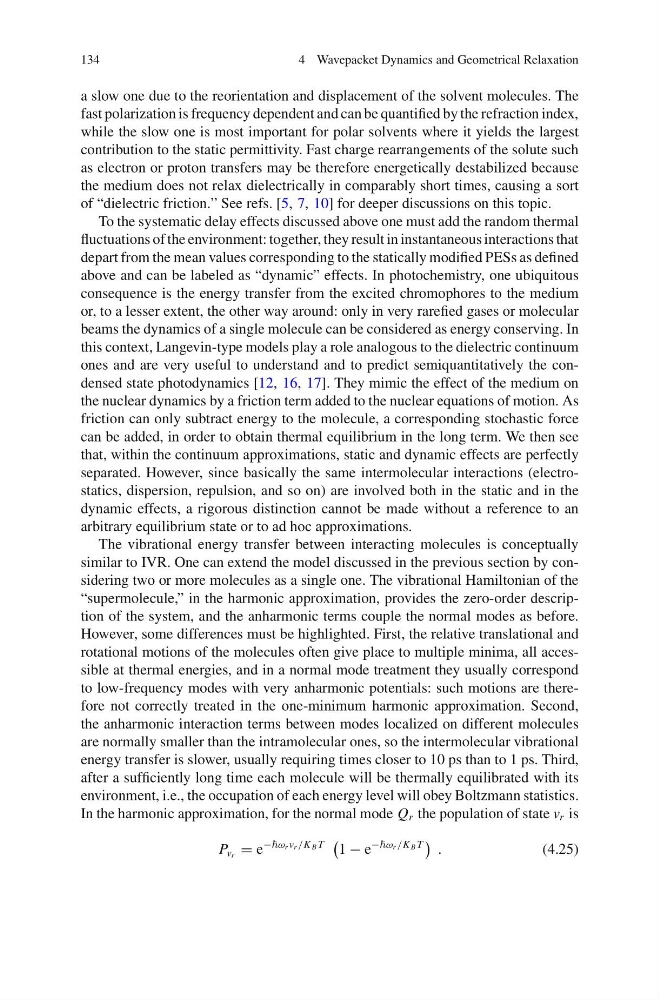
In the harmonic approximation, for the normal mode Q r the population of state v r is
P v r = e
−ω r v r /K B T
1 − e
−ω r /K B T
.
(4.25)
4 Wavepacket Dynamics and Geometrical Relaxation
a slow one due to the reorientation and displacement of the solvent molecules. The
fast polarization is frequency dependent and can be quantified by the refraction index,
while the slow one is most important for polar solvents where it yields the largest
contribution to the static permittivity. Fast charge rearrangements of the solute such
as electron or proton transfers may be therefore energetically destabilized because
the medium does not relax dielectrically in comparably short times, causing a sort
of “dielectric friction.” See refs. [5, 7, 10] for deeper discussions on this topic.
To the systematic delay effects discussed above one must add the random thermal
fluctuations of the environment: together, they result in instantaneous interactions that
depart from the mean values corresponding to the statically modified PESs as defined
above and can be labeled as “dynamic” effects. In photochemistry, one ubiquitous
consequence is the energy transfer from the excited chromophores to the medium
or, to a lesser extent, the other way around: only in very rarefied gases or molecular
beams the dynamics of a single molecule can be considered as energy conserving. In
this context, Langevin-type models play a role analogous to the dielectric continuum
ones and are very useful to understand and to predict semiquantitatively the condensed state photodynamics [12, 16, 17]. They mimic the effect of the medium on
the nuclear dynamics by a friction term added to the nuclear equations of motion. As
friction can only subtract energy to the molecule, a corresponding stochastic force
can be added, in order to obtain thermal equilibrium in the long term. We then see
that, within the continuum approximations, static and dynamic effects are perfectly
separated. However, since basically the same intermolecular interactions (electrostatics, dispersion, repulsion, and so on) are involved both in the static and in the
dynamic effects, a rigorous distinction cannot be made without a reference to an
arbitrary equilibrium state or to ad hoc approximations.
The vibrational energy transfer between interacting molecules is conceptually
similar to IVR. One can extend the model discussed in the previous section by considering two or more molecules as a single one. The vibrational Hamiltonian of the
“supermolecule,” in the harmonic approximation, provides the zero-order description of the system, and the anharmonic terms couple the normal modes as before.
However, some differences must be highlighted. First, the relative translational and
rotational motions of the molecules often give place to multiple minima, all accessible at thermal energies, and in a normal mode treatment they usually correspond
to low-frequency modes with very anharmonic potentials: such motions are therefore not correctly treated in the one-minimum harmonic approximation. Second,
the anharmonic interaction terms between modes localized on different molecules
are normally smaller than the intramolecular ones, so the intermolecular vibrational
energy transfer is slower, usually requiring times closer to 10 ps than to 1 ps. Third,
after a sufficiently long time each molecule will be thermally equilibrated with its
environment, i.e., the occupation of each energy level will obey Boltzmann statistics.
In the harmonic approximation, for the normal mode Q r the population of state v r is
P v r = e
−ω r v r /K B T
1 − e
−ω r /K B T
.
(4.25)