

4.4 Static Environmental Effects
133
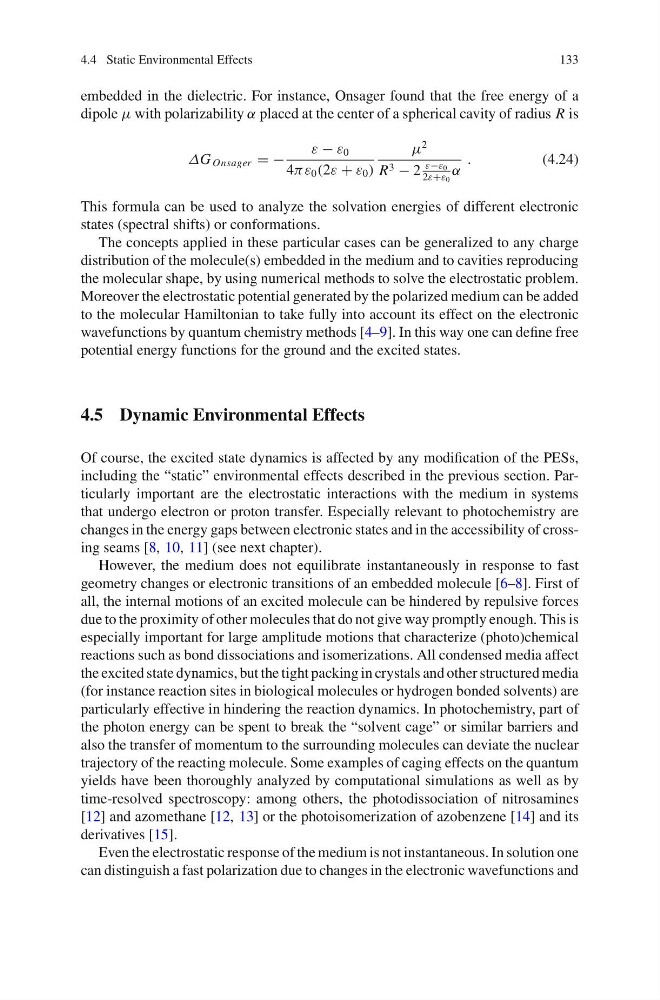
embedded in the dielectric. For instance, Onsager found that the free energy of a
dipole μ with polarizability α placed at the center of a spherical cavity of radius R is
ΔG Onsager = −
ε − ε 0
4πε 0 (2ε + ε 0 )
μ
2
R 3 − 2
ε−ε 0
2ε+ε 0
α
.
(4.24)
This formula can be used to analyze the solvation energies of different electronic
states (spectral shifts) or conformations.
The concepts applied in these particular cases can be generalized to any charge
distribution of the molecule(s) embedded in the medium and to cavities reproducing
the molecular shape, by using numerical methods to solve the electrostatic problem.
Moreover the electrostatic potential generated by the polarized medium can be added
to the molecular Hamiltonian to take fully into account its effect on the electronic
wavefunctions by quantum chemistry methods [4–9]. In this way one can define free
potential energy functions for the ground and the excited states.
4.5 Dynamic Environmental Effects
Of course, the excited state dynamics is affected by any modification of the PESs,
including the “static” environmental effects described in the previous section. Particularly important are the electrostatic interactions with the medium in systems
that undergo electron or proton transfer. Especially relevant to photochemistry are
changes in the energy gaps between electronic states and in the accessibility of crossing seams [8, 10, 11] (see next chapter).
However, the medium does not equilibrate instantaneously in response to fast
geometry changes or electronic transitions of an embedded molecule [6–8]. First of
all, the internal motions of an excited molecule can be hindered by repulsive forces
due to the proximity of other molecules that do not give way promptly enough. This is
especially important for large amplitude motions that characterize (photo)chemical
reactions such as bond dissociations and isomerizations. All condensed media affect
the excited state dynamics, but the tight packing in crystals and other structured media
(for instance reaction sites in biological molecules or hydrogen bonded solvents) are
particularly effective in hindering the reaction dynamics. In photochemistry, part of
the photon energy can be spent to break the “solvent cage” or similar barriers and
also the transfer of momentum to the surrounding molecules can deviate the nuclear
trajectory of the reacting molecule. Some examples of caging effects on the quantum
yields have been thoroughly analyzed by computational simulations as well as by
time-resolved spectroscopy: among others, the photodissociation of nitrosamines
[12] and azomethane [12, 13] or the photoisomerization of azobenzene [14] and its
derivatives [15].
Even the electrostatic response of the medium is not instantaneous. In solution one
can distinguish a fast polarization due to changes in the electronic wavefunctions and
133
embedded in the dielectric. For instance, Onsager found that the free energy of a
dipole μ with polarizability α placed at the center of a spherical cavity of radius R is
ΔG Onsager = −
ε − ε 0
4πε 0 (2ε + ε 0 )
μ
2
R 3 − 2
ε−ε 0
2ε+ε 0
α
.
(4.24)
This formula can be used to analyze the solvation energies of different electronic
states (spectral shifts) or conformations.
The concepts applied in these particular cases can be generalized to any charge
distribution of the molecule(s) embedded in the medium and to cavities reproducing
the molecular shape, by using numerical methods to solve the electrostatic problem.
Moreover the electrostatic potential generated by the polarized medium can be added
to the molecular Hamiltonian to take fully into account its effect on the electronic
wavefunctions by quantum chemistry methods [4–9]. In this way one can define free
potential energy functions for the ground and the excited states.
4.5 Dynamic Environmental Effects
Of course, the excited state dynamics is affected by any modification of the PESs,
including the “static” environmental effects described in the previous section. Particularly important are the electrostatic interactions with the medium in systems
that undergo electron or proton transfer. Especially relevant to photochemistry are
changes in the energy gaps between electronic states and in the accessibility of crossing seams [8, 10, 11] (see next chapter).
However, the medium does not equilibrate instantaneously in response to fast
geometry changes or electronic transitions of an embedded molecule [6–8]. First of
all, the internal motions of an excited molecule can be hindered by repulsive forces
due to the proximity of other molecules that do not give way promptly enough. This is
especially important for large amplitude motions that characterize (photo)chemical
reactions such as bond dissociations and isomerizations. All condensed media affect
the excited state dynamics, but the tight packing in crystals and other structured media
(for instance reaction sites in biological molecules or hydrogen bonded solvents) are
particularly effective in hindering the reaction dynamics. In photochemistry, part of
the photon energy can be spent to break the “solvent cage” or similar barriers and
also the transfer of momentum to the surrounding molecules can deviate the nuclear
trajectory of the reacting molecule. Some examples of caging effects on the quantum
yields have been thoroughly analyzed by computational simulations as well as by
time-resolved spectroscopy: among others, the photodissociation of nitrosamines
[12] and azomethane [12, 13] or the photoisomerization of azobenzene [14] and its
derivatives [15].
Even the electrostatic response of the medium is not instantaneous. In solution one
can distinguish a fast polarization due to changes in the electronic wavefunctions and