

132
4 Wavepacket Dynamics and Geometrical Relaxation
4.4 Static Environmental Effects
In Sect. 2.8 we discussed the environmental effects on the absorption and emission
spectra, which are essentially due to modifications of the ground and excited state
PESs and wavefunctions caused by the medium. Such effects can be labeled as
“static,” in the sense that the modifications are not time dependent and concern the
stationary states of the system.
A quantitative description of the static effects may be based on a full optimization
of the medium coordinates, which can be a reasonable option for a chromophore
embedded in a crystal or adsorbed on a solid surface. However, normally such an
optimization is only partially representative of the physical reality because of the
existence of multiple minima in the energy landscape and because of thermal motions
that affect the relative positions and orientations of interacting molecules.
A more comprehensive definition must involve the thermal averaging over the
medium coordinates or states. An approximate way to define and compute the static
effects of the environment on a molecule of interest is to treat the medium as a continuum characterized by its macroscopic response properties, such as the permittivity
ε or the refraction index n. In fact, such properties reflect not only the molecular
features of the medium, but also the appropriate statistical averaging. An important
consequence is that the potential energy surfaces defined by this approach include
the entropic contribution, i.e., are free energy functions of the internal coordinates
of the molecule embedded in the dielectric: after averaging over the medium coordinates, the only parameter describing the dielectric is its polarization [4]. The simplest
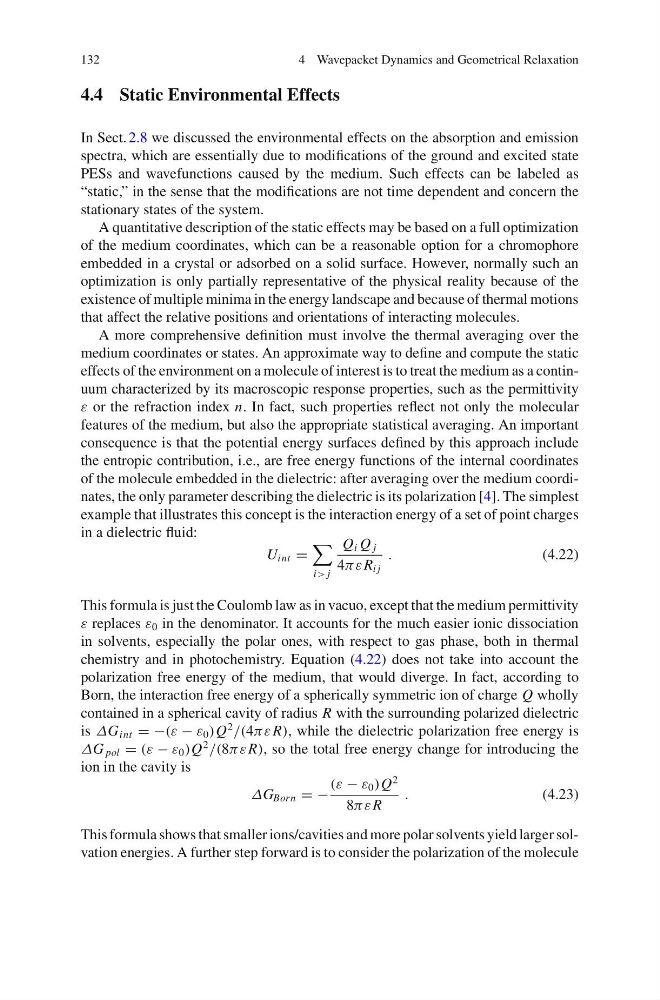
example that illustrates this concept is the interaction energy of a set of point charges
in a dielectric fluid:
U int =
i> j
Q i Q j
4πε R i j
.
(4.22)
This formula is just the Coulomb law as in vacuo, except that the medium permittivity
ε replaces ε 0 in the denominator. It accounts for the much easier ionic dissociation
in solvents, especially the polar ones, with respect to gas phase, both in thermal
chemistry and in photochemistry. Equation (4.22) does not take into account the
polarization free energy of the medium, that would diverge. In fact, according to
Born, the interaction free energy of a spherically symmetric ion of charge Q wholly
contained in a spherical cavity of radius R with the surrounding polarized dielectric
is ΔG int = −(ε − ε 0 )Q
2
/(4πε R), while the dielectric polarization free energy is
ΔG pol = (ε − ε 0 )Q
2
/(8πε R), so the total free energy change for introducing the
ion in the cavity is
ΔG Born = −
(ε − ε 0 )Q
2
8πε R
.
(4.23)
This formula shows that smaller ions/cavities and more polar solvents yield larger solvation energies. A further step forward is to consider the polarization of the molecule
4 Wavepacket Dynamics and Geometrical Relaxation
4.4 Static Environmental Effects
In Sect. 2.8 we discussed the environmental effects on the absorption and emission
spectra, which are essentially due to modifications of the ground and excited state
PESs and wavefunctions caused by the medium. Such effects can be labeled as
“static,” in the sense that the modifications are not time dependent and concern the
stationary states of the system.
A quantitative description of the static effects may be based on a full optimization
of the medium coordinates, which can be a reasonable option for a chromophore
embedded in a crystal or adsorbed on a solid surface. However, normally such an
optimization is only partially representative of the physical reality because of the
existence of multiple minima in the energy landscape and because of thermal motions
that affect the relative positions and orientations of interacting molecules.
A more comprehensive definition must involve the thermal averaging over the
medium coordinates or states. An approximate way to define and compute the static
effects of the environment on a molecule of interest is to treat the medium as a continuum characterized by its macroscopic response properties, such as the permittivity
ε or the refraction index n. In fact, such properties reflect not only the molecular
features of the medium, but also the appropriate statistical averaging. An important
consequence is that the potential energy surfaces defined by this approach include
the entropic contribution, i.e., are free energy functions of the internal coordinates
of the molecule embedded in the dielectric: after averaging over the medium coordinates, the only parameter describing the dielectric is its polarization [4]. The simplest
example that illustrates this concept is the interaction energy of a set of point charges
in a dielectric fluid:
U int =
i> j
Q i Q j
4πε R i j
.
(4.22)
This formula is just the Coulomb law as in vacuo, except that the medium permittivity
ε replaces ε 0 in the denominator. It accounts for the much easier ionic dissociation
in solvents, especially the polar ones, with respect to gas phase, both in thermal
chemistry and in photochemistry. Equation (4.22) does not take into account the
polarization free energy of the medium, that would diverge. In fact, according to
Born, the interaction free energy of a spherically symmetric ion of charge Q wholly
contained in a spherical cavity of radius R with the surrounding polarized dielectric
is ΔG int = −(ε − ε 0 )Q
2
/(4πε R), while the dielectric polarization free energy is
ΔG pol = (ε − ε 0 )Q
2
/(8πε R), so the total free energy change for introducing the
ion in the cavity is
ΔG Born = −
(ε − ε 0 )Q
2
8πε R
.
(4.23)
This formula shows that smaller ions/cavities and more polar solvents yield larger solvation energies. A further step forward is to consider the polarization of the molecule