

4.3 Intramolecular Vibrational Energy Redistribution
131
classical
mode 6
mode 5
mode 4
mode 3
mode 2
mode 1
total energy E tot , cm −1
average energy in each mode E
r
E
tot
, cm −1
5000
4000
3000
2000
1000
0
1600
1400
1200
1000
800
600
400
200
0
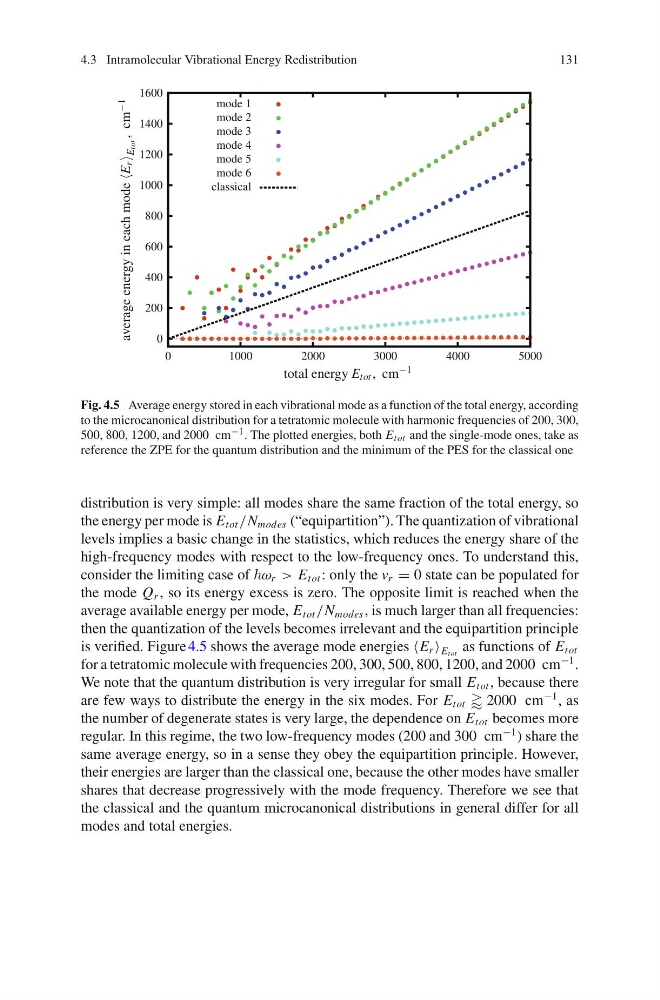
Fig. 4.5 Average energy stored in each vibrational mode as a function of the total energy, according
to the microcanonical distribution for a tetratomic molecule with harmonic frequencies of 200, 300,
500, 800, 1200, and 2000 cm −1 . The plotted energies, both E tot and the single-mode ones, take as
reference the ZPE for the quantum distribution and the minimum of the PES for the classical one
distribution is very simple: all modes share the same fraction of the total energy, so
the energy per mode is E tot /N modes (“equipartition”). The quantization of vibrational
levels implies a basic change in the statistics, which reduces the energy share of the
high-frequency modes with respect to the low-frequency ones. To understand this,
consider the limiting case of ω r > E tot : only the v r = 0 state can be populated for
the mode Q r , so its energy excess is zero. The opposite limit is reached when the
average available energy per mode, E tot /N modes , is much larger than all frequencies:
then the quantization of the levels becomes irrelevant and the equipartition principle
is verified. Figure 4.5 shows the average mode energies E r E tot as functions of E tot
for a tetratomic molecule with frequencies 200, 300, 500, 800, 1200, and 2000 cm
−1 .
We note that the quantum distribution is very irregular for small E tot , because there
are few ways to distribute the energy in the six modes. For E tot 2000 cm
−1 , as
the number of degenerate states is very large, the dependence on E tot becomes more
regular. In this regime, the two low-frequency modes (200 and 300 cm
−1 ) share the
same average energy, so in a sense they obey the equipartition principle. However,
their energies are larger than the classical one, because the other modes have smaller
shares that decrease progressively with the mode frequency. Therefore we see that
the classical and the quantum microcanonical distributions in general differ for all
modes and total energies.
131
classical
mode 6
mode 5
mode 4
mode 3
mode 2
mode 1
total energy E tot , cm −1
average energy in each mode E
r
E
tot
, cm −1
5000
4000
3000
2000
1000
0
1600
1400
1200
1000
800
600
400
200
0
Fig. 4.5 Average energy stored in each vibrational mode as a function of the total energy, according
to the microcanonical distribution for a tetratomic molecule with harmonic frequencies of 200, 300,
500, 800, 1200, and 2000 cm −1 . The plotted energies, both E tot and the single-mode ones, take as
reference the ZPE for the quantum distribution and the minimum of the PES for the classical one
distribution is very simple: all modes share the same fraction of the total energy, so
the energy per mode is E tot /N modes (“equipartition”). The quantization of vibrational
levels implies a basic change in the statistics, which reduces the energy share of the
high-frequency modes with respect to the low-frequency ones. To understand this,
consider the limiting case of ω r > E tot : only the v r = 0 state can be populated for
the mode Q r , so its energy excess is zero. The opposite limit is reached when the
average available energy per mode, E tot /N modes , is much larger than all frequencies:
then the quantization of the levels becomes irrelevant and the equipartition principle
is verified. Figure 4.5 shows the average mode energies E r E tot as functions of E tot
for a tetratomic molecule with frequencies 200, 300, 500, 800, 1200, and 2000 cm
−1 .
We note that the quantum distribution is very irregular for small E tot , because there
are few ways to distribute the energy in the six modes. For E tot 2000 cm
−1 , as
the number of degenerate states is very large, the dependence on E tot becomes more
regular. In this regime, the two low-frequency modes (200 and 300 cm
−1 ) share the
same average energy, so in a sense they obey the equipartition principle. However,
their energies are larger than the classical one, because the other modes have smaller
shares that decrease progressively with the mode frequency. Therefore we see that
the classical and the quantum microcanonical distributions in general differ for all
modes and total energies.